
WOVEN CARBON FIBRES
Table of main properties of woven carbon fiber composite
| Property | Typical Value | Remarks |
|---|---|---|
| Density | ~1.5–1.6 g/cm³ | Very low |
| Young’s modulus (E) | ~70–200 GPa | Depends on fiber orientation |
| Tensile strength | ~500–1500 MPa | High |
| Hardness (HV) | Not applicable | Composite material |
| Thermal conductivity | ~5–20 W/m·K | Low to moderate |
| Electrical conductivity | Low to moderate | Depends on resin and fiber layout |
| Thermal expansion | ~0–2 ×10⁻⁶ /K | Very low |
| Melting point | Not applicable | Decomposes at high temperature |
| Magnetism | No | Non-magnetic |
| Corrosion resistance | Excellent | Chemically stable |
| Machinability | Difficult | Abrasive, requires specific tools |
- General description
- Structure and weave types
- Matrix and manufacturing
- Watchmaking applications
- Advantages and limitations
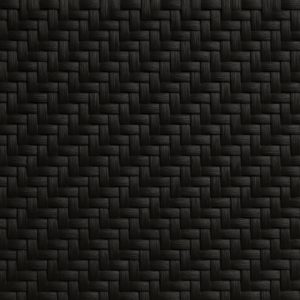
Woven carbon fibers are composite materials made of carbon fibers arranged in a woven structure and bonded by a polymer matrix (most commonly epoxy resin). Introduced relatively recently in watchmaking, they are primarily used for their high mechanical properties, very low density, and distinctive technical aesthetic.
Unlike metals, this is not a homogeneous material but an anisotropic composite, whose properties depend on the orientation and type of fiber weave.
Main Properties
Woven carbon fibers exhibit several remarkable characteristics:
- Very low density (~1.5–1.7 g/cm³)
- Very high mechanical strength (depending on fiber orientation)
- High Young’s modulus along the fiber axis (~70 to 300 GPa)
- Excellent fatigue resistance
- Very low thermal expansion coefficient
- Non-magnetic material
- Good corrosion resistance
These properties make it particularly suitable for applications requiring both lightness and rigidity.
Carbon fibers are arranged in different weave types, influencing both mechanical properties and aesthetics:
1. Plain Weave
- Regular checkerboard pattern
- Good dimensional stability
- Classic aesthetic appearance
2. Twill Weave
- Characteristic diagonal pattern
- Better drapability
- Widely used in watchmaking
3. Unidirectional (UD) Weave
- Fibers oriented in a single direction
- Maximum mechanical properties along this axis
- Less commonly used for aesthetic reasons
The fibers are impregnated with a polymer resin (the matrix), forming a composite:
Polymer resins: two main categories exist:
- Thermosetting resins → irreversible chemical reaction transforming the liquid resin into a solid (epoxy resin: the most common)
- Thermoplastic resins → soften when heated and harden upon cooling (PEEK resin)
The resin is then integrated into the fibers through various processes:
- Hand lay-up (contact molding)
- Vacuum molding
- Infusion
- Injection
The material then undergoes a curing cycle to polymerize and harden.
The part can subsequently be processed by machining, milling, etc.
Woven carbon fibers are used for:
- Watch cases
- Dials
- Mainplates and movement structures (rare)
- Aesthetic components
Advantages
- Extremely lightweight
- Very high mechanical strength
- Non-magnetic
- Corrosion-resistant
- Modern and technical aesthetic
- Good vibration damping
Limitations
- Anisotropic properties (dependent on fiber orientation)
- Sensitivity to localized impacts (possible delamination)
- Difficult to repair
- Potential aging of the polymer matrix
- Specific machining required (abrasive to tools)