
MENU
1. General description
Its role is to transmit the energy produced by the rotations of the crown to the motor organ (power source) responsible for storing it and gradually redistributing it to the movement.
Figure 1
Kinematics of a winding mechanism (manual)
Click on the animation to enlarge it
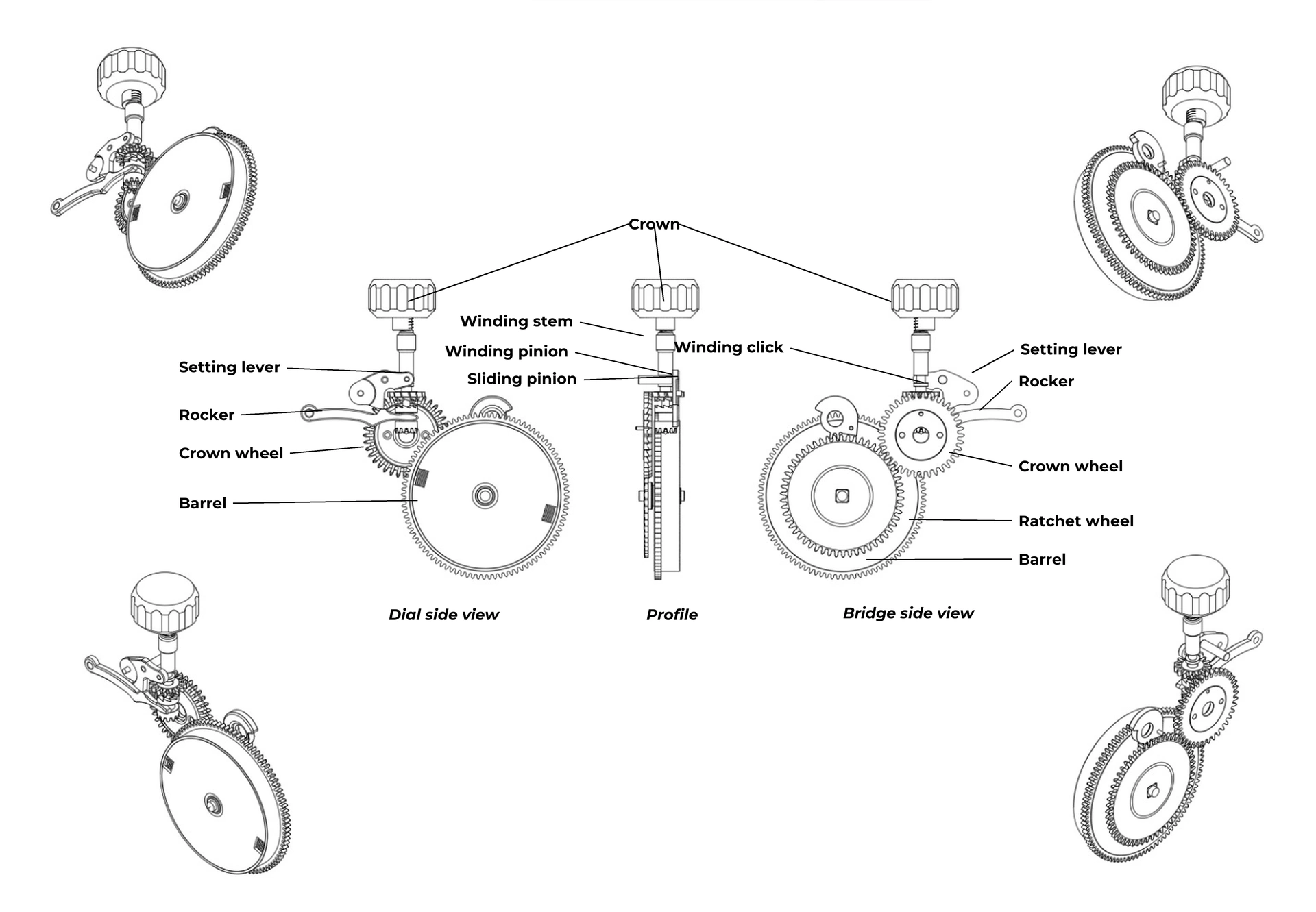
Figure 2
Diagram of a winding mechanism (manual)
Click on the thumbnail to enlarge it
2. Components
The following components make up the winding mechanism:
3. History
The winding mechanism owes its name to the era of weight-driven clocks. The energy that powers this type of clock comes from gravity, which causes weights attached to their drums to descend by means of cords that wind around them (winding) and unwind (normal running). When the cords of the weights are completely unwound from their drum, the clock has no more energy and stops. Energy is restored by winding the weights back up, hence the term winding mechanism. After the appearance of the first mainsprings and of portable horology, the term remained and now designates any mechanism intended to restore energy to a mechanical clock or watch.
Until the middle of the 19th century, watches were wound using a key. This key engaged directly with the square of the barrel arbor by passing through a hole made in the case back of the watch.
Although other watchmakers had looked into the subject, it was the Frenchman Adrien Philippe who invented in 1842 an integrated winding mechanism (without a key). Its small size made it possible to house the mechanism under the dial and to operate it, for the first time, by a crown. Five years after Philippe’s invention, Antoine Le Coultre filed the patent for the first winding and time-setting mechanism linked by a lever/rocker. The combined winding and time-setting mechanisms as we know them today had been born.
This page has been automatically translated from the reference French version using an artificial intelligence tool. Errors or inaccuracies may remain. If you notice any, especially if this is your native language, please feel free to report them to info@horopedia.org. Your contribution helps us improve the quality of the encyclopedia.
While awaiting their translation, images and videos will temporarily remain displayed in French.
Thank you for your understanding.