
CARBON NANOTUBES (CNT)
Table of main properties of carbon nanotubes (CNT’s)
| Property | Typical Value | Remarks |
|---|---|---|
| Density | ~1.3–1.4 g/cm³ | Very low |
| Young’s modulus (E) | ~1000–1500 GPa | Extremely high |
| Tensile strength | ~50–150 GPa | Exceptional |
| Hardness (HV) | Not applicable | Nanostructured material |
| Thermal conductivity | ~2000–6000 W/m·K | Extremely high (along axis) |
| Electrical conductivity | Very high | Metallic or semiconducting behavior |
| Thermal expansion | ~0–1 ×10⁻⁶ /K | Extremely low |
| Melting point | Not applicable | Decomposes at very high temperature |
| Magnetism | No | Non-magnetic |
| Corrosion resistance | Excellent | Chemically stable |
| Machinability | Not machinable | Used as reinforcement or in composites |
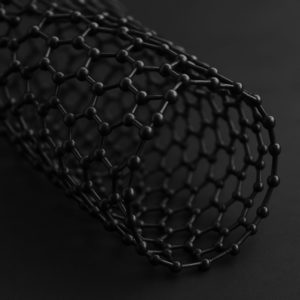
Carbon nanotubes are cylindrical structures made of graphene sheets rolled at the nanometric scale. Derived from nanotechnology, they exhibit exceptional mechanical, thermal, and physical properties, far superior to those of traditional materials.
Due to environmental hazards and potential health risks, carbon nanotubes have been subject to REACH regulations since 2020.
In watchmaking, their use remains very limited and mainly experimental, particularly in the development of composite hairsprings aimed at improving the performance of the regulating organ.
Main Properties
Carbon nanotubes are characterized by:
- Extremely high Young’s modulus (~1 TPa)
- Exceptional mechanical strength
- Very low density (~1.3–1.4 g/cm³)
- Excellent fatigue resistance
- Very low thermal expansion coefficient
- Non-magnetic material
- Excellent chemical stability
These properties make them a theoretically ideal material for high-precision dynamic components.
Carbon nanotubes can be:
- Single-walled (SWCNT) → a single graphene layer
- Multi-walled (MWCNT) → multiple concentric layers
They are generally used:
- In the form of networks
- Integrated into a composite matrix
At the macroscopic scale, their properties strongly depend on:
- Their orientation
- Their dispersion
- Their density
In watchmaking, carbon nanotubes have been explored experimentally for:
- Composite hairsprings
Their main interest lies in their ability to:
- Provide highly stable elasticity
- Reduce sensitivity to thermal variations
- Eliminate the effects of magnetism
Advantages
- Exceptional mechanical properties
- Very low density
- Outstanding thermal stability
- Non-magnetic
- High fatigue resistance
Limitations
- Complex processing
- Difficulty in large-scale production
- Properties dependent on structuring
- Very high cost
- Still largely experimental use
- Limited industrial reproducibility
- Subject to REACH regulations (health and environmental risks)