
PLASTICS AND POLYMERS
Table of main properties of plastics and polymers
| Property | Typical Value | Remarks |
|---|---|---|
| Density | ~0.9–2.2 g/cm³ | Very low |
| Young’s modulus (E) | ~1–5 GPa | Very low |
| Tensile strength | ~20–150 MPa | Depends on polymer |
| Hardness (HV) | ~5–30 HV | Very low |
| Thermal conductivity | ~0.1–0.5 W/m·K | Very low |
| Electrical conductivity | Very low | Insulating material |
| Thermal expansion | ~50–150 ×10⁻⁶ /K | Very high |
| Melting point | ~100–350 °C | Depends on polymer |
| Magnetism | No | Non-magnetic |
| Corrosion resistance | Excellent | Chemically resistant |
| Machinability | Easy | Injection, machining, molding |
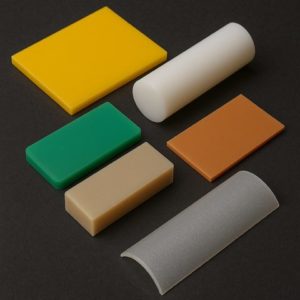
- General description
- Types of polymers used in watchmaking
- Manufacturing methods
- Watchmaking applications
- Advantages and limitations
Plastics and polymers encompass a broad family of organic materials composed of macromolecular chains. Gradually introduced into watchmaking during the 20th century, they now play an important role, both in external components and in certain quartz—and even mechanical—movements, as well as in tooling.
Their success is based on their low density, wide range of properties, and ease of processing, allowing the production of complex parts at controlled cost. Depending on their nature (thermoplastics, thermosets, or composites), they can meet a variety of requirements, from external components to functional movement parts.
Main Properties
Polymers used in watchmaking exhibit variable characteristics, but generally:
- Low density (~0.9–1.5 g/cm³)
- Good corrosion resistance
- Non-magnetic materials
- Low thermal and electrical conductivity
- Low to moderate Young’s modulus (~1–5 GPa)
- Good chemical resistance
- Possibility of self-lubrication (depending on the polymer)
These properties make them particularly suitable for lightweight and low-stress applications.
1. Thermoplastics
Thermoplastics can be melted and reshaped.
Examples:
- ABS → cases, cost-effective components
- PMMA (acrylic / plexiglass) → watch crystals
- Polycarbonate (PC) → impact-resistant transparent elements
- PEEK → technical applications
2. Thermosets
These polymers harden irreversibly after polymerization.
Examples:
- Epoxy resins
- Phenolic resins
They are notably used in composites (carbon, etc.).
3. High-Performance Engineering Polymers
Some polymers offer advanced properties:
- PEEK (polyether ether ketone)
- PTFE (Teflon)
- PA (engineering polyamides)
Characteristics:
- Good mechanical strength
- Low friction coefficient
- Improved thermal resistance
Polymers are shaped using various industrial processes:
1. Injection Molding
- Melting of the polymer
- Injection into a mold
- Cooling and solidification
👉 The most common process in industrial watchmaking
2. Machining
- Material removal from a solid block
- Used for technical polymers
3. Compression / Molding
- Used for resins and composites
- Enables complex shapes
4. Additive Manufacturing (more marginal)
- 3D printing
- Prototyping or small production runs
Advantages
- Very lightweight
- Low cost
- High design freedom
- Corrosion-resistant
- Non-magnetic
- Electrical insulation
- Possibility of self-lubrication
- Good shock resistance (for certain polymers)
Limitations
- Low stiffness
- Sensitivity to temperature
- Aging (UV, oxidation)
- Limited mechanical strength
- Less prestigious than traditional materials
- Susceptibility to scratching (depending on the polymer)