
MENU
1. Table of main properties of mother of pearl
| Property | Typical Value | Remarks |
|---|---|---|
| Density | ~2.6–2.8 g/cm³ | Moderate |
| Elasticity modulus (E) | ~50–70 GPa | Low to moderate |
| Tensile strength | Low | Brittle |
| Hardness (HV) | ~200–400 HV | Low |
| Hardness (Mohs) | ~3–4 | Relatively soft |
| Thermal conductivity | Low | |
| Electrical conductivity | None | Insulating |
| Expansion coefficient | Variable | |
| Magnetism | No | Non-magnetic |
| Corrosion resistance | Good | Sensitive to acids |
| Machinability | Delicate | Fragile material |
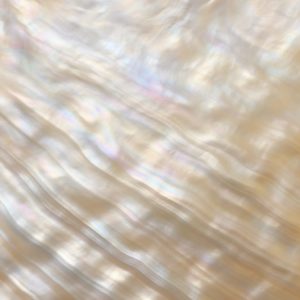
2. General description
Mother of pearl is an organic material produced by certain mollusks and forming the inner layer of their shell. It is composed mainly of calcium carbonate (aragonite) and organic matter (conchiolin), organized into a very fine lamellar structure.
In watchmaking, mother of pearl is used exclusively for its aesthetic properties, notably for making dials. It stands out for its natural iridescent reflections, resulting from the interference of light within its structure.
3. Structure and behavior
Mother of pearl consists of:
- microscopic platelets of aragonite
- bound by an organic matrix
This structure gives it:
- a certain relative resilience (higher than a pure crystal)
- an overall fragility against mechanical stress
- an anisotropic behavior
Each piece of mother of pearl is unique in terms of:
- color
- iridescence
- patterns
4. Origin and types
The mother of pearl used in watchmaking mainly comes from:
- Pearl oysters (Pinctada)
- Abalone → very colorful mother of pearl
Common types:
- White mother of pearl
- Gray mother of pearl
- Pink mother of pearl
- Black mother of pearl
- Abalone mother of pearl (multicolored)
5. Manufacturing mother of pearl dials
The main steps are:
- Cutting the shell
- Sawing into thin sheets
- Precision machining (diameter, drilling)
- Polishing
- Assembly onto a support (often metallic)
👉 Mother of pearl is often glued to a support to ensure its stability.
👉 In some cases, the support can be painted to artificially tint the mother of pearl.
👉 Although fragile, mother of pearl lends itself very well to engraving and guilloché (engine-turning).
6. Watchmaking applications
Dials (main use)
- Dials in natural Mother of pearl
👉 Unique visual effect that changes depending on the Light
Decoration
- Applied Index (hour markers)
- decorative elements
Jewelry
- Combination with precious stones
- Marquetry
7. Advantages and limitations
Advantages
- Unique aesthetic (natural iridescence)
- Each piece is different
- Noble and natural Material
- Non-magnetic
- Good chemical stability
Limitations
- Significant fragility
- Sensitivity to impact
- Requires a rigid support
- Natural variability (non-homogeneous)
- Strictly decorative use
This page was automatically translated from the French reference version using an artificial intelligence tool. Errors or inaccuracies may remain. If you notice any, especially if this is your native language, please feel free to report them to info@horopedia.org. Your contribution helps us improve the quality of the encyclopedia.
Until their translation, images and videos will remain temporarily displayed in French.
Thank you for your understanding.