
EMERALD
Table of main properties of emerald
| Property | Typical Value | Remarks |
|---|---|---|
| Density | ~2.7–2.8 g/cm³ | Moderate |
| Young’s modulus (E) | ~200–300 GPa | High |
| Compressive strength | ~1000–1500 MPa | Moderate to high |
| Hardness (HV) | ~500–800 HV | Moderate |
| Hardness (Mohs) | 7.5–8 | Lower than sapphire/ruby |
| Thermal conductivity | ~2–5 W/m·K | Low |
| Electrical conductivity | Very low | Insulating material |
| Thermal expansion | ~5–8 ×10⁻⁶ /K | Low |
| Melting point | ~1200–1400 °C | Decomposes before melting |
| Magnetism | No | Non-magnetic |
| Corrosion resistance | Good | Chemically stable but sensitive to inclusions |
| Machinability | Not machinable | Cut and polished only |
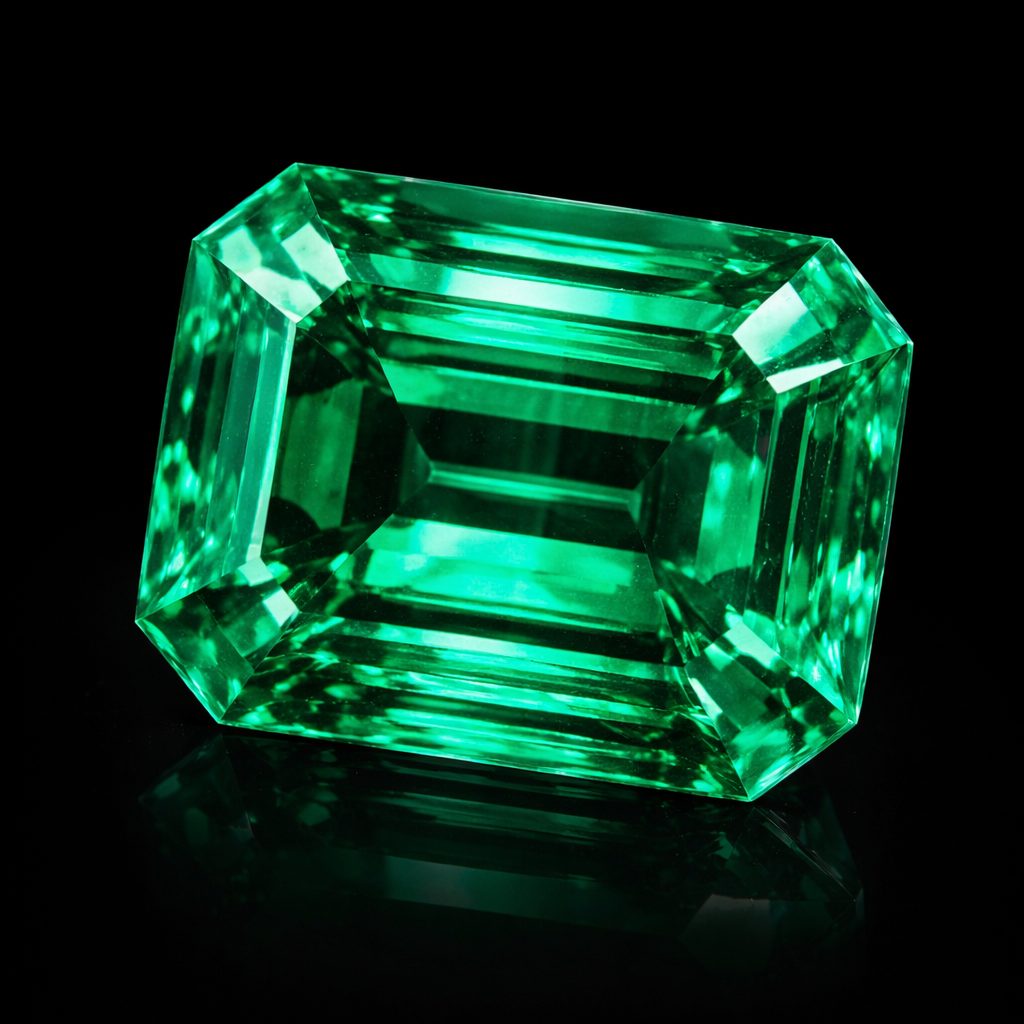
Emerald is a variety of beryl (Be₃Al₂Si₆O₁₈), characterized by its green color due to the presence of chromium and/or vanadium. An emblematic precious stone, it is used in watchmaking exclusively for jewelry applications.
Unlike other materials used in technical watchmaking, emerald exhibits intrinsic fragility due to the frequent presence of internal inclusions. These characteristics significantly limit its use to components that are not subjected to mechanical stress or impact.
Main Properties
Emerald exhibits the following properties:
- Moderate hardness (7.5 to 8 on the Mohs scale)
- Brittle crystalline structure (presence of inclusions)
- Low impact resistance
- Good chemical stability
- Non-magnetic material
- Low tensile strength
- Excellent optical quality (transparency and color)
Natural emerald is characterized by:
- Characteristic inclusions (known as “emerald garden”)
- Variations in color and transparency
- A heterogeneous internal structure
These inclusions, although aesthetically valued, constitute areas of mechanical weakness.
Although all types of cuts can be applied, emeralds are generally cut as follows:
- Emerald cut (rectangular with truncated corners)
- Round cut (less common)
- Cabochon cut (depending on quality)
Advantages
- Exceptional aesthetic appeal
- Unique and recognizable color
- High jewelry value
- Noble material
Limitations
- High fragility
- Sensitivity to shocks
- Presence of inclusions
- Difficult implementation
- Strictly decorative use
- High cost