
OILS
Definition and role
Oils are fluid lubricants whose role is to reduce friction between the moving parts of a calibre. Unlike greases, their liquid consistency allows them to flow in minute quantities into the very confined spaces of bearings, pivots and the impulse faces of the escapement. A poorly chosen oil, or one applied in the wrong quantity, can cause immediate timekeeping disturbances, accelerated wear, or even stop the movement. Their application requires both precise knowledge of the areas to be lubricated and a rigorous technique, as the volumes involved are measured in fractions of a nanolitre. Although invisible to the naked eye once applied, oils play a decisive role in the rate regularity and longevity of a movement.
Viscosity, the fundamental parameter
The primary criterion for choosing an oil is its viscosity, expressed in millipascal-seconds (mPa·s) or centistokes (cSt). As a general rule, viscosity decreases as one progresses along the kinematic chain of the movement: from relatively viscous lubricants at the barrel to increasingly fluid oils approaching the regulating organ. This gradation is fundamental: an oil that is too viscous on the pivots of the escape wheel would impede the oscillations of the balance wheel; an oil that is too fluid on the gear train arbors would migrate quickly out of the reservoirs. Viscosity also varies with temperature, which justifies the existence of specific formulations for extreme temperature environments.
Synthetic oils (Moebius — Synt-A-Lube range, 9010 series)
Moebius is the reference and near-exclusive supplier of watchmaking lubricants. Its range of synthetic oils covers all the needs of a modern mechanical movement.
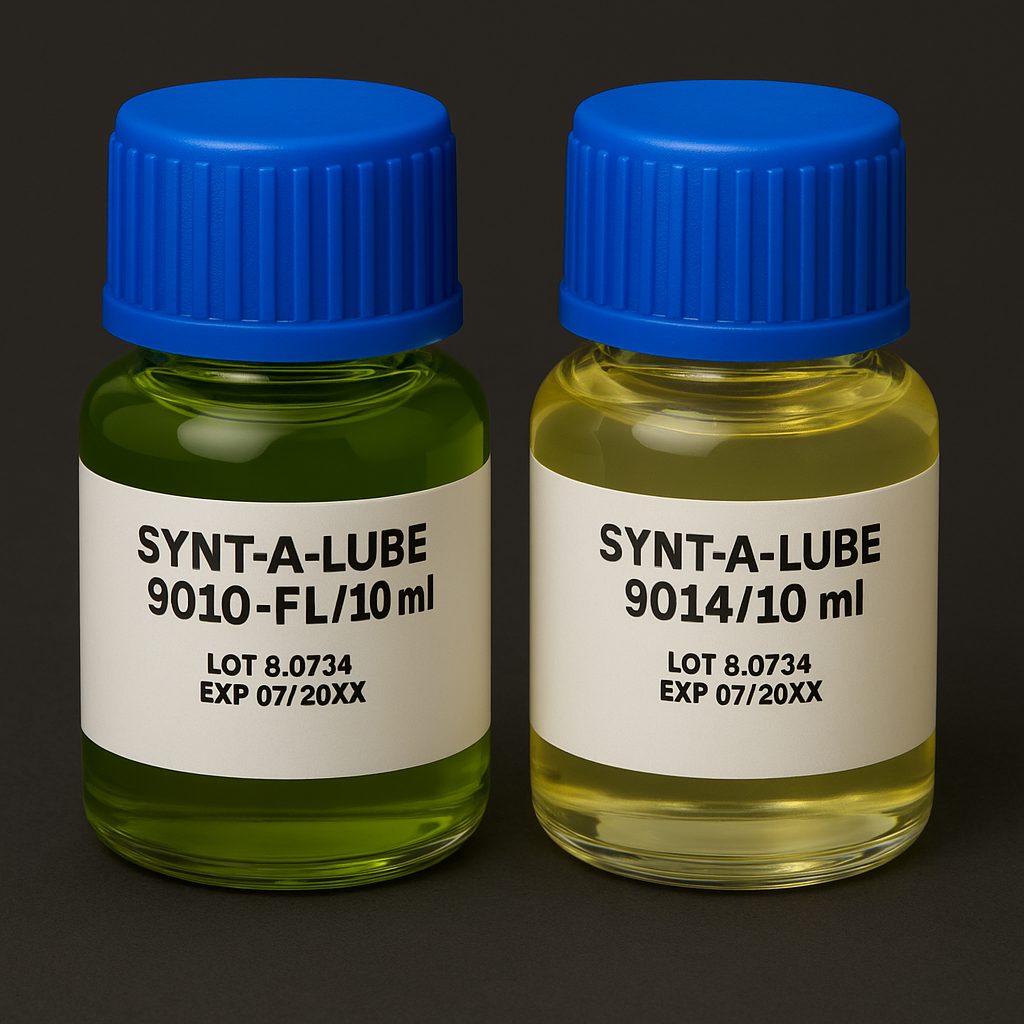
The Synt-A-Lube series groups together fine universal oils intended for fast-moving parts and regulating components. The 9010 (viscosity 150 cSt) is the universal reference par excellence: fluid, stable, with excellent lubricating power, it is suitable for fast-moving parts and regulating components. The 9014 (100 cSt) offers an intermediate viscosity between the 9010 and the 9030. The 9015 (150 cSt) is specifically recommended for lubricating plastic components.
Synthetic oils (Moebius — Synta-Visco-Lube range, 9020 series)
The Synta-Visco-Lube range groups together medium to high viscosity synthetic oils, intended for slower-moving parts and areas subjected to greater pressure.
The 9020 (270 cSt) is ideal for parts subjected to moderate to high pressure, where the 9010 would be too fluid. The 9024 (260 cSt) is also recommended for plastics. The 9026 (235 cSt) incorporates molybdenum disulphide (MoS₂) to enhance pressure resistance under increased stress. The 9027 (1060 cSt), highly viscous, is reserved for slow-moving parts subjected to the highest pressures.
Synthetic oils for the escapement (Moebius Syntescap 941)
The escapement is the most delicate area to lubricate in a mechanical movement. The pallet impulse faces sustain repeated high-frequency impacts on the escape wheel, in a contact that combines shock, sliding and friction.
The 941 (Syntescap, 110 cSt) is the 100% synthetic oil specially formulated for lubricating the impulse faces. Its excellent lubricating power and ageing stability make it the essential reference for this critical point of the movement. It is applied in extremely small quantities — a few nanolitres — to each impulse face of the pallets. Any excess would immediately disturb the rate through capillary action.
It should be noted that, so as not to disturb isochronism, the bearings of the pallet fork are never lubricated.
Microgliss and silicone oils
The Microgliss range offers mineral and mixed oils for micromechanics. The D series (D-2 to D-5, from 75 to 1200 cSt) covers a wide spectrum of viscosities for varied applications combining stability and pressure resistance.
Silicone oils stand out for their chemical inertness and exceptional stability at extreme temperatures. The I-31-B (510 cSt) and I-4 (1000 cSt) offer improved lubricating properties while benefiting from the chemical inertness of silicone. The H-10 (11,000 cSt), extremely viscous, is used as an assembly aid and for sealing. Like silicone greases, these oils should not be used indiscriminately on all parts, as certain materials are not compatible with silicones.
Application best practices
The application of oils requires appropriate tools: oilers. The quantity is just as critical as the choice of product: too large a drop migrates by capillary action out of the jewel reservoir, contaminates surrounding areas and disturbs proper timekeeping. Conversely, an insufficient quantity fails to protect the surfaces.