
RUBY
Table of main properties of ruby
| Property | Typical Value | Remarks |
|---|---|---|
| Density | ~3.9–4.1 g/cm³ | Moderate |
| Young’s modulus (E) | ~345–400 GPa | Very high |
| Compressive strength | ~2000 MPa | Very high |
| Hardness (HV) | ~2000 HV | Extremely high |
| Hardness (Mohs) | 9 | Second only to diamond |
| Thermal conductivity | ~25–40 W/m·K | Moderate |
| Electrical conductivity | Very low | Insulating material |
| Thermal expansion | ~5–8 ×10⁻⁶ /K | Low |
| Melting point | ~2050 °C | Very high |
| Magnetism | No | Non-magnetic |
| Corrosion resistance | Excellent | Chemically inert |
| Machinability | Not machinable | Shaped by grinding and polishing |
- General description
- Natural rubies and synthetic rubies
- Manufacturing of watchmaking rubies
- Types of watchmaking rubies
- Watchmaking applications
- Advantages and limitations
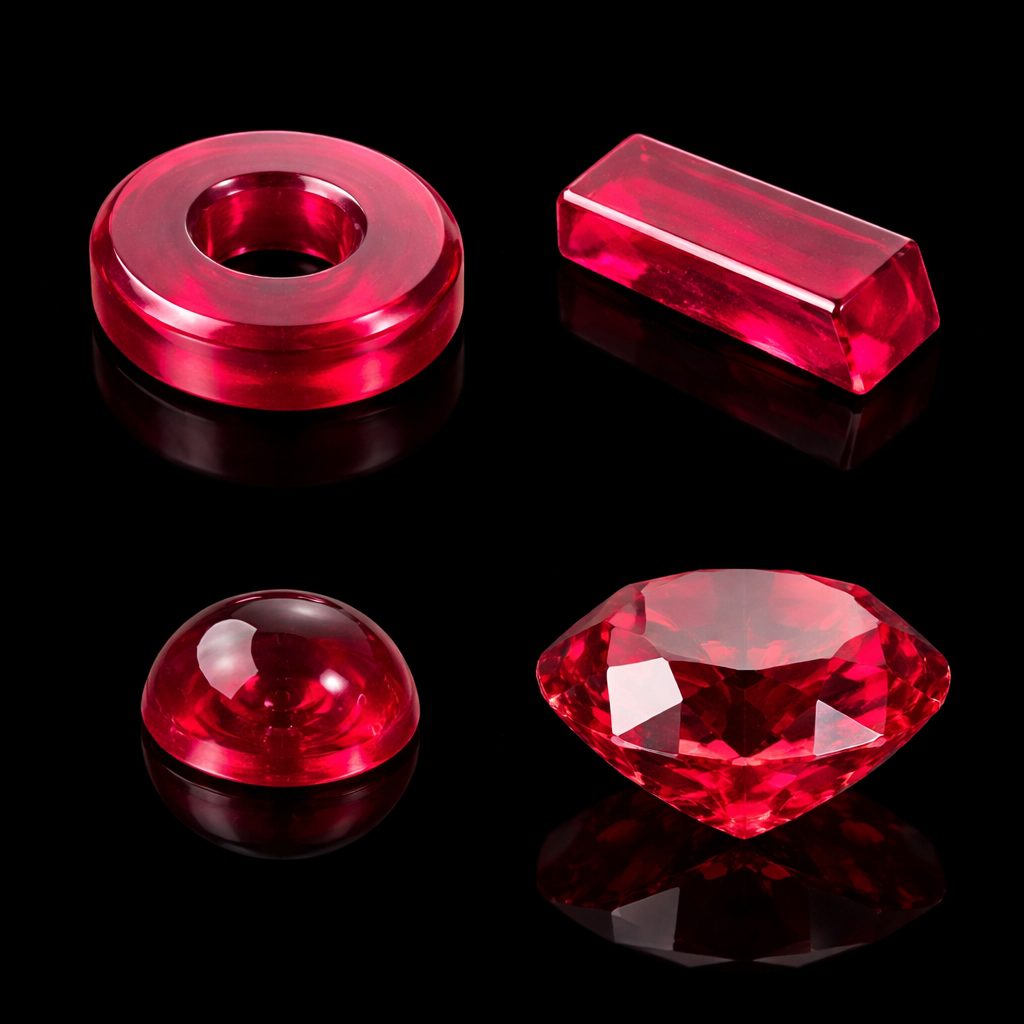
Ruby is a variety of corundum (Al₂O₃), a crystallized aluminum oxide characterized by very high hardness (9 on the Mohs scale) and excellent wear resistance. Today, its use in watch movements is exclusively in the form of synthetic ruby, due to its purity, consistency, and availability. The properties of synthetic rubies are identical to those of natural rubies but are uniform in color and free from inclusions (which could otherwise lead to breakage).
Introduced as early as the 18th century in watch movements, ruby is an essential element in bearings and friction-reduction systems, playing a key role in the precision and longevity of watches.
Main Properties
Ruby exhibits properties particularly suited to watchmaking functions:
- Very high hardness (~2000 HV, 9 on the Mohs scale)
- Excellent wear resistance
- Low coefficient of friction (in combination with steel)
- Very good chemical stability
- Non-magnetic material
- Low thermal expansion
- Excellent polishability
These properties make it an ideal material for moving contact surfaces.
1. Natural Ruby
Historically, the first rubies used in watchmaking were natural.
Characteristics:
- Variability in properties
- Natural impurities
- Limited availability
👉 Today, its use is exclusively reserved for jewelry applications (setting in dials, cases, bracelets, etc.)
2. Synthetic Ruby
Synthetic ruby is produced artificially from aluminum oxide.
Main methods:
- Verneuil process (flame fusion)
- Crystal growth (Czochralski method)
Advantages:
- High purity
- Consistent properties (color)
- Controlled production
- Cost efficiency
👉 It is now the standard for technical applications (movement components)
Watchmaking rubies are produced through the following steps:
- Growth of the synthetic crystal
- Cutting into wafers
- Precision machining (drilling, shaping)
- Polishing of functional surfaces
These operations make it possible to obtain:
- Perfectly calibrated holes
- Extremely smooth surfaces
- Highly precise geometries
Several types can be distinguished depending on their function:
- Hole jewels (plain bearings) → guidance of pivots
- Cap jewels → axial positioning
- Impulse jewels → energy transmission (lever stones, roller jewels, etc.) (see escapement and regulating organ)
- Friction-reduction elements → roller tables, etc.
Ruby is used for:
- Pivot bearings (gear train, balance wheel, etc.)
- Escapement systems (lever, impulse pin, etc.)
- Friction reduction (fixed and rotating rollers)
It is present in virtually all mechanical and quartz movements.
Advantages
- Very high wear resistance
- Significant friction reduction
- Long-term stability
- Non-magnetic material
- Excellent manufacturing precision
- Exceptional durability
Limitations
- Brittleness (fragile material)
- Higher cost than standard materials
- Requires precise assembly
- Sensitive to strong impacts