
TWO NEW FILMS AND ENRICHED TECHNICAL PAGES
To provide an ever deeper understanding of the mechanical principles of watchmaking, several contents have recently been enhanced on the online encyclopaedia Horopedia.org. In particular, the pages dedicated to the Swiss lever escapement and the regulating organ (balance wheel–hairspring) have been expanded. In addition, two new films are now available: a technical film on the industrial manufacturing of the mainspring and an institutional film dedicated to the Poinçon de Genève.
A film on the industrial manufacturing of the mainspring
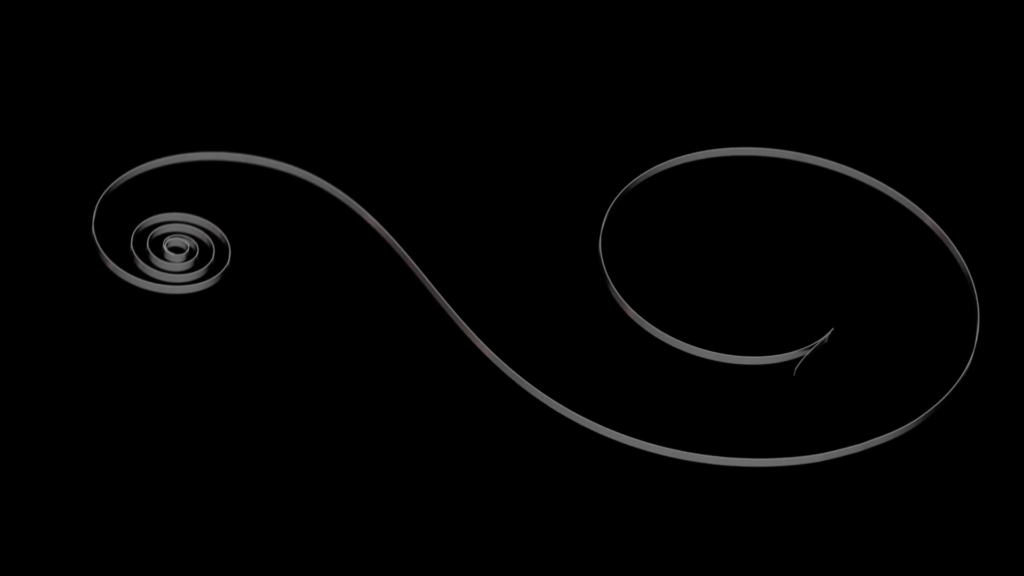
The Horopedia team had the opportunity to visit a specialised manufacturing facility to document the industrial manufacturing of the mainspring.
An essential component of the barrel — itself the driving organ of the watch — the mainspring plays a fundamental role in the functioning of the movement. It consists of a long rectangular-section steel strip, wound in a spiral around the barrel arbor inside the drum. Its function is to store the energy required to power the movement and to release it gradually.
Through this film, discover the various stages involved in producing this component and gain a clearer understanding of its role within the gear train.
A film on the Poinçon de Genève (Timelab Foundation)
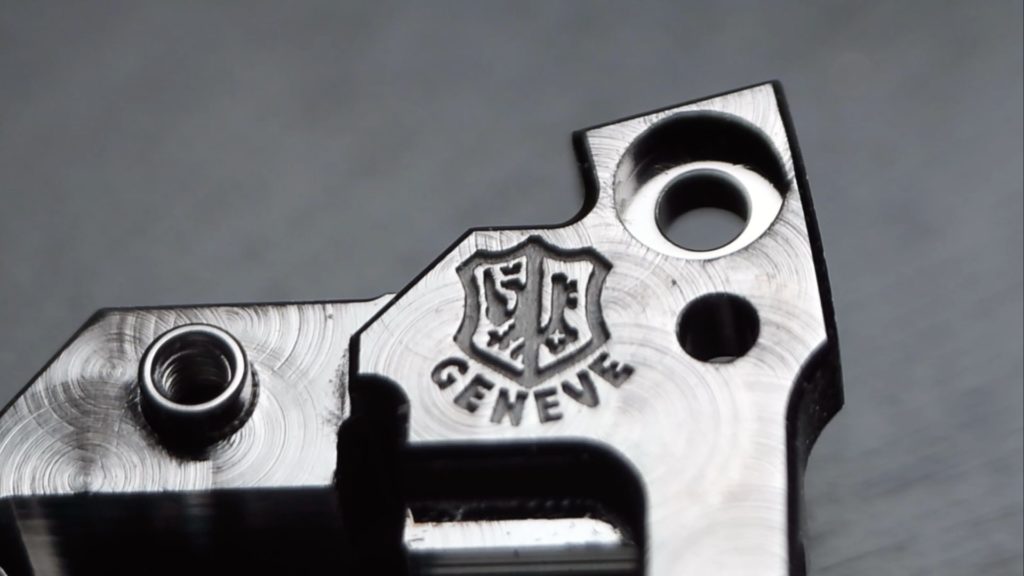
Created in 1886 by the Republic and Canton of Geneva, the Poinçon de Genève is one of the oldest watchmaking certifications still in force today. It guarantees:
- Genevan origin of the movement (assembled, adjusted and cased up in the canton)
- Quality of execution and finishing of components
- Chronometric and functional performance of the watch
Over the decades, this mark of excellence has preserved its high standards while adapting to technological developments. The film explores its history, its certification criteria and its central role in preserving and promoting Geneva’s watchmaking expertise.
Enriched technical pages
Several key pages of the encyclopaedia have also been enhanced with new diagrams, illustrations and detailed explanations.
The Swiss lever escapement
A pillar of modern watchmaking since the nineteenth century, the Swiss lever escapement became the standard due to its robustness, precision and industrial efficiency. Its complete operation is explained step by step, including detailed information on angles, shocks, draw and the interactions between its components.
The regulating organ (balance wheel–hairspring)
The page dedicated to the regulating organ clarifies the central role of the oscillator in ensuring the accuracy of a mechanical watch. Composed of the balance wheel and the hairspring, this assembly — commonly referred to as the balance wheel–hairspring — forms the heart of the regulating organ.
The hairspring , due to the complexity of its manufacture and its direct impact on the rate of the watch, is considered one of the most sensitive components of the mechanical movement. Its role is to constantly return the oscillator (balance wheel or pendulum) to its mid-point, known as the rest point — the position it occupies when it no longer receives energy.
The balance wheel, for its part, acts as the movement’s inertia wheel. To ensure optimal precision while minimising energy consumption, it should ideally combine a high moment of inertia with the lowest possible mass.
The roles, interactions and operating principles of these components are explained in greater depth and illustrated on the corresponding pages.
With these new films and technical enhancements, Horopedia continues its mission: to document, transmit and make watchmaking culture accessible to all.
►► Explore Horopedia.org now, discover these new contents and deepen your knowledge of watchmaking without limits!
►► To support our educational initiatives and contribute to the promotion of an exceptional craftsmanship, become a patron! More information at: https://horopedia.org/the-circle/
ABOUT HOROPEDIA
Horopedia Foundation was established in February 2023 and given the status of public interest. The Foundation Council is composed of Philippe Dufour (President), Dr. Helmut Crott, André Colard, and Marc André Deschoux.
The Foundation governs Horopedia.org, the first online video encyclopedia on watchmaking. The platform was launched in 2022 and quickly gathered unanimous support within the community.
To date, over 100 multilingual documentary films on museums, watchmaking schools, watch tools and components, and the mechanical principles behind their work can be found on Horopedia.org. To enhance its educational mission, the platform also incorporates visual pedagogic materials to facilitate a better understanding of the provided information. The website features nearly 1000 pages with detailed definitions of watchmaking terms and historical anecdotes about significant horological inventions.
Horopedia.org meticulously covers all facets of the fascinating horological industry in French, English, and German. It offers detailed definitions of tools and complications, 3D images of movements, and thorough video explanations of component production, their history, and functions in a watch. A dedicated section of the website lists horological institutions, including schools and museums in Switzerland and worldwide.
More recently, the Foundation unveiled its ambitious project: the Maison des Arts & de la Culture Horlogère (MACH). More than just a museum, the MACH will be a dynamic venue for exhibitions, knowledge-sharing and dialogue around the art of watchmaking. Located in the heart of the Quartier des Banques, this 1,250 m² house will span four floors, offering didactic, thematic and chronological exhibitions, complemented by a space dedicated to temporary exhibitions. Visitors will also be able to enjoy a boutique, an auditorium and a variety of interactive areas designed to spark curiosity and encourage discovery. Open and vibrant, the MACH is intended to become the crossroads of watchmaking in Geneva.