
OILERS
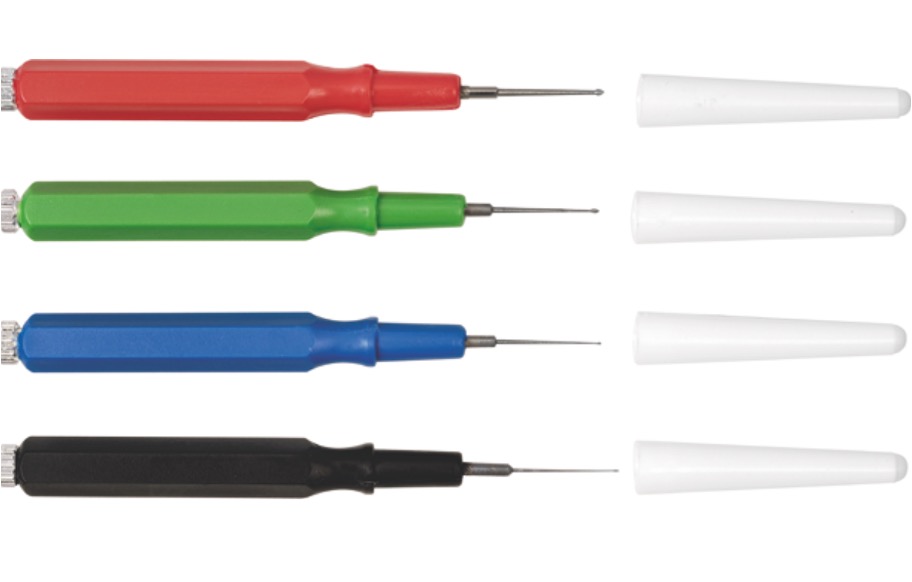
Manual oilers
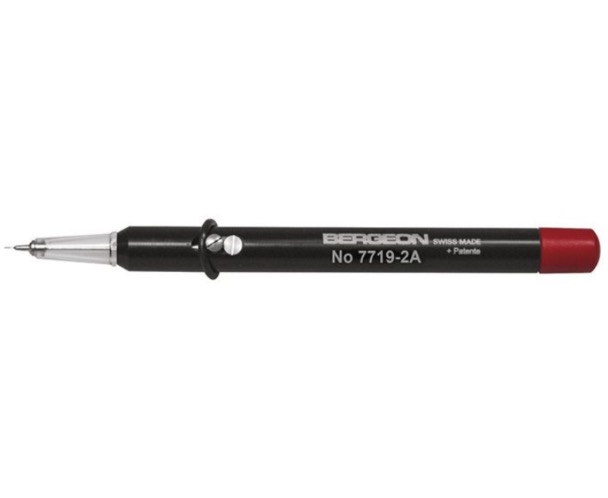
Automatic oiler
WHAT ARE OILERS USED FOR?
Oilers are the instruments used to pick up and then deposit a precise quantity of lubricant onto each of the lubrication points of the movement. Today they exist in two main forms: the manual oiler, the watchmaker’s traditional instrument, and the automatic oiler, more recent, which integrates an oil reservoir and a dosing mechanism. The coexistence of the two forms responds to the diversity of service situations: one favours the fineness of the gesture and the visual reading of the droplet, the other the regularity of the volume deposited.
The manual oiler consists of a fine steel rod whose tip is shaped to retain a small quantity of lubricant by capillarity. This end is flattened, then slightly hollowed, sometimes split, so as to present a zone to which the oil adheres naturally when the tip is dipped into the oil cup. The rod is mounted on a cylindrical handle, of wood, metal or synthetic material, the colour of which generally identifies the size.
The automatic oiler takes the form of a cylindrical body integrating an oil reservoir and a spring-loaded pusher that commands the expulsion of a calibrated quantity of lubricant at the tip of the point. With each press on the pusher, a defined volume of oil is brought to the end of the needle, ready to be deposited on the application point. The automatic oiler is generally used to lubricate cap-jewel bearings and shock-absorber systems that do not require dismantling. The principle frees the watchmaker from repeated back-and-forth between the oil cup and the part, and guarantees a regularity of dosage independent of the fineness of the gesture. This tool spread with the demand for repeatability typical of series assembly.
The automatic oiler is essential in repetitive operations and on assembly lines, where regularity of dosage prevails over tactile sensitivity, and where productivity dictates that handling between the oil cup and the part be reduced. In both cases, the absolute cleanliness of the tip, the choice of the calibre suited to the application point, and the quality of the oil used remain the primary conditions for successful oiling.