
RIVETING-STAKE
WHAT IS THE RIVETING STAKE?
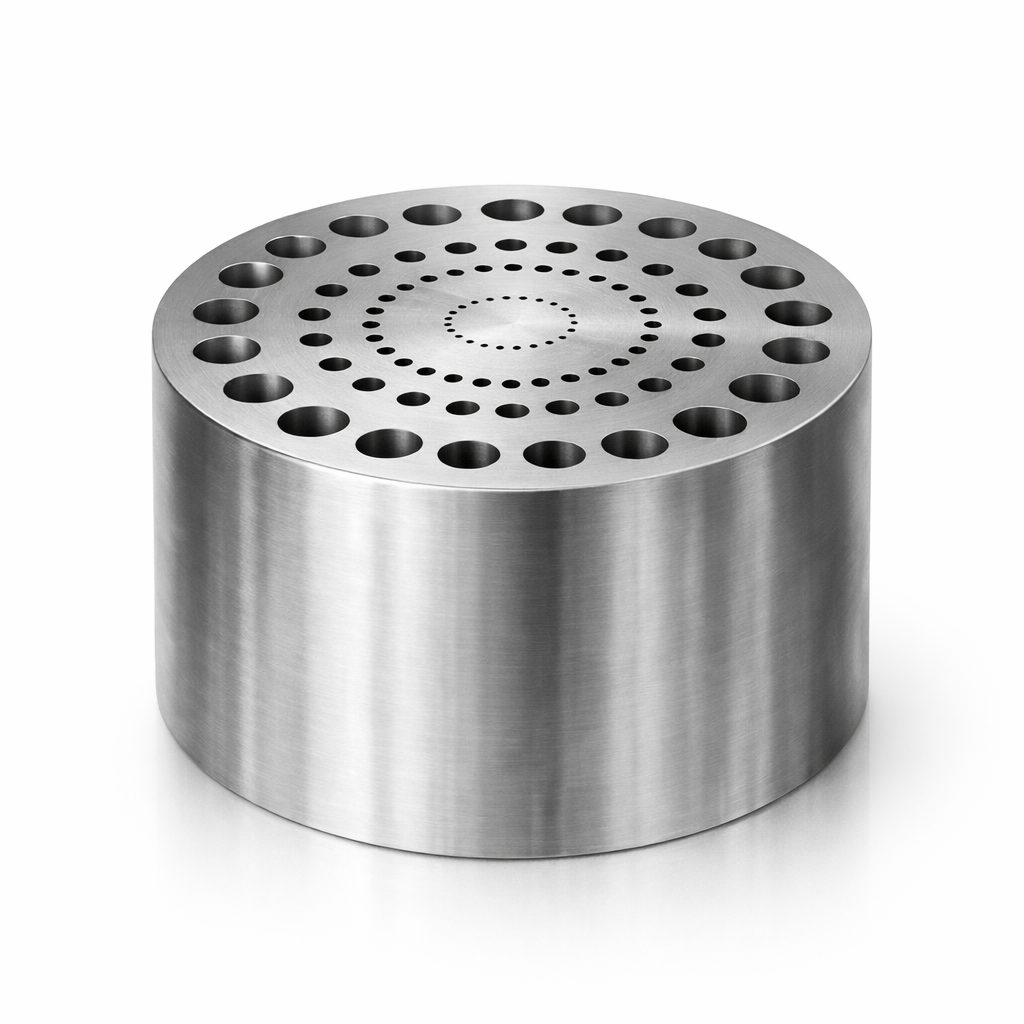
The riveting stake takes the form of a plate or a small block, pierced with a series of holes of different diameters, intended to receive and hold vertically components fitted with a staff or a pivot. Its primary function is to seat the component: the part rests flat on its rim, table or body, while the pivot or staff passes through the corresponding hole and remains clear of any unwanted contact. Train wheels, balance wheel, pallet fork (lever), and so on: any element of the mechanism whose stability depends on a staff finds on the riveting stake a precise seating, free and accessible to the eye, allowing various operations to be carried out.
Construction and Materials
Depending on its use, the riveting stake is made of steel, brass or glass. Steel, generally softened and surface-polished, offers the best rigidity and the best wear resistance; it is particularly suited to operations involving slight pressure or repeated impact and can be regarded as an anvil. Brass, being softer, has the advantage of not marking the components placed on it, and remains widely used for delicate finishing or handling operations. Glass, for its part, offers a valuable transparency.
Whatever the material, the plate is small in size — a few centimetres in diameter or side length for the common models — and of low thickness, just sufficient to ensure the stability of the component and to allow the pivot to pass through without contact between it and the workbench surface.
Hole Geometry
The holes are arranged in a regular grid, in a circle, or in lines, and their diameters cover the range of components to be received: from the finest balance staffs to barrel arbors. The upper edges are most often slightly chamfered, which facilitates the introduction of pivots and limits any friction detrimental to the edge of the jewel or to the shoulder. On the most carefully made tools, the holes are calibrated with a reamer and their entrances polished, so that no burr can damage pivots or pivot shoulders when the component is placed or removed. The distribution of diameters generally follows a regular progression.
Uses According to the Components
The riveting stake is used for almost all moving elements of the mechanism. The train wheels are placed on it by one of their pivot shoulders, the rim resting flat on the surface: the watchmaker can then freely examine the teeth, check the flatness of the wheel, work on a spoke, or simply set the part aside awaiting assembly without risking that it tip over on its fragile pivots.
The balance wheel finds in the riveting stake an ideal support: placed by its staff, it allows the watchmaker to inspect the hairspring or to perform a touch-up without constraining the blade. This presentation is particularly useful for cleaning, inspection or thickness-correction operations.