
TIMEGRAPHER
What is a timegrapher?
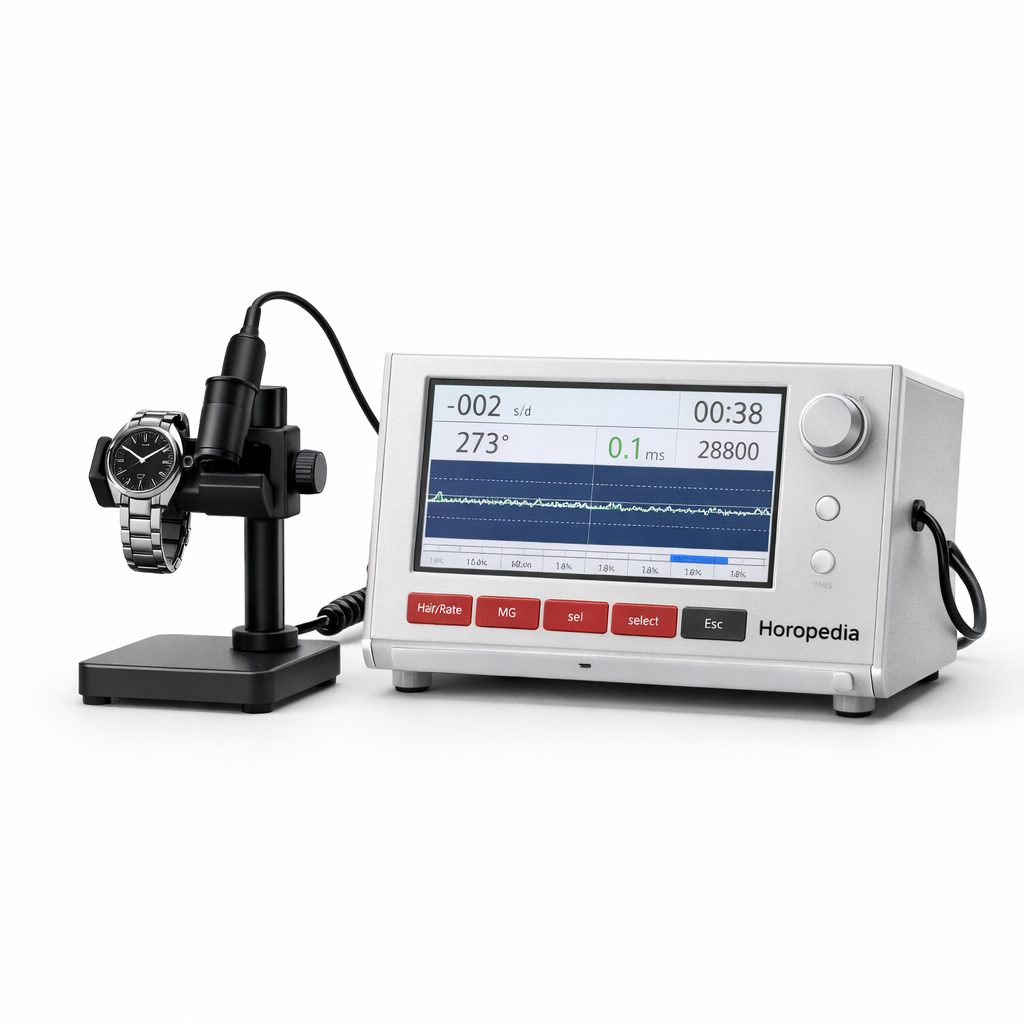
A timegrapher is a control instrument used in watchmaking to analyze the accuracy and consistency of a watch or mechanical movement’s operation. It allows for precise, non-invasive measurement of the balance wheel’s oscillation rate, thereby evaluating the chronometric performance of the movement.
The timegrapher is often referred to by the name of its manufacturer or model (such as Vibrograph, Witschi, etc.).
Function and use
This device captures the sounds produced by the escapement’s impulses using a sensitive microphone, typically attached to a support that holds the mechanical movement or complete watch. By analyzing these sounds, it calculates key parameters: the regulator’s frequency, amplitude variations, timing error, and daily rate expressed as seconds gained or lost per day.
It facilitates fine regulation of the watch movement by detecting irregularities or malfunctions that might affect accuracy. It is particularly useful during adjustment in the workshop or for quality control.
Some timegraphers, especially those used in laboratories or by official chronometric certification organizations (like Timelab, COSC), perform an optical measurement by filming a component of the movement or the second hand on the watch dial.
Characteristics
- Acoustic sensor: A high-performance microphone designed to pick up very faint and precise sounds produced by the escapement.
- Electronic analyzer: Digital processing of the acoustic signals to display key parameters such as timing error, frequency, daily rate, and amplitude.
- Clear display: Results shown on a digital screen, often with graphs to aid interpretation.
- Portability: Compact equipment allowing direct use in the workshop without complex wiring.
Importance in watchmaking
The timegrapher is an indispensable tool for watchmakers. By providing fast and accurate measurements of the movement’s behavior, it helps identify proper adjustments and ensures a steady rate. Based on numeric or graphic indications, it also serves as a diagnostic instrument.
Its non-destructive, contactless principle prevents any mechanical alteration during testing, protecting the delicate watch mechanics while delivering reliable diagnostics.