
BRASSES
Table of main properties of brass
| Property | Typical Value | Remarks |
|---|---|---|
| Density | ~8.4–8.7 g/cm³ | High |
| Young’s modulus (E) | ~90–110 GPa | Moderate |
| Tensile strength | ~300–600 MPa | Depends on alloy |
| Hardness (HV) | ~80–200 HV | Moderate |
| Thermal conductivity | ~100–130 W/m·K | Good |
| Electrical conductivity | ~15–30 MS/m | Moderate |
| Thermal expansion | ~18–22 ×10⁻⁶ /K | Moderate |
| Melting point | ~900–940 °C | Depends on composition |
| Magnetism | No | Non-magnetic |
| Corrosion resistance | Good | May tarnish |
| Machinability | Very good | Excellent |
- General description
- Types of brass used in watchmaking
- Heat and surface treatments
- Watchmaking applications
- Advantages and limitations
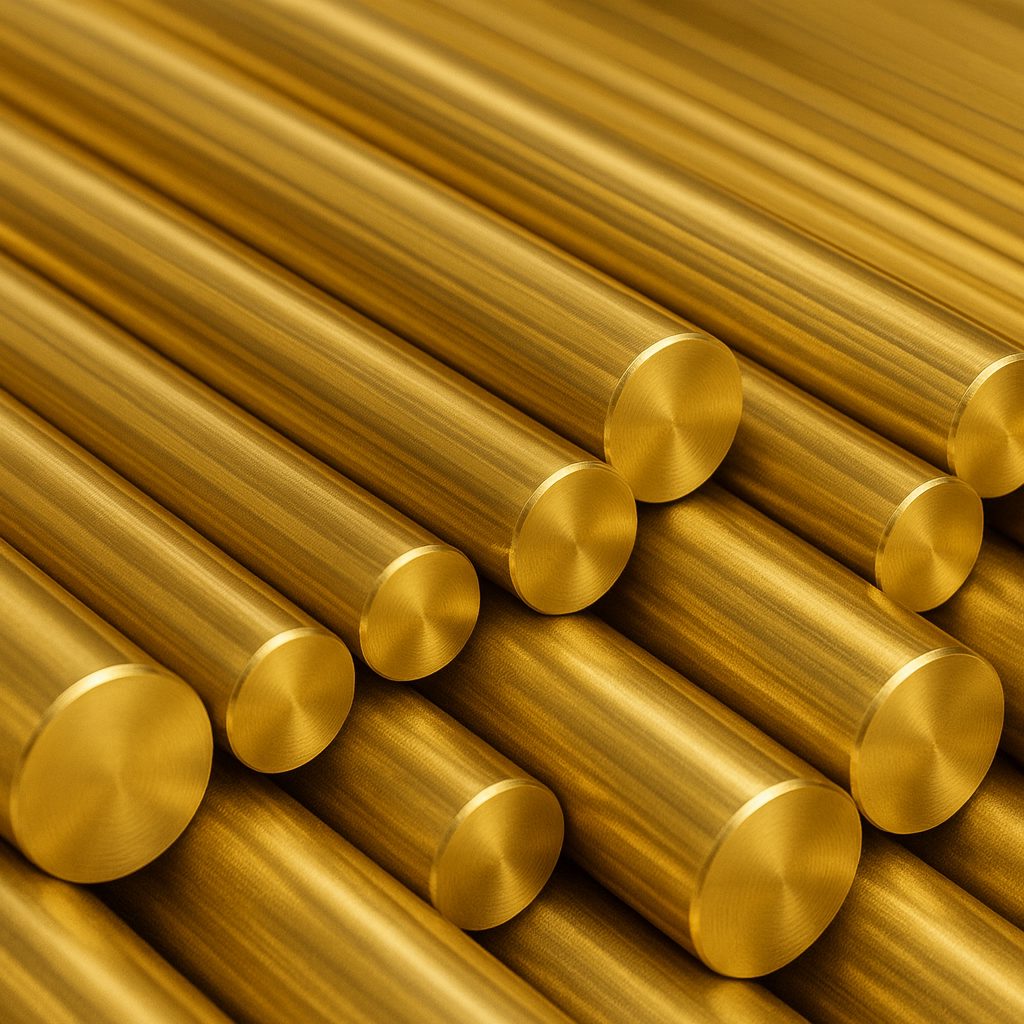
Brass is an alloy of copper and zinc, with a zinc content typically ranging between 5% and 40%. In watchmaking, it is one of the most widely used materials, particularly for movement components, due to its excellent machinability, dimensional stability, and good corrosion resistance.
Historically, brass established itself as a base material for the production of mainplates, bridges, and wheel blanks, and remains widely used in the watch industry today for both technical and aesthetic reasons.
History
Brass appeared as early as prehistoric times. However, it was during the Roman era (around 100 BC) that its production was mastered and carried out intentionally. It was notably used for coinage (Roman sestertii).
From the Middle Ages onwards, its use expanded to the production of cauldrons, tableware, and boilers. Its properties—ductility, malleability, and corrosion resistance—have made it a historically and enduringly valued alloy among watchmakers.
Main Properties
Brass used in watchmaking exhibits several essential characteristics:
- Excellent machinability → ideal for milling, drilling, and turning
- Good corrosion resistance → superior to non-stainless steels
- Dimensional stability → minimal deformation over time
- Moderate Young’s modulus (~90–110 GPa)
- Good vibration damping
- Non-magnetic properties
These properties make brass particularly suitable for fixed and structural components, as well as for wheel blanks. Brass wheel blanks driven by steel pinions ensure minimal friction.
1. Standard Brasses (CuZn)
Standard brasses are primarily composed of copper and zinc.
Applications:
Characteristics:
- Good mechanical strength
- Excellent finishing capability
- Characteristic yellow color
2. Leaded Brasses (Free-Cutting Brasses)
These brasses contain a small proportion of lead (1 to 3%) to improve machinability.
Applications:
- Turned components (screws, studs, etc.)
- Industrial production
Characteristics:
- Very easy machining
- Short chip formation
- Less suitable for highly stressed components
The European REACH regulation, aimed at reducing the use of harmful chemical elements for health and the environment, is currently driving the watch industry to develop alternative alloys to replace leaded brasses.
3. Special Brasses (Modified Alloys)
Some brasses are alloyed with additional elements (tin, aluminum, silicon) in order to improve:
- Mechanical strength
- Wear resistance
- Corrosion resistance
Brass is rarely left untreated in a watch movement. It is generally subjected to surface treatments to enhance its properties:
- Nickel plating → protection and base for further finishing
- Gold plating (yellow or rose gold) → aesthetic enhancement and protection
- Rhodium plating → white appearance and corrosion resistance
- Various electroplated coatings (ruthenium, NAC, etc.)
- Vapor phase depositions (PVD, CVD)
These treatments also contribute to the aesthetic appearance of the movement.
After machining—and especially after stamping—brass often requires heat treatments such as annealing to relieve internal stresses generated by mechanical deformation.
Brass is primarily used for:
- Mainplates → movement structure
- Bridges → support of the components
- Wheel blanks → lightness, ease of machining, and low friction coefficient
- Dials → base for decorative treatments
Advantages
- Exceptional machinability
- Good dimensional stability
- Natural corrosion resistance
- Non-magnetic material
- Cost-effective
Limitations
- Lower mechanical strength than steel
- Sensitivity to wear (without treatment)
- Possible oxidation (tarnishing)
- Relatively high density