
DIAMOND
Table of main properties of diamond
| Property | Typical Value | Remarks |
|---|---|---|
| Density | ~3.5 g/cm³ | Moderate |
| Young’s modulus (E) | ~1000–1200 GPa | Extremely high |
| Compressive strength | ~8000–10000 MPa | Extremely high |
| Hardness (HV) | ~8000–10000 HV | Extremely high |
| Hardness (Mohs) | 10 | Highest known natural hardness |
| Thermal conductivity | ~1000–2200 W/m·K | Extremely high |
| Electrical conductivity | Very low | Insulating (pure diamond) |
| Thermal expansion | ~1 ×10⁻⁶ /K | Extremely low |
| Melting point | Not applicable | Sublimates at very high temperature |
| Magnetism | No | Non-magnetic |
| Corrosion resistance | Excellent | Chemically inert |
| Machinability | Not machinable | Requires abrasive or laser processes |
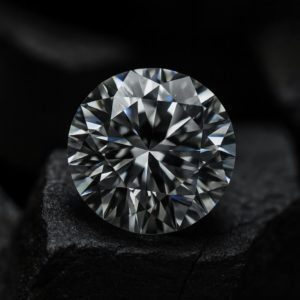
- General description
- Natural diamond and synthetic diamond
- Watchmaking applications
- Advantages and limitations
Diamond is a crystalline form of carbon, characterized by an extremely rigid cubic structure that gives it the highest mechanical properties known among natural materials. In watchmaking, it is primarily used for its abrasive and cutting properties (synthetic diamond), as well as for its aesthetic qualities in jewelry applications (natural diamond).
Its direct use in watch mechanisms remains very rare and anecdotal, due to its relative brittleness under impact and the constraints associated with its processing. However, it plays a key role in manufacturing processes, particularly in the form of abrasives and cutting tools.
Main Properties
Diamond exhibits exceptional characteristics:
- Maximum hardness (10 on the Mohs scale)
- Very high wear resistance
- Very high Young’s modulus (~1000–1200 GPa)
- Very high thermal conductivity (~2000 W/m·K)
- Low thermal expansion coefficient
- Non-magnetic material
- Low friction coefficient (high polishability)
These properties make it a reference material for machining and finishing.
1. Natural Diamond
Historically used, particularly in jewelry applications.
2. Synthetic Diamond
Now widely dominant in technical applications.
Production methods:
- HPHT (High Pressure High Temperature)
- CVD (Chemical Vapor phase Deposition)
👉 Enables controlled, homogeneous production tailored to industrial needs (tooling, abrasives)
1. Tooling and Abrasives (Primary Use)
Diamond is used in the form of:
- Abrasive powders
- Polishing pastes
- Diamond cutting tools (drills, milling cutters, grinding wheels)
Applications:
- Component polishing
- Machining of hard materials (ceramics, synthetic sapphire, carbides, steels, etc.)
- Finishing of rubies and precision surfaces
👉 Diamond is now essential for achieving the levels of finishing required in watchmaking.
2. Applications in the Movement (Anecdotal Use)
Diamond has been used experimentally or very sparingly for:
- Bearings
- Ultra-low friction contact surfaces
Benefits:
- Extreme reduction of friction
- Very high wear resistance
Limitations:
- Brittleness under impact
- Complex implementation
- High cost
👉 These applications remain marginal.
3. Jewelry and Setting
Natural diamond is widely used in watchmaking for:
Cut types:
- Brilliant cut
- Baguette cut
- Princess cut
- Fancy cuts
Setting can be carried out using different techniques:
- Grain setting
- Bezel setting
- Snow setting
- Invisible setting
👉 Diamond is a key element in jewelry watchmaking.
Advantages
- Unmatched hardness
- Exceptional wear resistance
- Very high precision as an abrasive
- Prestigious aesthetic
- Chemical stability
- Non-magnetic
Limitations
- Brittleness (possible cleavage)
- High cost
- Limited technical applications in movements
- Sensitivity to shocks