
PLATINUM
Table of main properties of platinum
| Property | Typical Value | Remarks |
|---|---|---|
| Density | ~21.4 g/cm³ | Very high |
| Young’s modulus (E) | ~160–170 GPa | High |
| Tensile strength | ~120–300 MPa | Depends on alloy |
| Hardness (HV) | ~40–200 HV | Low to moderate |
| Thermal conductivity | ~70–75 W/m·K | Moderate |
| Electrical conductivity | ~9–10 MS/m | Low |
| Thermal expansion | ~8–9 ×10⁻⁶ /K | Low |
| Melting point | ~1768 °C | Very high |
| Magnetism | No | Non-magnetic |
| Corrosion resistance | Excellent | Highly inert |
| Machinability | Difficult | Tough and dense material |
- General description
- Platinum alloys in watchmaking
- Hallmarking and fineness standards
- Treatments and finishings
- Watchmaking applications
- Advantages and limitations
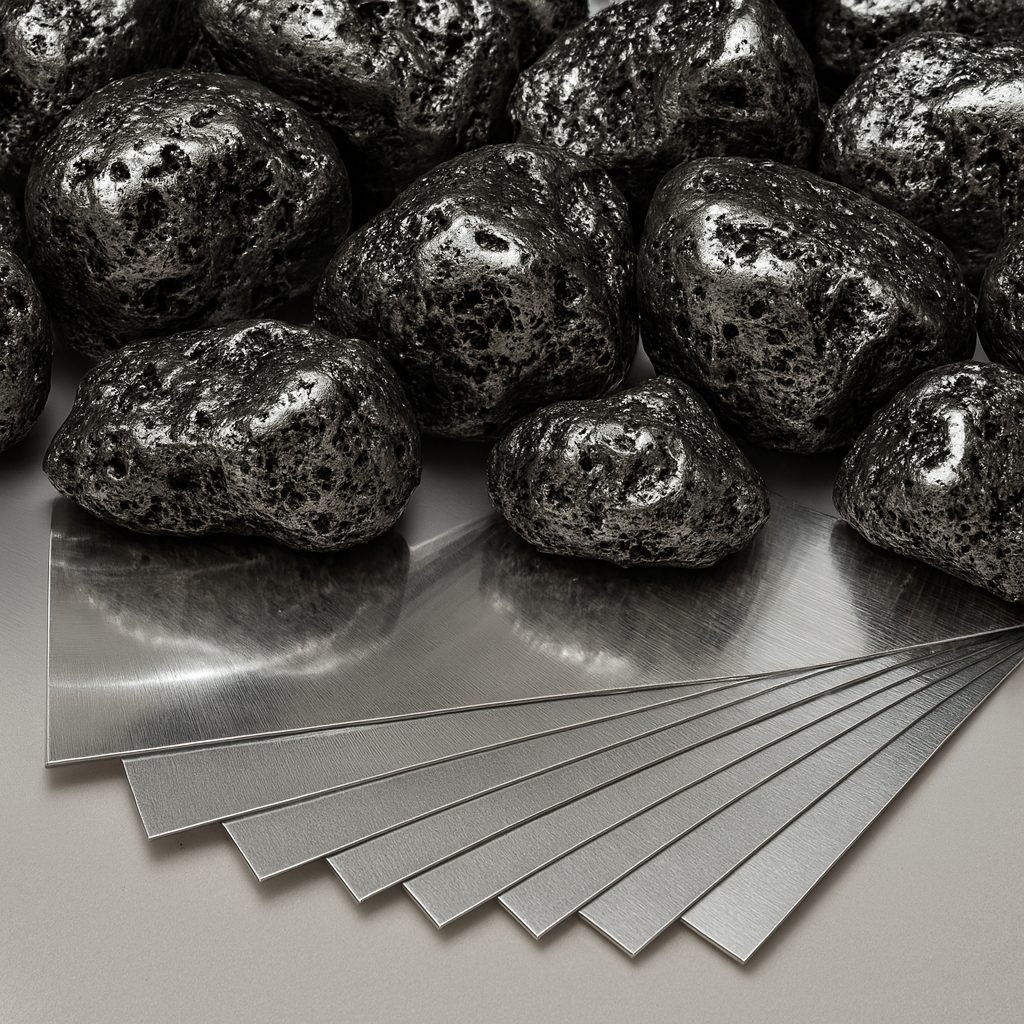
Platinum is a rare precious metal used in watchmaking for its exceptional physical properties, outstanding corrosion resistance, and high symbolic value. Denser and more stable than gold, it is primarily used for the production of cases and bracelets, and more rarely for specific components such as oscillating weights.
Its use remains limited, however, due to its high cost and machining difficulty, which require specialized expertise. Platinum is therefore reserved for the most prestigious pieces in high-end watchmaking.
Main Properties
Platinum exhibits several remarkable characteristics:
- Very high density (~21.4 g/cm³)
- Excellent corrosion resistance (virtually non-tarnishing)
- High chemical stability
- Good ductility and malleability
- Non-magnetic material
- Moderate Young’s modulus (~160–170 GPa)
- Very good wear resistance
Platinum used in watchmaking is generally alloyed to improve its mechanical strength.
1. Platinum 950 (Pt950)
The most common alloy:
- 95% platinum
- 5% alloying elements (iridium, ruthenium, cobalt)
Characteristics:
- High purity
- Excellent strength
- Standard in high-end watchmaking
2. Specific Platinum Alloys
Depending on the manufacturer, different elements may be used:
- Iridium → improves hardness
- Ruthenium → enhances mechanical strength
- Cobalt → improves machinability
Platinum Fineness
Fineness indicates the proportion of pure platinum in the alloy:
- Pt950 (950‰) → 95% platinum
- Pt900 (900‰) → 90% platinum
👉 In watchmaking, the standard is Pt950, ensuring a high level of purity.
Hallmark
Platinum is subject to regulatory marking:
- Fineness hallmark → guarantees the platinum content
- Maker’s mark → identifies the manufacturer
In many countries, a specific hallmark is used for platinum (often represented by a head or a distinctive symbol).
Platinum is generally used without surface treatment, in order to preserve:
- Its natural grey-white appearance
- Its soft, deep luster
Possible finishes:
More difficult to work than gold, platinum is less suitable for hand engraving and guilloché (engine-turned) work.
Platinum is primarily used for:
- Watch cases
- Bracelets
- Oscillating weights → high density is advantageous
- Technical components requiring high density (balance wheel weights, etc.)
Advantages
- Very high density
- Non-tarnishing and extremely stable
- High wear resistance
- Noble and prestigious material
- Non-magnetic
Limitations
- Very high cost
- Difficult machining
- Difficult polishing
- High density
- Specialized tooling required