
TANTALUM
Table of main properties of tantalum
| Property | Typical Value | Remarks |
|---|---|---|
| Density | ~16.6 g/cm³ | Very high |
| Young’s modulus (E) | ~185–190 GPa | High |
| Tensile strength | ~200–900 MPa | Depends on processing |
| Hardness (HV) | ~100–300 HV | Moderate |
| Thermal conductivity | ~55–60 W/m·K | Moderate |
| Electrical conductivity | ~7–8 MS/m | Low |
| Thermal expansion | ~6–7 ×10⁻⁶ /K | Low |
| Melting point | ~3017 °C | Extremely high |
| Magnetism | No | Non-magnetic |
| Corrosion resistance | Excellent | Highly inert |
| Machinability | Difficult | Dense and tough material |
- General description
- Specific characteristics
- Treatments and finishings
- Watchmaking applications
- Advantages and limitations
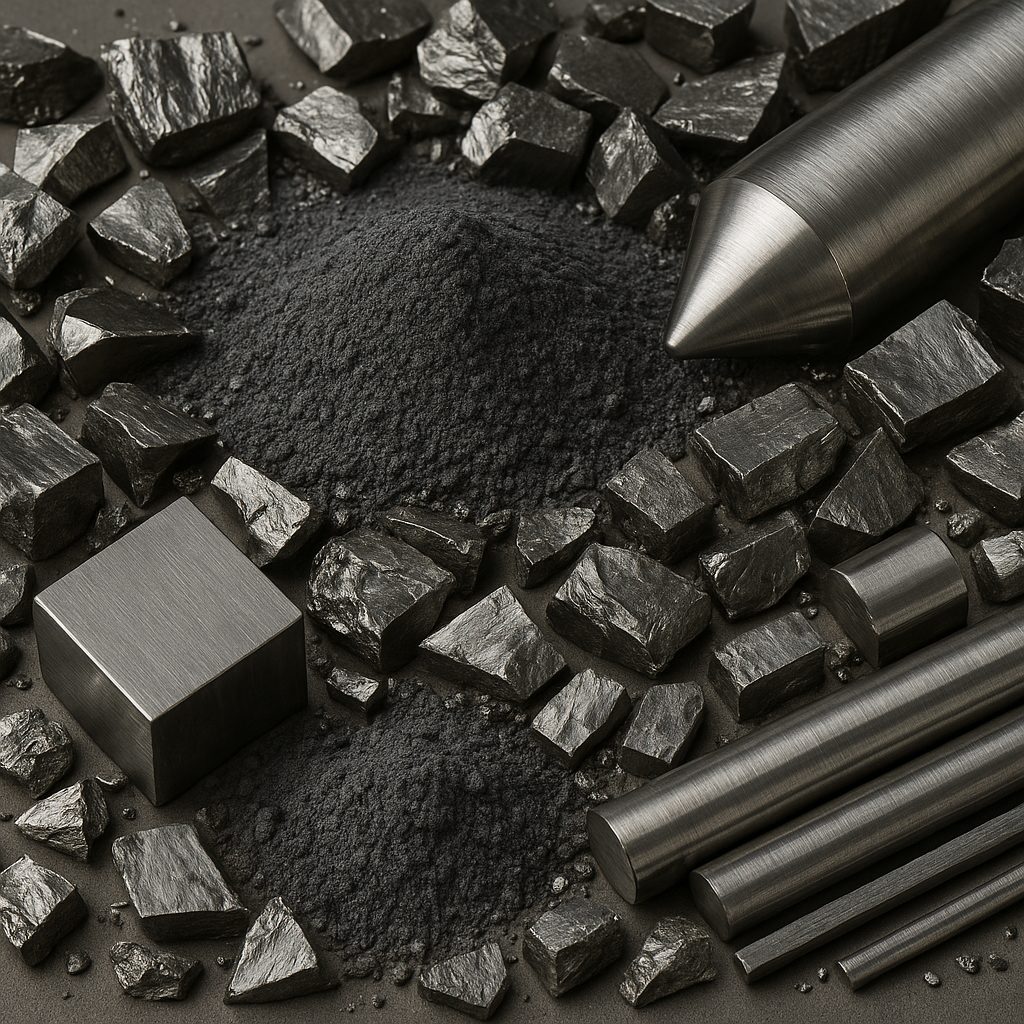
Tantalum is a rare transition metal used in a confidential manner in watchmaking for its exceptional corrosion resistance, high density, and non-magnetic properties. Its naturally dark bluish-grey color and matte appearance give it a distinctive aesthetic identity, particularly appreciated in certain high-end watchmaking creations.
Despite its qualities, its use remains limited due to its machining difficulty and complex processing, which require specialized tools and advanced expertise.
Main Properties
Tantalum exhibits a set of remarkable properties:
- Very high corrosion resistance (even in aggressive environments)
- High density (~16.6 g/cm³)
- Excellent chemical stability
- Non-magnetic material
- High Young’s modulus (~180–190 GPa)
- Very good wear resistance
- Very high melting point (~3000 °C)
These properties make it an extremely durable and stable material.
Tantalum is known for:
- Its machining difficulty (a “sticky” material that tends to adhere to cutting tools)
- Its tendency to work-harden during deformation
- Its sensitivity to cutting conditions
- Its resistance to plastic deformation
These constraints explain its limited use in industrial production.
Tantalum is generally used without surface treatment, in order to preserve:
- Its natural bluish-grey tone
- Its slightly matte appearance
Possible finishes:
Tantalum is very difficult to polish, and the resulting finish is rarely satisfactory, which is why the two finishes mentioned above are generally preferred.
Advantages
- Exceptional corrosion resistance
- High chemical stability
- Non-magnetic material
- Unique aesthetic appearance
Limitations
- Very difficult machining
- High cost
- High density (inertia in case of shocks or drops)
- Complex processing