
SAPPHIRE
Table of main properties of sapphire
| Property | Typical Value | Remarks |
|---|---|---|
| Density | ~3.9–4.1 g/cm³ | Moderate |
| Young’s modulus (E) | ~345–400 GPa | Very high |
| Compressive strength | ~2000 MPa | Very high |
| Hardness (HV) | ~2000 HV | Extremely high |
| Hardness (Mohs) | 9 | Same as ruby |
| Thermal conductivity | ~25–40 W/m·K | Moderate |
| Electrical conductivity | Very low | Insulating material |
| Thermal expansion | ~5–8 ×10⁻⁶ /K | Low |
| Melting point | ~2050 °C | Very high |
| Magnetism | No | Non-magnetic |
| Corrosion resistance | Excellent | Chemically inert |
| Machinability | Not machinable | Ground and polished with diamond tools |
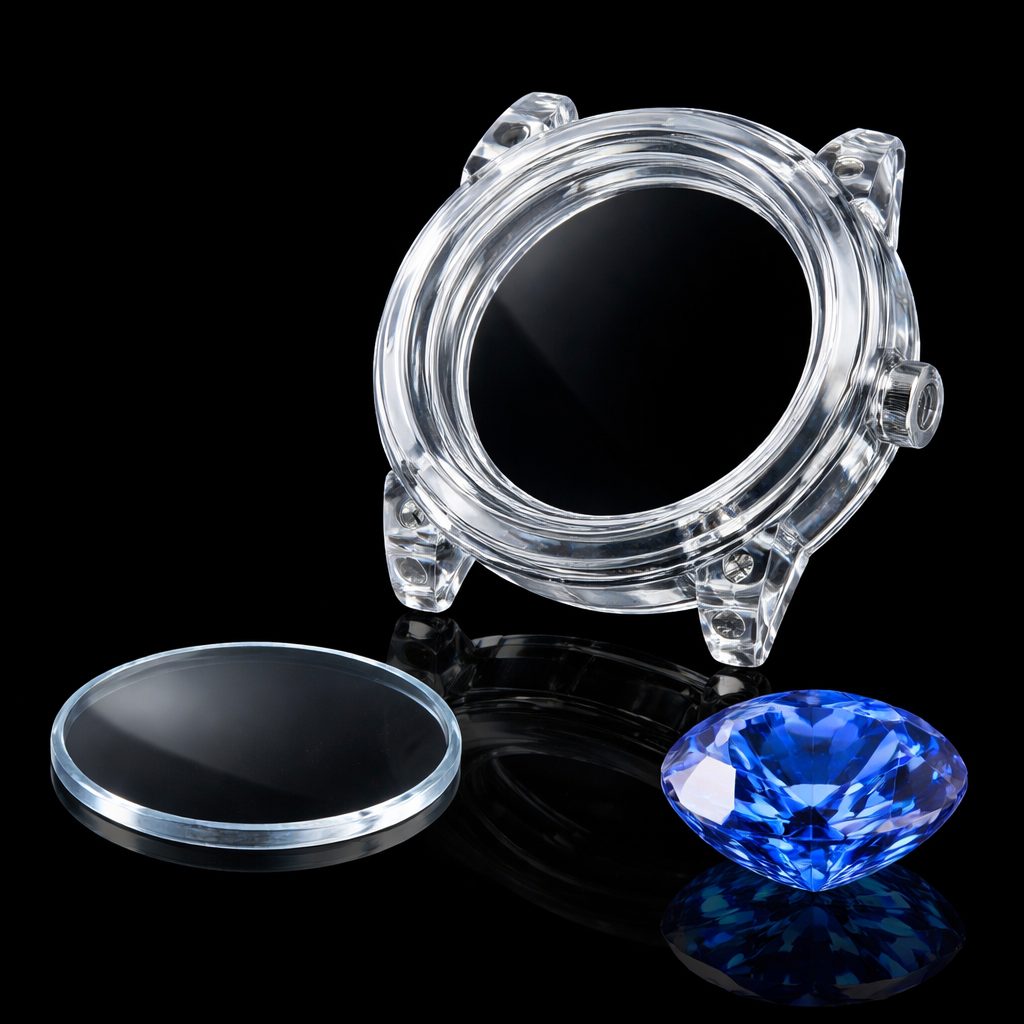
- General description
- Natural sapphire and synthetic sapphire
- Manufacturing of sapphire components
- Watchmaking applications
- Advantages and limitations
Sapphire, like ruby, is a variety of corundum (Al₂O₃). It differs from ruby only by the absence of chromium, which gives it transparency or a range of colors. In watchmaking, it is used in two distinct forms:
- Natural sapphire → mainly used in jewelry (setting)
- Synthetic sapphire → widely used for crystals, cases, and technical components (discs, bearings, gongs)
Today, synthetic sapphire has become an essential material due to its transparency, hardness, and scratch resistance.
Main Properties
Apart from its color, sapphire exhibits characteristics identical to those of ruby:
- Very high hardness (9 on the Mohs scale)
- Excellent scratch resistance
- Good optical transparency
- Very good chemical stability
- Non-magnetic material
- Low thermal expansion coefficient
- Excellent corrosion resistance
1. Natural Sapphire
Natural sapphire is extracted from mineral deposits.
Characteristics:
- Color variability (blue, yellow, pink, etc.)
- Natural inclusions
- Primarily used in jewelry
Applications:
2. Synthetic Sapphire
Synthetic sapphire is produced industrially from aluminum oxide.
Main methods:
- Verneuil process (flame fusion)
- Czochralski growth
- Kyropoulos method (widely used for large parts)
Characteristics:
- High purity
- Perfect transparency (or controlled coloration)
- Consistent properties
- Controlled production
👉 It is now the standard in watchmaking.
The main steps are:
- Crystal growth
- Cutting into blocks or wafers
- Machining (diamond tools)
- Optical polishing
- Surface treatments (anti-reflective coatings, etc.)
👉 Machining is time-consuming and costly due to the material’s hardness.
1. Watch Crystals (Synthetic Sapphire)
- Primary application
- High scratch resistance
- High transparency
- Often treated with anti-reflective coatings
2. Sapphire Cases (Synthetic Sapphire)
- Fully transparent (or colored and translucent) cases
👉 Allow the movement to be viewed from all angles
3. Jewelry (Natural Sapphire)
- Set natural sapphires
- Decorative elements
Advantages
- Very high scratch resistance
- Exceptional transparency
- Chemical stability
- Non-magnetic
- High-end aesthetic
- Durability
Limitations
- Brittleness (fragile material)
- Sensitivity to shocks
- Difficult and costly machining
- Not completely scratch-proof (only diamond is harder)