
BROACHES
WHAT ARE BROACHES USED FOR?
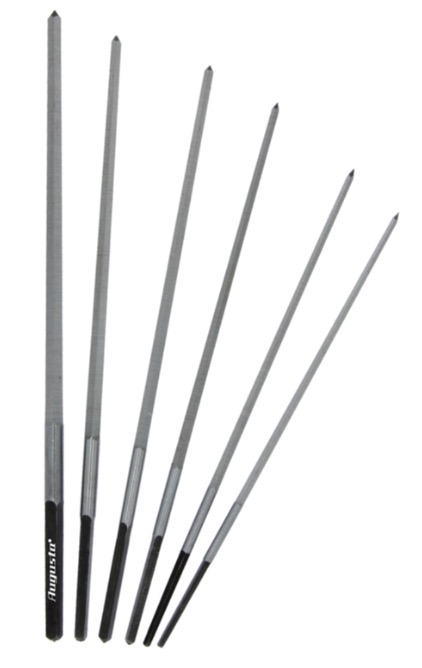
Broaches are hand-held cutting and sizing tools used by the watchmaker to finish, adjust or precisely enlarge a hole drilled in a component. The term derives from the French word carré (square) and, by extension, designates more broadly any tool whose shank features sharp “squared” edges — triangular, square or polygonal — that ensure the progressive removal of material through manual rotation.
In its most common watchmaking form, the broach consists of a slightly tapered hardened-steel shank with a five- or six-sided cross-section. Inserted by hand into a round hole, it sizes the diameter by removing extremely fine chips as the watchmaker turns it back and forth with alternating movements. This unassuming geometry gives the tool great tactile sensitivity: cutting can be stopped the moment the desired fit is reached, with no risk of suddenly biting into the material.
The taper of the shank makes it possible, in every case, to enter the hole at its finest section and then progress gradually to the required dimension.
At the bench, the watchmaker uses the broach to size a bearing hole before fitting a jewel, to adjust the clearance for a screw or a pin, or to true up a hole that has become slightly oval through use. The tool is held directly in the hand or fitted into a handle; it is never driven by a machine.