
SCREWED CASE-BACK OPENING PRESS
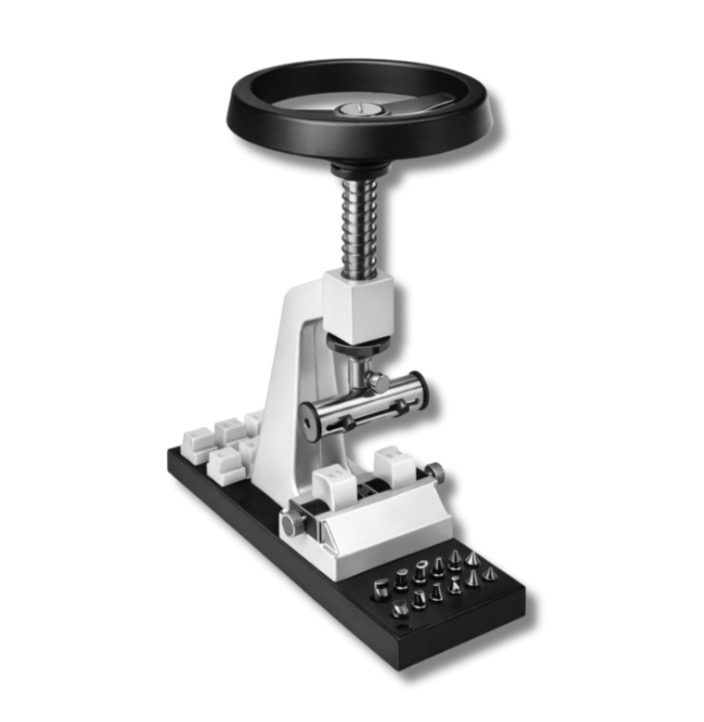
The screw-back case opening press is a workbench tool used for dismantling and reassembling the screw-down case back of a water-resistant watch case. It adopts the classic architecture of the watchmaking press — a stable base, a vertical column and a movable head sliding along it — to apply simultaneously, above the case, a controlled axial pressure and rotational torque, thereby allowing the case back to be unscrewed without damaging the notches that provide the grip.
In its usual configuration, the head receives, on its lower part, an interchangeable die whose profile engages in the ring of notches machined around the periphery of the case back. A flywheel or a lever, acting on the upper operating screw, applies the downward pressure necessary to maintain the die firmly in the notches during rotation. This pressure is essential: without it, the die jumps from one notch to another and irretrievably scratches or tears the metal.
At the base of the tool, the watch case is immobilised in a case holder shaped to fit the middle part. These case holders, made of a soft plastic material — polyacetal type — or fitted with protective coverings, protect the case from any mark or scratch caused by clamping. Centring is rigorous: the die must coincide with the ring of notches, otherwise the slightest misalignment transfers all the effort to a single notch instead of distributing the torque over the whole.
Two families of dies are encountered. Fixed-jaw dies, or profiled dies, are cut to correspond to a specific notch pattern: each reference or family of cases then requires its own die. Adjustable-pin dies — generally with three pins, cylindrical or of square section — offer superior versatility: the position and the spacing of the pins can be adjusted to a wide range of diameters and notch configurations. It is this latter type that equips the majority of versatile workshop presses.
In practice, the watchmaker immobilises the case in the case holder, selects and adjusts the die corresponding to the notches of the case back, engages it carefully, then exerts a firm axial pressure before applying rotation in the unscrewing direction. The pressure must be maintained throughout the rotation, otherwise the die slips out. The same press serves for re-screwing at the end of the operation, a critical step for restoring the water resistance (gaskets).
Distinct from manual case-back wrenches — rubber-jawed pliers or flat pin wrenches — by the rigour of its guidance and the mastery of the forces it allows, the screw-back case opening press, with the widespread adoption of water-resistant wristwatches during the 20th century, has established itself as an indispensable hand-operated tool on any workbench called upon to work on cases with screw-down backs.