
SCREW PLATES
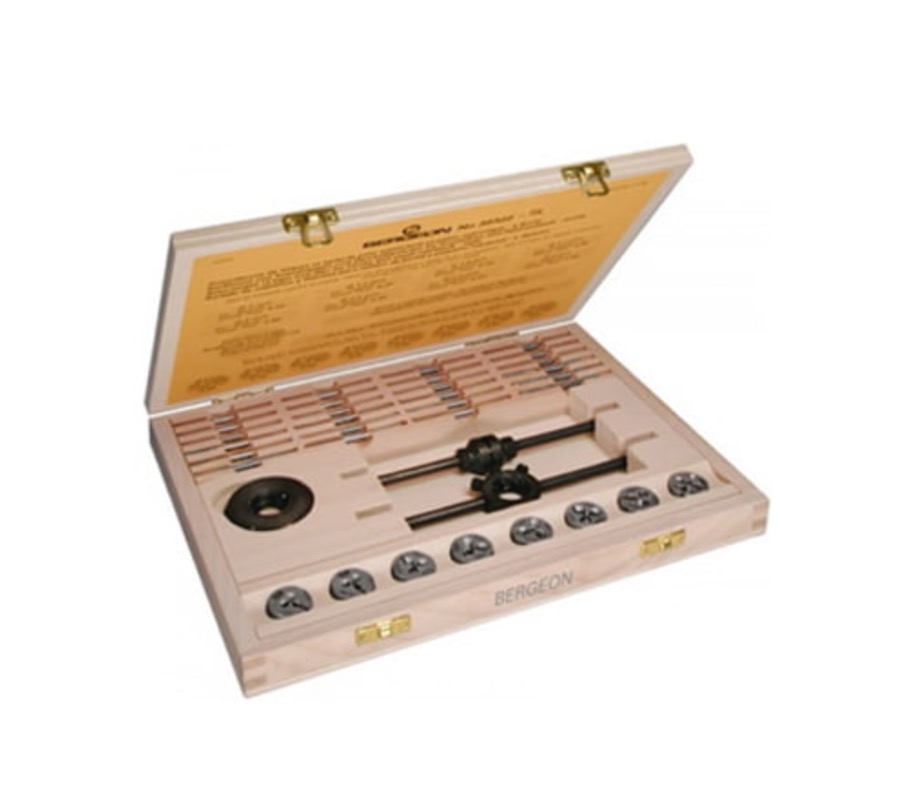
WHAT IS A SREW PLATES ?
Screw plates are cutting tools used to form an external thread — in other words a screw thread — on the circumference of a cylindrical rod. Used by rotation with the aid of a screw plate holder, or screw plate stock, which ensures their grip and drive, they complement their internal counterpart, the tap, employed for cutting female threads. The small size of watchmaking components imposes specific characteristics on their use that distinguish horological screw plates from those of general mechanics (dies).
The horological screw plates takes the form of a thin disc of tool steel or high-speed steel, pierced in its centre with a threaded hole whose profile constitutes the exact negative of the thread to be reproduced. Several radial flutes — generally three or four — define as many cutting edges and provide passage for the chips. The usual diameters of horological scew plates typically start at around 0.30 millimetre, a dimension at which the material removed per turn is of the order of a micrometre and requires a very fluid lubrication, as well as perfect alignment of the rod.
The threads used in watchmaking obey standardised series specific to the trade, distinct from the ISO metric series of general mechanics. Within the Standards of the Swiss Watchmaking Industry (NIHS), the “S series” defines a set of diameter/pitch pairs adapted to very small diameters, reserving for horological components proportions more favourable to the strength and stability of the threads. These threads are used in all the screwed assemblies of the calibre — fastening of the bridges to the mainplate, retention of springs, cams and levers in particular.
A fundamental peculiarity of horological practice is the almost total absence of nuts: screw fastening is carried out directly between the threaded screw and the tapped component opposite (mainplate, bridge, balance cock, oscillating weight, etc.). Several reasons combine to explain this. The thickness of the components usually offers enough material to produce a blind tapped hole guaranteeing a satisfactory number of engaged threads; the addition of a nut would weigh down and complicate the assembly, at the cost of bulk incompatible with the density of the movement; finally, direct tapping ensures controlled location and dismantling during maintenance operations. The screw plate is thus systematically paired not with a nut device, but with a tap that reproduces its profile at the very heart of the calibre’s components.