
GREASES
Definition and role
Greases are lubricants with a semi-solid or paste-like consistency. They differ from oils by their much higher viscosity, which gives them better staying power. In watchmaking, they are applied to contact points subjected to significant pressure, slow movements, or surfaces where a fluid lubricant would migrate too quickly. Their role is twofold: to reduce friction between two metal parts in contact, and to protect those surfaces against wear and corrosion. Unlike oils, greases do not require a reservoir (oil sink) to be retained. They adhere naturally to surfaces and remain in place durably, even under the vibrations and shocks inherent to wearing a watch.
Composition and properties
A watchmaking grease is composed of three main elements: a base oil, a thickener, and optionally additives. The base oil — mineral, synthetic, or silicone — provides the lubricating power. The thickener — often a metallic soap or organic compound — gives the grease its characteristic consistency. Additives improve certain properties: pressure resistance, corrosion protection, or thermal stability. The consistency of a grease is measured on the NLGI scale (National Lubricating Grease Institute) and ranges from very soft (grade 0) to very hard (grade 6). In watchmaking, grades 0 to 2 are mainly used. Thixotropy — the property of certain greases to become fluid under mechanical stress and then recover their consistency at rest — is particularly valued for its ability to adapt to the demands of the movement.
Natural greases (Moebius 8200 and 8300 series)
Moebius is a world-reference and near-sole supplier of watchmaking lubricants. Its range of natural greases covers a wide spectrum of applications.
The 8200 series groups together semi-liquid thixotropic greases of natural origin, intended for large-surface friction, slow-moving parts, and ball bearings. The 8200 is the standard reference, fusible and versatile. The 8201 adds molybdenum disulphide (MoS₂) to enhance lubricating power under high pressure. The 8207 incorporates graphite for the same purpose. These greases are particularly suited to areas subjected to moderate loads and slow movements.
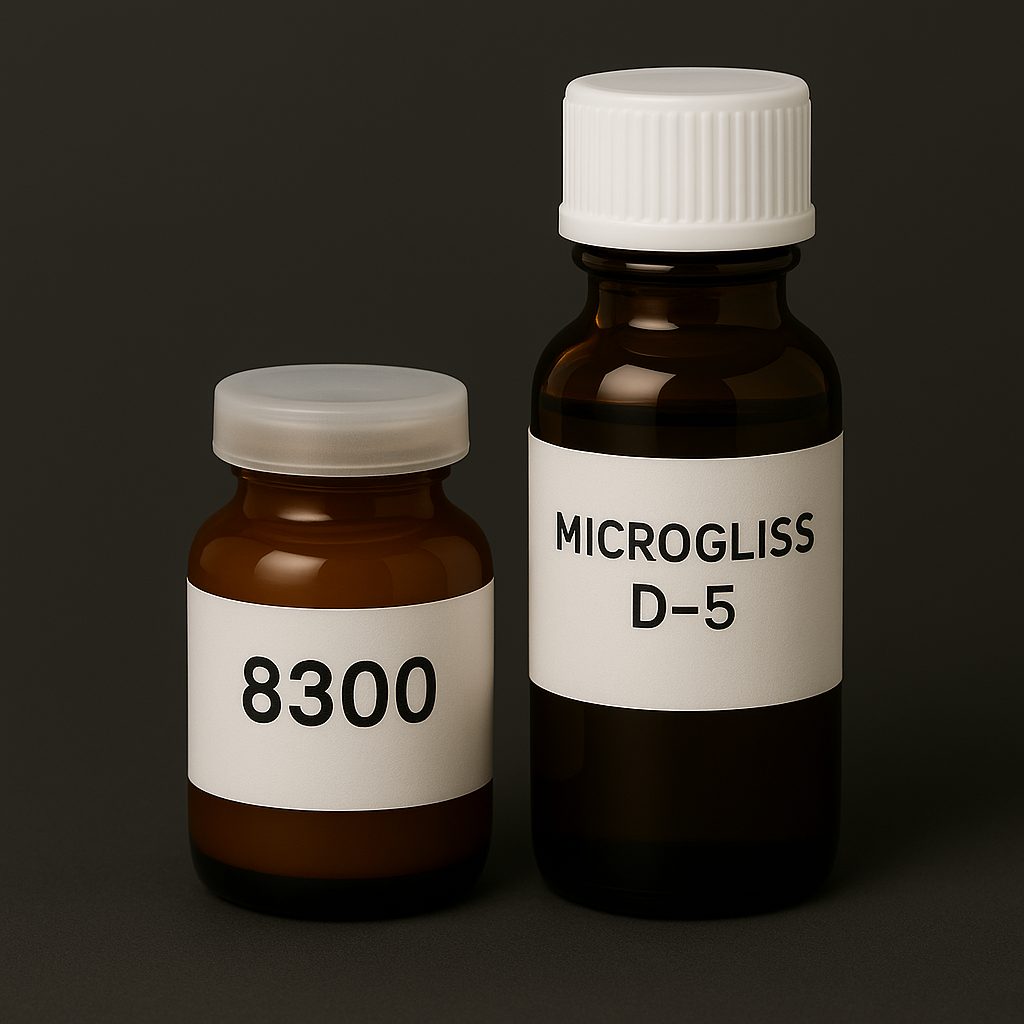
The 8300 series is intended for more demanding applications in terms of retention. The 8300 is a hard grease, recommended for springs and the functions of the winding mechanism. The 8301 (with graphite) and 8302 (with MoS₂) are reinforced variants for steel-on-steel contacts under high pressure.
Barrel greases (8200 series — braking greases)
The barrel is a special case: the grease there plays a controlled braking role between the drum wall and the spring, regulating the let-down of the mainspring. The material of the barrel determines the choice of lubricant.
The 8212 (Glissalube B, red) is a soft grease providing moderate braking, particularly recommended for aluminium barrel walls. Its colourless version, 8212-SC, is used when the red tint would pose an aesthetic problem. The 8213, a hard orange grease, provides more effective braking and is recommended for brass barrels. The 8217 (Glissalube 20) is a very soft braking grease suitable for all barrel types. The synthetic grease 9500, based on polyol ester, was specifically developed for lubricating modern barrels, with excellent stability.
It should be noted that modern mainsprings are self-lubricating and that adding grease would damage them. Only the drum walls of automatic movement barrels require such lubrication.
Synthetic greases (Moebius 9400–9550 series)
Synthetic greases offer superior stability to natural greases, particularly in terms of ageing and resistance to temperature variations. They now form the basis of lubrication for modern movements.
The 9415 is a 100% synthetic soft thixotropic grease, specially developed for lubricating the escapement. Its excellent lubricating power and stability make it the reference for contacts between the pallet and the escape wheel. The 9501 is a slightly thixotropic soft grease, developed for steel-on-steel friction in time-setting and other medium-load functions. The 9504, more versatile, is suitable for a wide range of applications: winding mechanism, calendar, setting friction. The 9550 offers high stability under compression for the highest pressures.
Silicone greases (Moebius 8500 series) and thixosilane
Silicone greases stand out for their exceptional chemical inertness. They resist water, UV, and oxidative attack, making them indispensable for sealing applications.
The 8513 is a hard silicone grease used primarily for sealing crowns, pushers and gaskets. The 8516 is the soft version, better suited to O-rings requiring gentle compression. Neither should be used for mechanical lubrication of movement parts, as they risk damaging materials that are incompatible with silicones.
The 9600-B (Thixosilane) is a special case: this silicone-based thixotropic fluid gel sits between a grease and a liquid. It is used for low pressures, the assembly or pressing-in of fragile parts, where a supple texture is required without the risk of contamination from an overly fluid lubricant.
Choice of lubricant and best practices
Choosing the correct grease is as critical as the application technique. As a general rule, grease should be applied in the minimum but sufficient quantity: excess attracts dust and may migrate to other parts of the component or movement. Natural greases age more quickly than synthetic ones and justify more frequent servicing of the movement.