
TOOLS FOR SETTING HANDS
What is the use of hand-setting tools?
Hand-fitting tools refer to the manual Pushers intended to secure the Hands onto their respective seats — Cannon pinion for the minute Hand, Hour wheel for the hour Hand, seconds wheel pivot for the seconds Hand, etc. — at the final stage of the Movement’s External parts (case, dial, hands) fitting. Although entrusted to simple hand-held instruments, the operation nonetheless demands absolute precision: the Hand, friction-fitted onto its Pipe, must be pressed perfectly flat, without deforming its plane or marking the underlying Dial. The motion tolerates neither lateral sliding nor excessive pressure, and requires pressure perfectly perpendicular to the plane of the Dial, which accounts for the existence of a family of specific tools, adapted to each type and size of Hand.
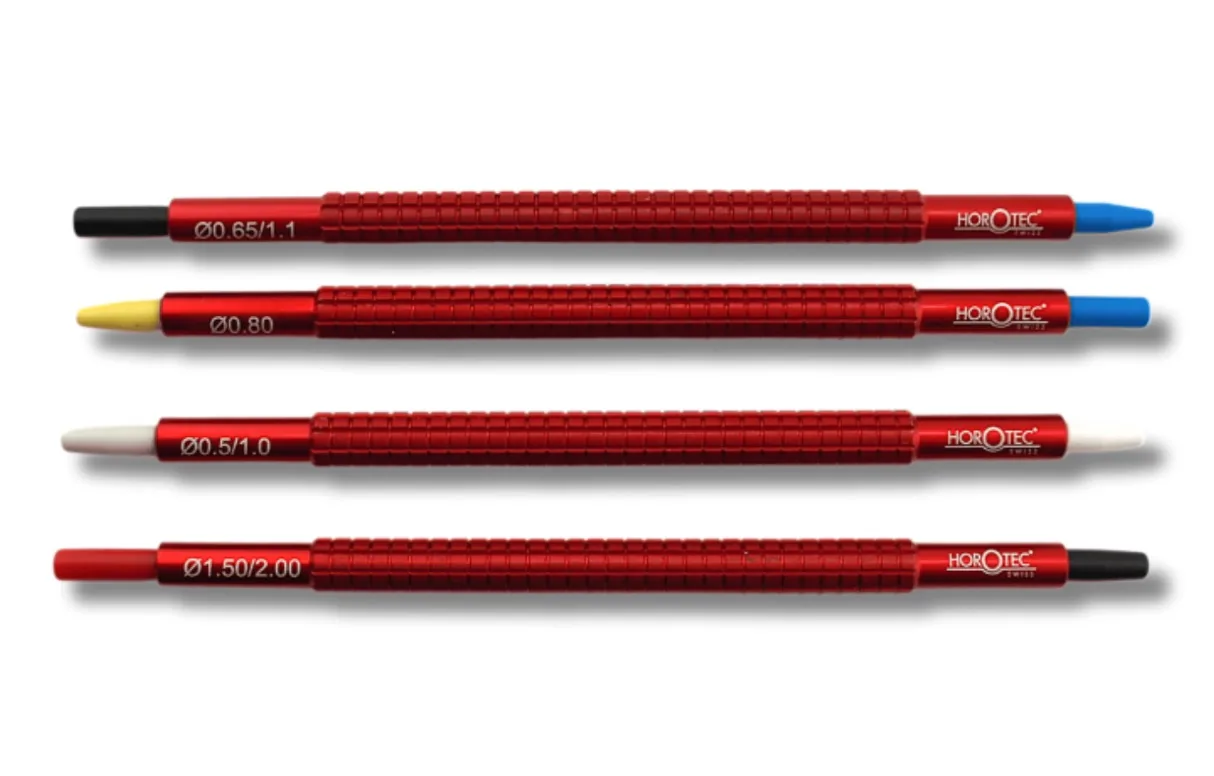
The Hand pusher is classically presented in the form of a thin cylindrical rod, most often with two active ends, mounted on a handle that promotes a smooth and precise grip. Each end has a small central hole, drilled and chamfered in a pad of suitable material — Brass, Delrin, peek or nylon —, calibrated to the diameter of the Pipe of the Hand to be fitted. The double end allows two different diameters to be served, for example those of the hour Hand and the minute Hand; the handles are frequently colored or marked to quickly identify the dimension associated with each tool.
These pushers are sold individually or in sets, generally presented in a case covering the usual sizes, from the very fine diameters of small seconds or Chronograph Hands to larger spans.
Hand-fitting tools come into play at the very last stage of Movement Assembly, after reassembling the Train, fitting the Dial and preparing the Hands. The action is performed by hand, on the Bench, with the Horologist (watchmaker) holding the Movement with one hand and applying the Pusher vertically with the other, checking under a loupe the flatness and concentricity of each Hand. The accuracy of the diameter selection, the cleanliness of the Pusher tip and the consistency of the pressure determine the result: a poorly fitted Hand warps, rubs against the Dial or the Crystal (watch glass), interferes with the passage of the other Hands, or comes loose quickly in service.
This page has been automatically translated from the French reference version using an artificial intelligence tool. Errors or inaccuracies may remain. If you notice any, especially if this is your native language, please feel free to report them to info@horopedia.org. Your contribution helps us improve the quality of the encyclopedia.
While awaiting their translation, images and videos remain temporarily displayed in French.
Thank you for your understanding.