
HAND LEVERS
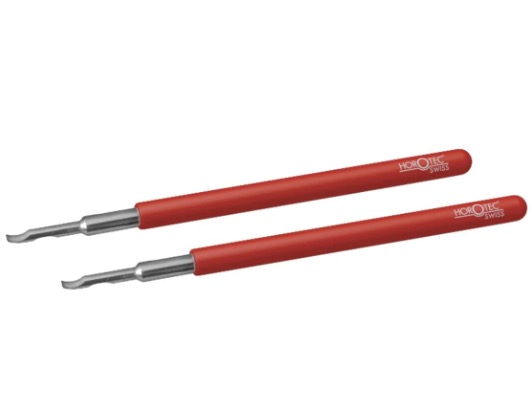
Hand levers
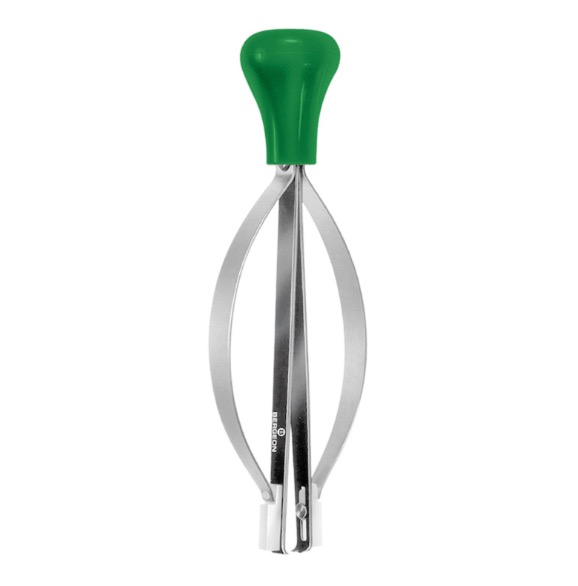
“Presto” tool for hands removing
WHAT ARE HAND LEVERS USED FOR?
Hand-removing levers (Fr. leviers aux aiguilles) form a family of tools specifically designed for removing the hands of a watch — that is, for separating them from the cylindrical seats, friction-fitted, that secure them to the motion work: cannon pinion, hour wheel and, where present, the small seconds arbor. Their design answers a very tight set of requirements: to exert a strictly axial pull on the hand, without applying the slightest lateral load liable to damage the pivots, while preserving the dial beneath and avoiding any deformation of the hand itself.
In its most traditional form, the hand lever consists of two fine metal rods, flattened at their tips and finished with a notch or a lance-shaped point designed to engage beneath the boss of the hand on either side of the central pipe. The watchmaker holds the two rods between the fingers, positions them carefully beneath the hand, then applies an upward leverage movement, bearing on the dial — previously protected by a cardboard or plastic mask. The symmetry of action of the two rods converts the manual gesture into a perfectly axial pull, a condition essential to preserving the component and its seatings.
A more recent and widely used variant, known as the presto — after the most widespread tool of this type on the market — takes the form of a spring-loaded plier fitted with two lance-pointed jaws and, in most cases, a protective plate of soft material or polished metal that is interposed between the hand and the dial before the action. A squeeze of the plier engages a spring mechanism that drives the jaws beneath the hand while pushing the protective plate against the dial: removal is performed in a single gesture, with great repeatability and without risk to the case-and-dial components.
At the bench, the watchmaker removes the hands in succession, in the usual order — first the seconds hand, then the minute hand, and finally the hour hand — systematically interposing, between the hand and the dial, a thin film or paper protector whenever the presto is not fitted with one. The reverse operation — the fitting of the hands — does not call upon these levers but rather upon a dedicated hand setter or hand-setting press, which exert a downward pressure instead. Although outwardly modest, hand levers are among the most delicate tools at the workbench: a poorly controlled gesture, and the hand is bent, the dial is scratched, or the pivots of the motion work are placed under strain.