
OIL POTS
WHAT ARE OIL POTS FOR?
Oil pots (Fr. huiliers) designate a set of specialised tools intended for the storage and precise application of the lubricants used in the movement. The diversity of lubrication operations — which call upon several different oils and greases, with deposited volumes measured in microlitres — has led the industry to develop entirely dedicated tooling, without equivalent in general mechanics.
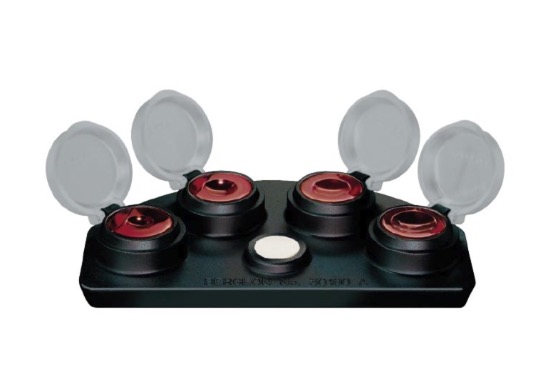
The term oil pot applies first to the container intended to receive and keep the oil within easy reach. In its classic form, it consists of a small well hollowed out of a material inert to the lubricant — glass or synthetic — set into a support of wood, metal or synthetic material. Several wells are generally grouped together in a single oil-pot stand, each assigned to a given lubricant and capped with a lid that protects it from dust, light and evaporation. Mastery of cleanliness and of the traceability of lubricants, fundamental to the quality of assembly, rests largely on this equipment.
The actual application is entrusted to a second tool, the dip oiler (Fr. pique-huile). It consists of a fine steel rod whose tip is flattened and shaped so as to present a capillary recess. When this tip is dipped into the oil pot, a minute quantity of lubricant is retained there by capillarity, and can then be deposited with great precision directly over the point of application. Dip oilers are calibrated in several sizes, traditionally numbered from 1 to 4 and beyond, corresponding to increasing drop volumes. The handles are frequently colour-coded to identify their size.
Oil pots and their dip oilers come into play during the final stages of assembly. Lubrication is precisely targeted at the jewel bearings of the train wheels, the pallet stones of the pallet fork and the teeth of the escape wheel, as well as certain cam and lever surfaces of the winding mechanism and the hand-setting mechanism. Successful lubrication depends as much on the choice of oils and greases — matched to the speed and contact pressures of each interface — as on the geometric precision and consistency of dosing that these unobtrusive yet decisive tools make possible, both for the longevity and for the rate stability of the movement.