
MENU
1. Table of main properties of tantalum
| Property | Typical value | Remarks |
|---|---|---|
| Density | ~16.6 g/cm³ | Very high |
| Elasticity modulus (E) | ~185–190 GPa | High |
| Tensile strength | ~200–900 MPa | |
| Hardness (HV) | ~100–300 HV | Moderate |
| Thermal conductivity | ~55–60 W/m·K | Moderate |
| Electrical conductivity | ~7–8 MS/m | Low |
| Thermal expansion | ~6–7 ×10⁻⁶ /K | Low |
| Melting point | ~3017 °C | Very high |
| Magnetism | No | Non-magnetic |
| Corrosion resistance | Excellent | |
| Machinability | Difficult |
2. General description
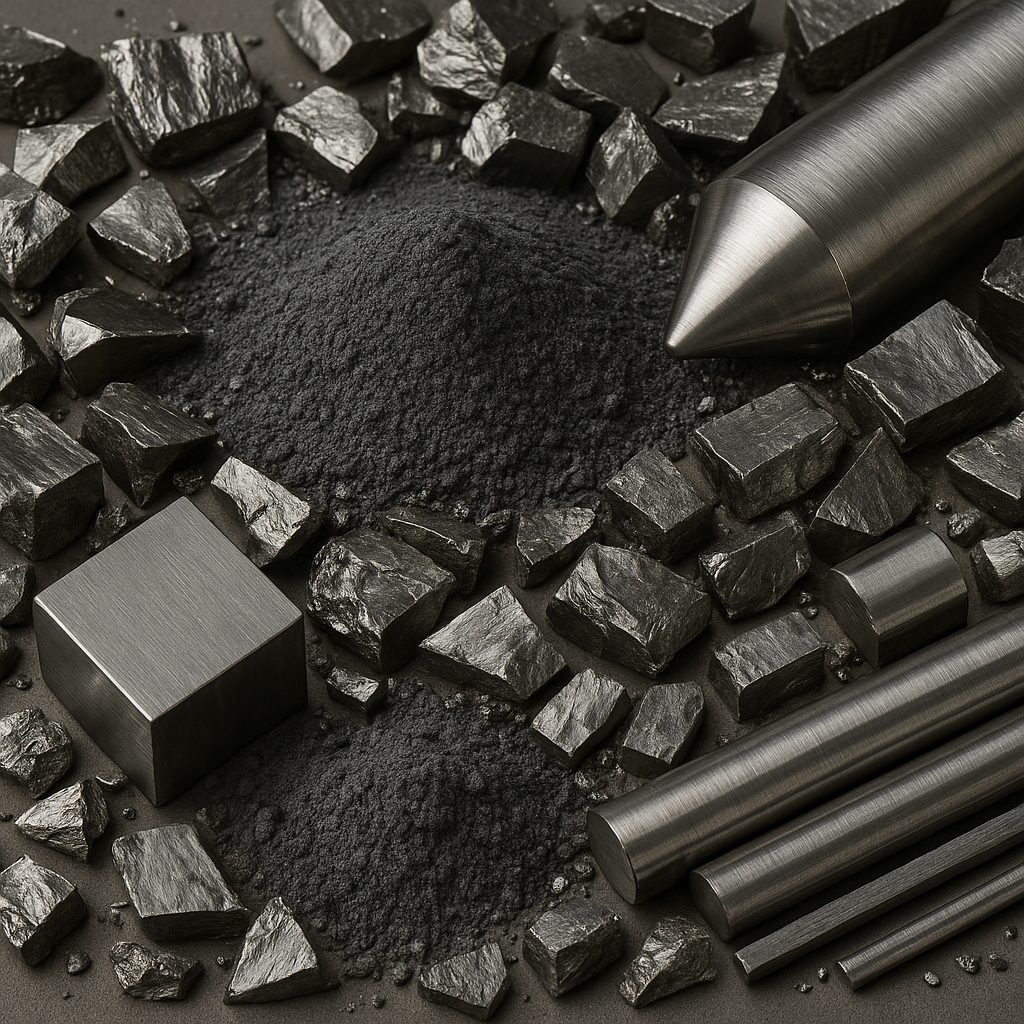
Tantalum is a rare transition metal, used sparingly in watchmaking for its exceptional properties of corrosion resistance, high density, and non-magnetic character. Its naturally dark bluish-gray hue and matte appearance give it a distinctive aesthetic identity, particularly appreciated in certain high-end watchmaking creations.
Despite its qualities, its use remains anecdotal due to the difficulty of machining and its complex implementation, which require specific tools and advanced expertise.
3. Specific characteristics
Tantalum is known for:
- Its machining difficulty (material that is “sticky” to the tool)
- Its tendency to work-harden during deformation
- Its sensitivity to cutting conditions
- Its resistance to plastic deformation
These constraints explain its limited use in industrial production.
4. Treatments and finishes
Tantalum is generally used without surface treatment, in order to preserve:
- Its natural bluish-grey tone
- Its slightly matte appearance
Possible finishes:
Tantalum is very difficult to polish, and the result obtained is rarely of good quality, which is why the two finishes mentioned above are generally preferred instead.
This page has been automatically translated from the French reference version using an artificial intelligence tool. Errors or inaccuracies may remain. If you notice any, especially if this is your native language, please feel free to report them to info@horopedia.org. Your contribution helps us improve the quality of the encyclopedia.
While awaiting their translation, images and videos remain temporarily displayed in French.
Thank you for your understanding.