
MENU
1. Table of Copper’s Main Properties
| Property | Typical Value | Remarks |
|---|---|---|
| Mass density | ~8.9 g/cm³ | High |
| Modulus of elasticity (E) | ~110–130 GPa | Moderate |
| Tensile strength | ~200–400 MPa | |
| Hardness (HV) | ~50–120 HV | Low |
| Thermal conductivity | ~380–400 W/m·K | Very high |
| Electrical conductivity | ~58–60 MS/m | Very high |
| Thermal expansion | ~16–17 ×10⁻⁶ /K | Moderate |
| Melting point | ~1085 °C | |
| Magnetism | No | Non-magnetic |
| Corrosion resistance | Good | Patina |
| Machinability | Good |
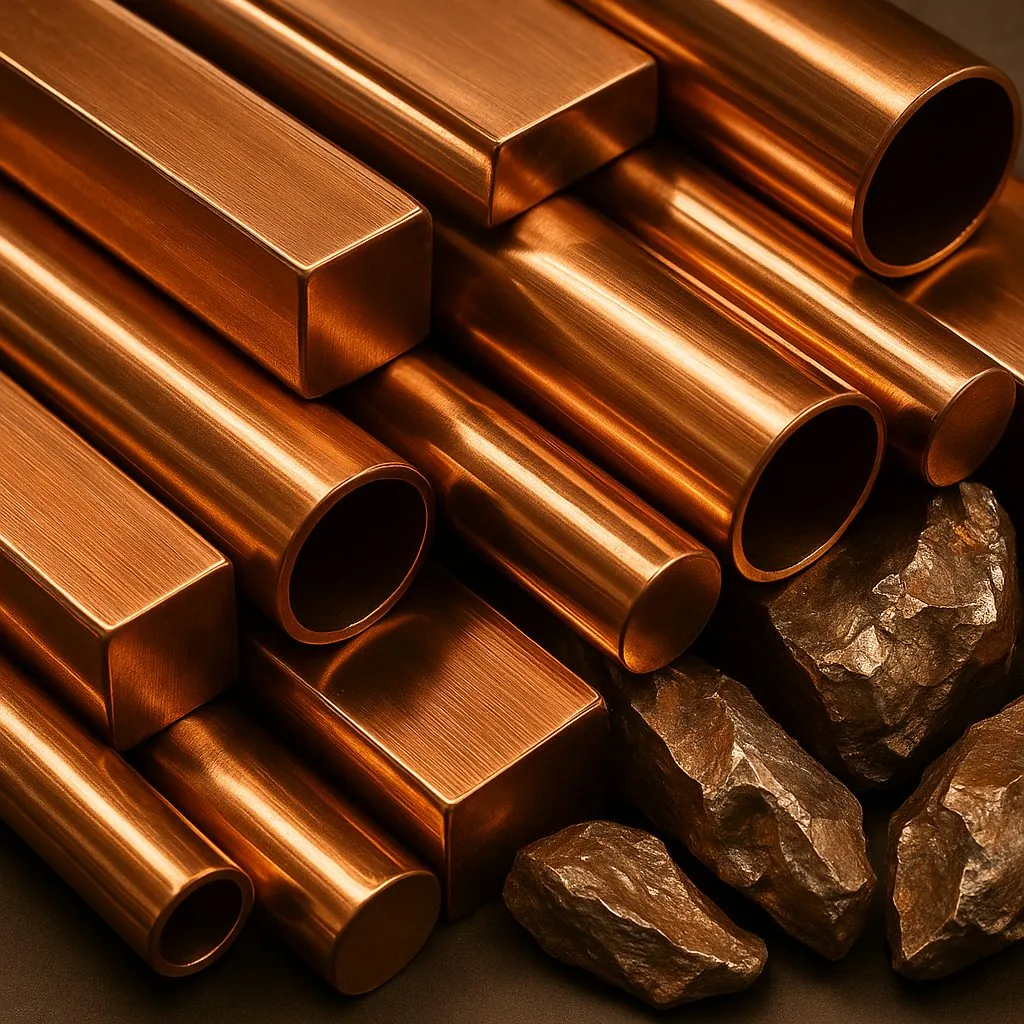
2. General description
Copper is a non-ferrous metal widely used in watchmaking, mainly as a constituent element of alloys (brasses, bronzes, German silvers) and, more rarely, in near-pure form for certain specific applications. With excellent thermal and electrical conductivity, high ductility and good workability, it has historically played a fundamental role in the development of watchmaking materials.
Today, its direct use is almost exclusively limited to dials, due to its low mechanical strength and sensitivity to oxidation. It remains, however, omnipresent in many alloys used for manufacturing movements.
3. Forms of use in watchmaking
Pure Copper
Used in a limited way in modern watchmaking.
Applications:
- Dials (often as a base)
Characteristics:
- Easy to work with
- Warm appearance (reddish-orange colour)
- Sensitive to oxidation (formation of patina)
Copper in alloys
Copper is the main element of many watchmaking Materials:
- Brass (Cu-Zn) → plates, bridges
- Bronze (Cu-Sn) → specific components
- German silver (Cu-Ni-Zn) → Movements high-end
It provides:
- Ductility
- Machinability
- Stability
4. Surface treatments
As copper is sensitive to oxidation, it is generally treated:
- Galvanisation (gilding, rhodium plating, nickel plating)
- Varnishing or painting (dials)
- Vapour deposition (PVD / CVD)
- Controlled patinas (aesthetic, mainly in clockmaking)
These treatments help stabilise the appearance and improve durability.
5. Watchmaking applications
Today, copper is mainly used for:
- Dials (base before treatment)
- Some decorative components (mainly in clockmaking)
- Technical alloys of the Movement
Its direct structural use is very limited.
6. Advantages and limitations
Advantages
- Excellent conductivity
- Very great ease of shaping
- Warm aesthetic
- Non-magnetic
- Essential base of watchmaking alloys
Limitations
- Low mechanical strength
- Sensitivity to oxidation (tarnishing, patina)
- Poor wear resistance
- Not very suitable for functional components
- Limited direct use in modern watchmaking
This page was automatically translated from the reference French version using an artificial intelligence tool. Errors or inaccuracies may remain. If you notice any, especially if this is your native language, please feel free to report them to info@horopedia.org. Your contribution helps us improve the quality of the encyclopedia.
Pending their translation, images and videos remain temporarily displayed in French.
Thank you for your understanding.