
WATER RESISTANCE TESTING DEVICES
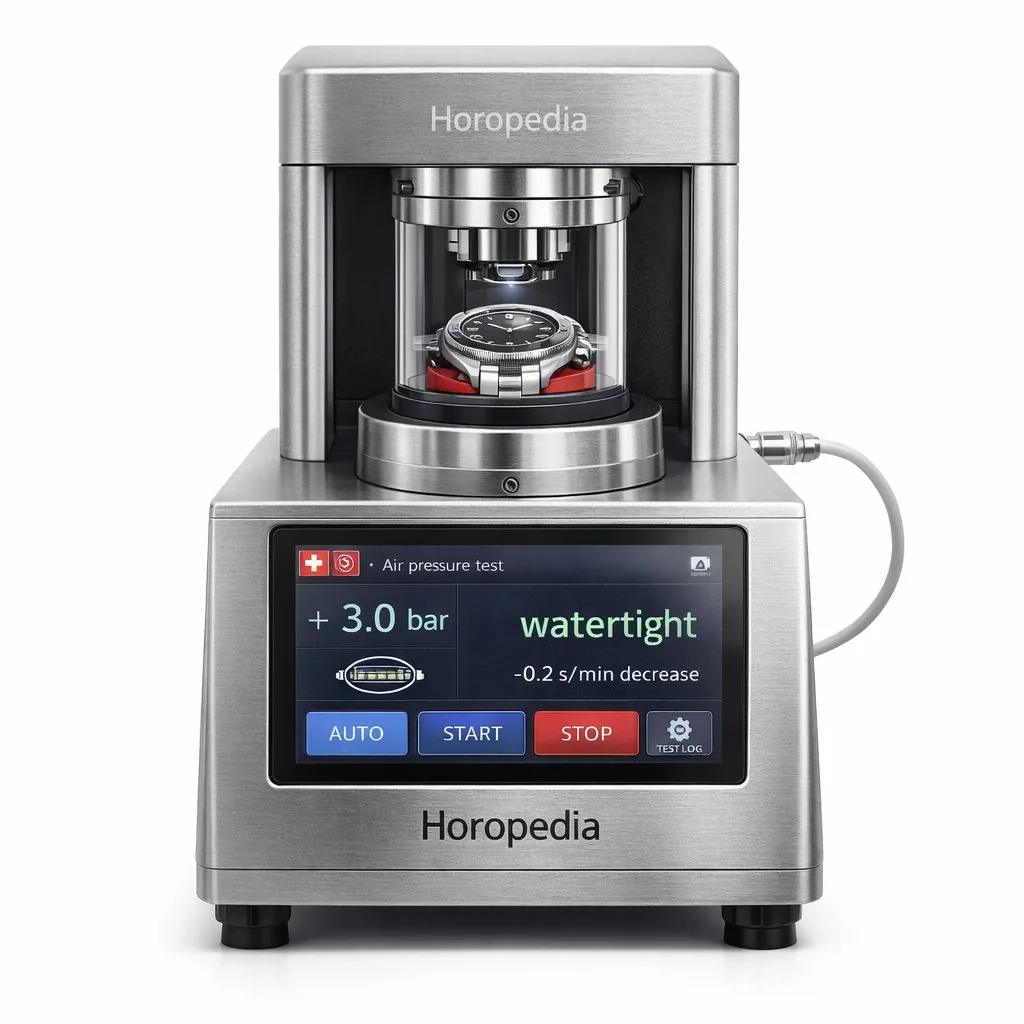
Air testing device
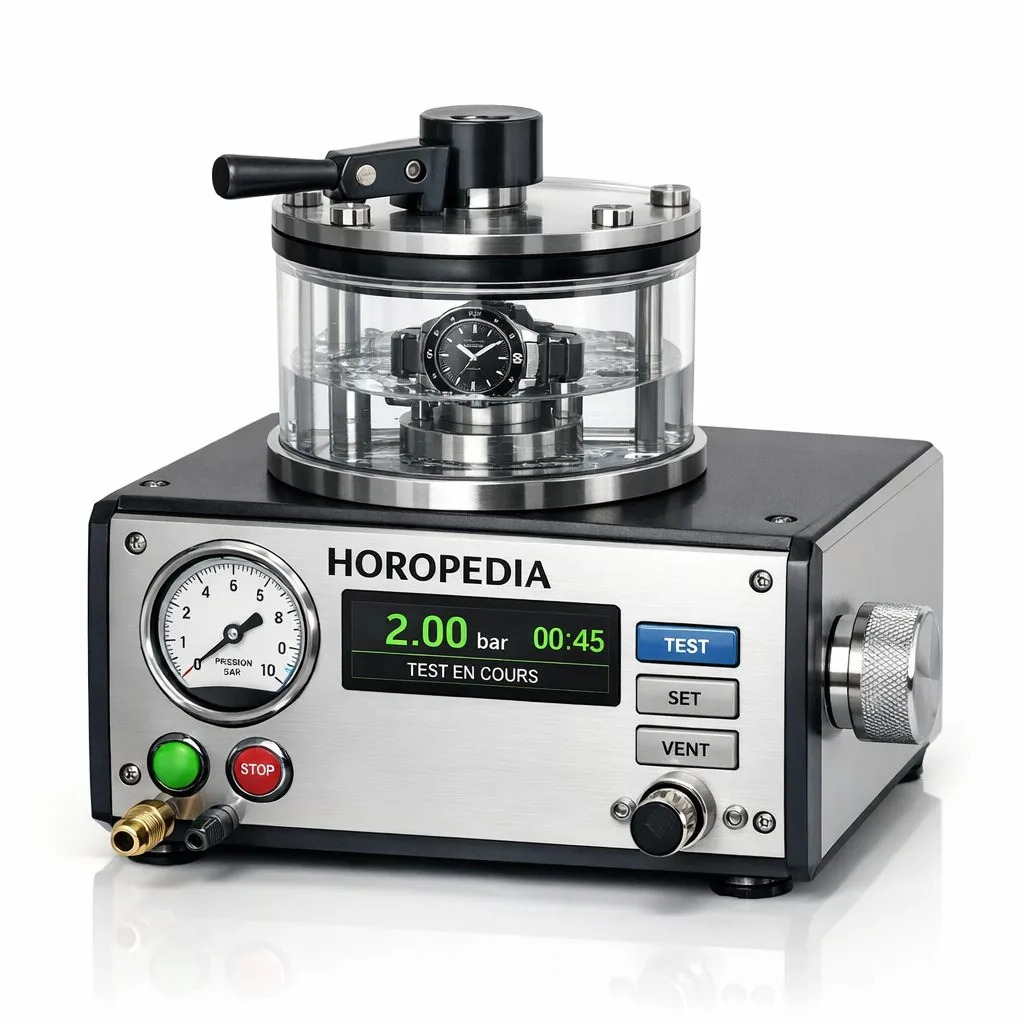
Water testing device
What are water resistance testing devices used for?
Water resistance is an essential feature to guarantee the protection of watches against infiltrations of air, moisture, or water, which could compromise their operation and durability. Water resistance testing devices, essential in the watchmaking industry, make it possible to verify the resistance of watches to the various pressures and conditions to which they are exposed.
Air water resistance testing
The air water resistance test aims to detect leaks likely to let moisture or fine particles in.
Operating principles
-
Vacuum test
The watch is placed in an airtight chamber where the air pressure is reduced. If the watch leaks, its case slightly deforms due to the pressure difference, which is detected by sensitive sensors. This test is non-destructive and suited to sensitive and complex watches. It is suitable for low pressures. -
Air overpressure test
In this test, the watch is subjected to an air pressure higher than normal. A probe detects any abnormal variation in volume or any air leak, which indicates a water resistance defect. It is suited to the highest pressures.
These tests ensure that the case elements, gaskets, and crowns are perfectly in place and sufficiently compressed to protect the internal components against atmospheric attacks.
Air tests generally do not make it possible to determine the origin of the leak.
Water resistance testing
Water resistance is a common requirement, particularly for sports or diving watches. The test must verify that the watch withstands a pressure equivalent to the immersion depth announced by the manufacturer.
Common methods
-
Test by immersion under water pressure
The watch is immersed in a water bath, in an airtight chamber where the pressure is gradually increased according to the depth to be tested (for example: 30 meters, 100 meters, etc.). The appearance of air bubbles or condensation inside the case is then observed, indicating a leak. -
Test by air overpressure followed by leak detection through immersion
Alternatively, the watch is first subjected to high air pressure, then immersed in a water tank. The presence of escaping air bubbles reveals a leak. -
Test by ultrasonic tester or by deformation measurement
Some modern devices use ultrasound to detect water resistance defects that are invisible and not apparent through conventional immersion.
Water tests generally make it possible to determine the origin of the leak.
Importance and standards
Water resistance tests must comply with international standards, such as ISO 22810 for daily-use water-resistant watches or ISO 6425 for diving watches. These standards define water resistance levels, testing methods, and success criteria to ensure performance.
This page was automatically translated from the French reference version using an artificial intelligence tool. Errors or inaccuracies may remain. If you notice any, especially if this is your native language, please feel free to report them to info@horopedia.org. Your contribution helps us improve the quality of the encyclopedia.
Pending their translation, images and videos remain temporarily displayed in French.
Thank you for your understanding.