
SILVER
Table of main properties of silver
| Property | Typical Value | Remarks |
|---|---|---|
| Density | ~10.5 g/cm³ | High |
| Young’s modulus (E) | ~80–85 GPa | Moderate |
| Tensile strength | ~150–300 MPa | Depends on alloy |
| Hardness (HV) | ~25–100 HV | Low |
| Thermal conductivity | ~400–430 W/m·K | Very high |
| Electrical conductivity | ~60–63 MS/m | Highest among metals |
| Thermal expansion | ~18–20 ×10⁻⁶ /K | Moderate |
| Melting point | ~961 °C | Pure silver |
| Magnetism | No | Non-magnetic |
| Corrosion resistance | Moderate | Tarnishes |
| Machinability | Good | Soft |
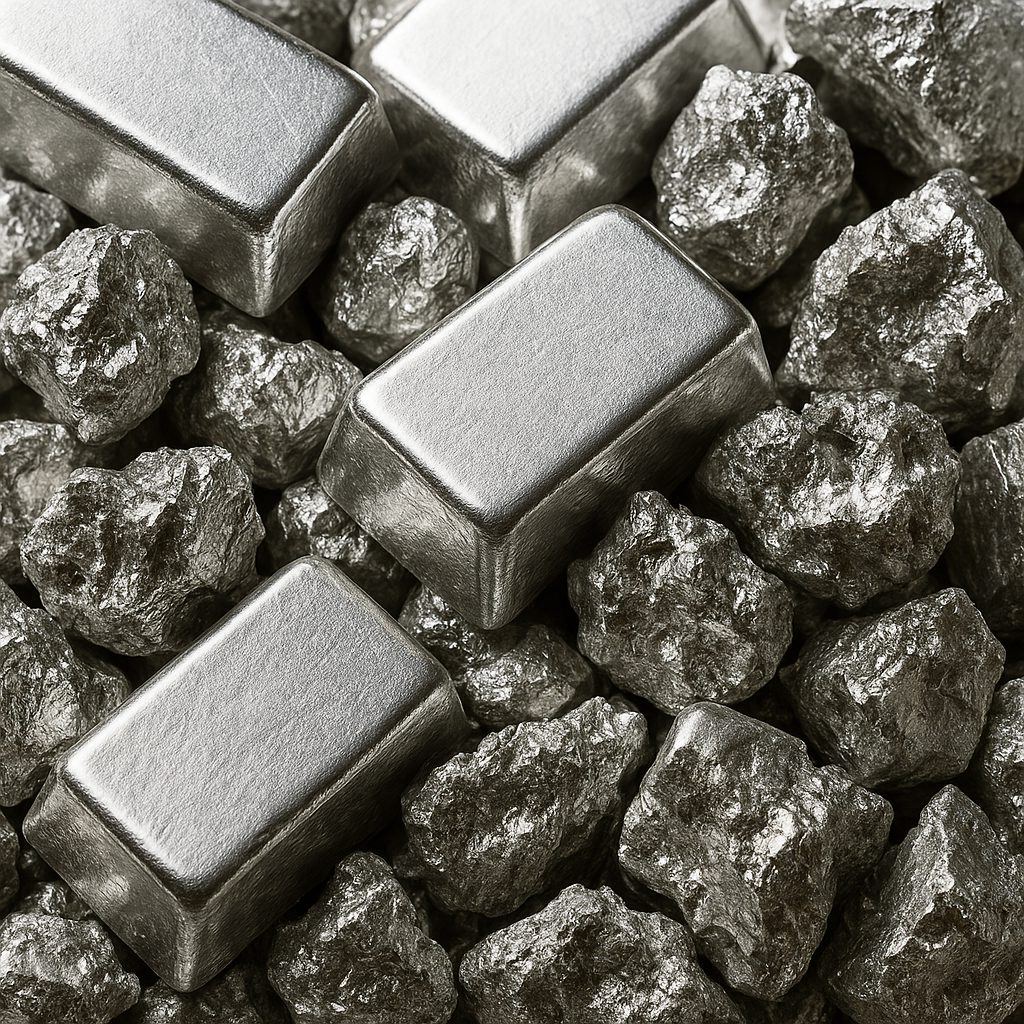
- General description
- Types of silver used in watchmaking
- Surface treatments
- Watchmaking applications
- Advantages and limitations
Silver is a precious metal that has been used in watchmaking since its earliest days, particularly for the production of visible and decorative components. With its excellent thermal and electrical conductivity, good ductility, and ease of forming, it historically played an important role in watch manufacturing.
Today, its use has become very limited, mainly due to its sensitivity to oxidation (tarnishing) and its lower mechanical properties compared to more modern materials. It nevertheless remains present in certain specific applications, as well as in artisanal and historical pieces.
Main Properties
Silver exhibits several notable characteristics:
- Very high thermal and electrical conductivity → the highest among metals
- Excellent ductility and malleability
- Good corrosion resistance, but sensitive to sulfur (tarnishing)
- Moderate Young’s modulus (~80 GPa)
- Non-magnetic material
- Excellent finishing capability (polishing, engraving, engine-turning)
1. Pure Silver (Ag 999)
Historically used but rarely employed today due to its low mechanical strength.
Characteristics:
- Very ductile
- Easy to work
- Low hardness
2. Alloyed Silver (925 Silver / Sterling Silver)
Silver is generally alloyed with copper to improve its mechanical strength.
Composition:
- 92.5% silver
- 7.5% copper
Applications:
- Watch cases (historically)
- Dials
Due to its sensitivity to tarnishing, silver is often treated:
- Rhodium plating → protection and bright white appearance
- Gold plating → protection and aesthetic enhancement (colour)
- Passivation → limits oxidation
These treatments help improve its long-term stability.
Historically, silver was used for:
- Watch cases
- Dials
- Decorative components
Today, its applications are more limited:
- Artisanal or historical pieces
- Specific aesthetic elements
- High-end dials (guilloché)
Advantages
- Excellent conductivity
- Very good formability
- High-quality aesthetic finishing
- Noble and historical material
- Non-magnetic
Limitations
- Sensitivity to tarnishing (sulfidation)
- Low hardness and mechanical strength
- High cost
- Limited suitability for modern constraints