

Hairspring stiffness
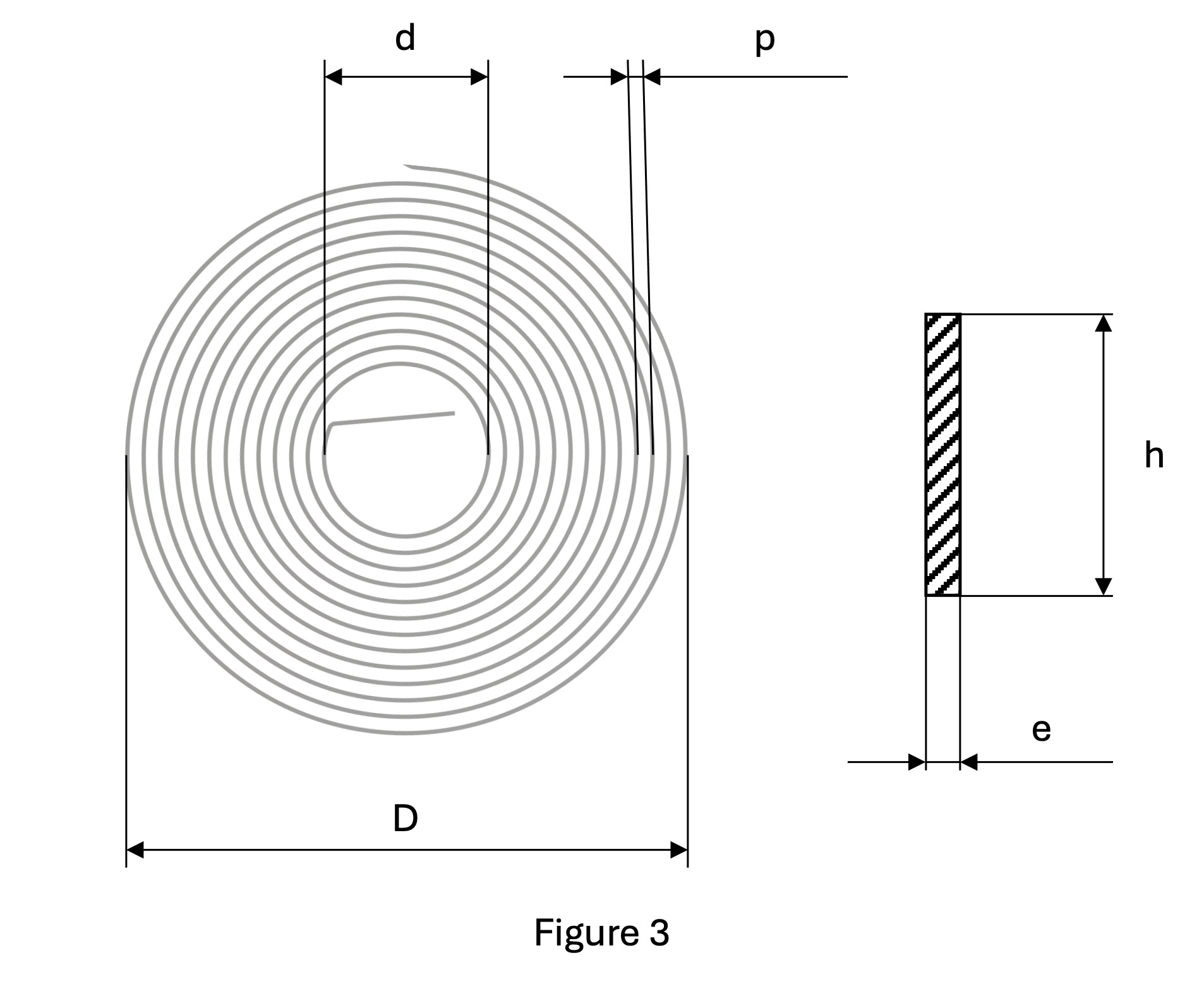
C = Elastic constant of the hairspring (N·mm/rad)
E = Elastic modulus of the strip (MPa)
h = Height of the hairspring (mm)
e = Thickness of the hairspring (mm)
L = Length of the hairspring (mm)

Proportionality factor
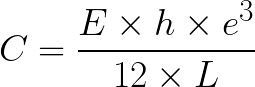
This is the ratio between the outer diameter of the hairspring and the diameter of the balance wheel. It depends on the frequency of the regulating organ. When replacing a hairspring, this factor makes it possible to calculate the CGS number of the hairspring based on a trial hairspring.
 = Outer diameter of the hairspring (mm)
 = Diameter of the balance wheel (mm)
 = Proportionality factor
Calculation of the CGS number from a trial hairspring
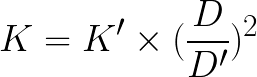
The following formula makes it possible to determine an approximate CGS number of an unknown hairspring based on the known CGS number of a trial hairspring and its outer diameter measured after counting. The required hairspring diameter depends on the balance wheel diameter and the proportionality factor (see above).
K = CGS number of the unknown hairspring (N·mm³/rad)
K′ = CGS number of the trial hairspring (N·mm³/rad)
D = Required outer diameter of the hairspring (mm)
D′ = Diameter of the trial hairspring at the counting point (mm)
Variation of the hairspring length as a function of the daily rate
ΔL = Variation of the hairspring length as a function of the daily rate (mm) = Hairspring length at the counting point (mm)
μ = Daily rate (s/day)

In 1675, Christiaan Huygens, who had discovered the theory of the pendulum (isochronism) twenty years earlier—probably aided by the preliminary work of Abbé de Hautefeuille in France and Dr. Robert Hooke in England—had the first watch regulated by a balance spring made. Portable clocks (travel clocks), navigation timekeepers (marine chronometers), and watches could then exist, providing mechanical watchmaking with the foundations of its technical principles. These principles have continually been improved through knowledge and technological advances but remain fundamentally unchanged to this day.
Watchmakers adopted Huygens’ principle and quickly realized that the influence of temperature variations and poise (concentric development of the hairspring) was significant. In 1766, John Harrison devised a thermal compensation system. A bimetallic strip controlled the index regulator’s movement to correct the active length of the hairspring as it expanded or contracted. Prestigious watchmakers such as Ferdinand Berthoud, Pierre Le Roy, and A.-L. Breguet refined Harrison’s work or developed their own thermal compensation solutions (bimetallic balances, etc.). In 1782, John Arnold patented a cylindrical hairspring. Unlike Huygens’ flat hairspring, it develops concentrically to the balance axis. This type of hairspring provides exceptional chronometry, particularly when paired with a detent escapement. Chronometry, navigation, and thus exploration greatly benefited from this true revolution. However, the cylindrical hairspring requires far more manufacturing steps and expertise than a flat hairspring and demands a volume that can significantly increase movement thickness. This is why its use in portable watches is limited to a few exceptional timepieces.
It was not until 1919 that Charles-Édouard Guillaume, who had invented Invar twenty-five years earlier, developed Elinvar (elastic and invariable). This alloy revolutionized hairsprings thanks to its low thermal expansion coefficient, ideal elastic modulus, and low sensitivity to magnetic fields. Together with his work on Invar, it earned Guillaume the Nobel Prize in Physics in 1920 and it remains the alloy used in the traditional manufacture of hairsprings.
Since 2000, the application of DRIE silicon production technology has revolutionized the world of hairsprings. This manufacturing method requires advanced and costly technology, but the process itself is relatively straightforward to master and allows high-quality mass production. The material (silicon) offers excellent elasticity, is non-magnetic, and has remarkable resistance to wear and corrosion. This production method has been experiencing continuous growth ever since.
Emerging in watchmaking since the year 2000, silicon has truly revolutionized the production of many components, especially the hairspring. While the production technology is complex, the process requires much less expertise and often involves only one automated step. This method is used for the fabrication of integrated circuits. The principle involves cutting a silicon wafer to a given thickness (generally that of the finished component) using a photolithographic process. This method can achieve the most complex profiles with precision reaching the micron. Depending on the size of the components to be produced, several hundred pieces can be made simultaneously on the same substrate wafer. The most complex profiles can be obtained without the drawback of the radii of a milling tool or even the wire of an EDM machine. This process exerts no mechanical stress, allowing for the creation of very thin components (springs, etc.) or perforating them to reduce weight. Silicon is harder than steel, has an excellent elasticity module, and is non-magnetic. Advances in this technology and its success make it increasingly attractive in terms of production costs and tend to become widespread for the production of many components (especially for the escapement and regulating organ).