
THE MICROMETRIC STAKE FOR DRIVING IN JEWELS
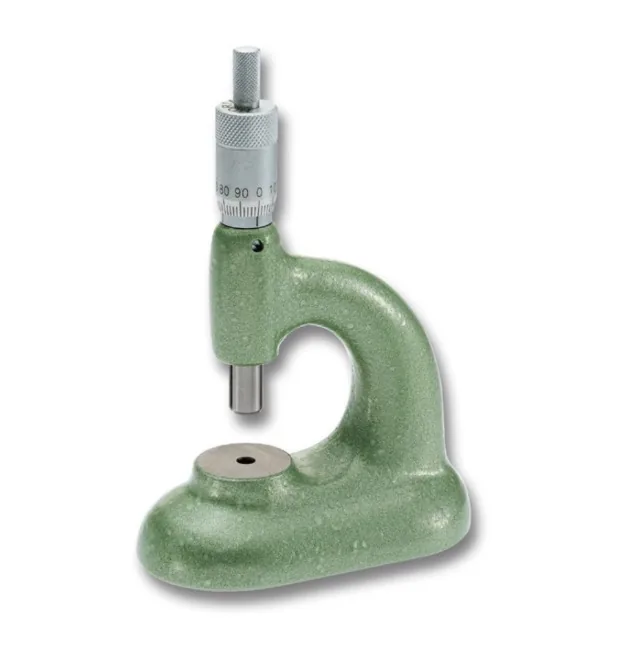
What is a micrometric stake?
The micrometric stake for driving in jewels refers to the bench tool intended for the setting, removal, and depth adjustment of watch jewels as well as bushings. The widespread jeweling of main plates and bridges, and even more so the requirement for a precise measurement of the axial set of the Axis — the height Shake (play) — led to the development of a press allowing both a perfectly vertical movement and micrometric control of the stroke. This equipment has since become an essential step in any careful jeweling work, whether it involves replacing a bearing or production work.
Construction
The instrument consists of a vertical frame made of machined Metal or Smelting, extended by a column on which a micrometric Screw head is mounted. The Screw controls, via a slide guided without Set, the descent of a punch-holder receiving the driving-in stake. At the base of the frame, a milled support tablet to receive the support stake on which rests the Main plate or Bridge to be jeweled. The stakes are supplied in complete Sets, comprising several dozen pieces paired by diameter: the active face of the driving-in stake comes to rest at the center of the stone, via a polished bearing surface. The center of the driving-in stake features a pump pivot whose diameter corresponds to that of the stone’s hole. This pump pivot allows the stone to be perfectly centered and ensures it is driven in perfectly straight. The lower stake receives the Main plate without stressing the stone already in place on the other side.
Usage
The driving-in operation consists of introducing the stone into its seat, then progressively lowering the driving-in block until contact and centering of the stone are achieved. The rotation of the micrometric screw then pushes the stone into its reaming, to the exact depth controlled by the tool’s travel. This depth directly determines the shake (play) of the pivot of the corresponding wheel: too shallow, it prevents the free operation of the train; too deep, it creates a risk of poor division (wheel-train height layout) between the wheels. The precision of the micrometric adjustment allows the horologist (watchmaker) to place the stone at the nominal dimension, then to correct it if needed through successive very short movements. Removal is performed according to the same principle, although one generally wants to move the stone in the same direction (from the inside to the outside).
This page has been automatically translated from the French reference version using an artificial intelligence tool. Errors or inaccuracies may remain. If you notice any, especially if this is your native language, please feel free to report them to info@horopedia.org. Your contribution helps us improve the quality of the encyclopedia.
While awaiting their translation, images and videos remain temporarily displayed in French.
Thank you for your understanding.