
MENU
Figure 1
Exploded view of the regulating organ
Click on the animation to enlarge it
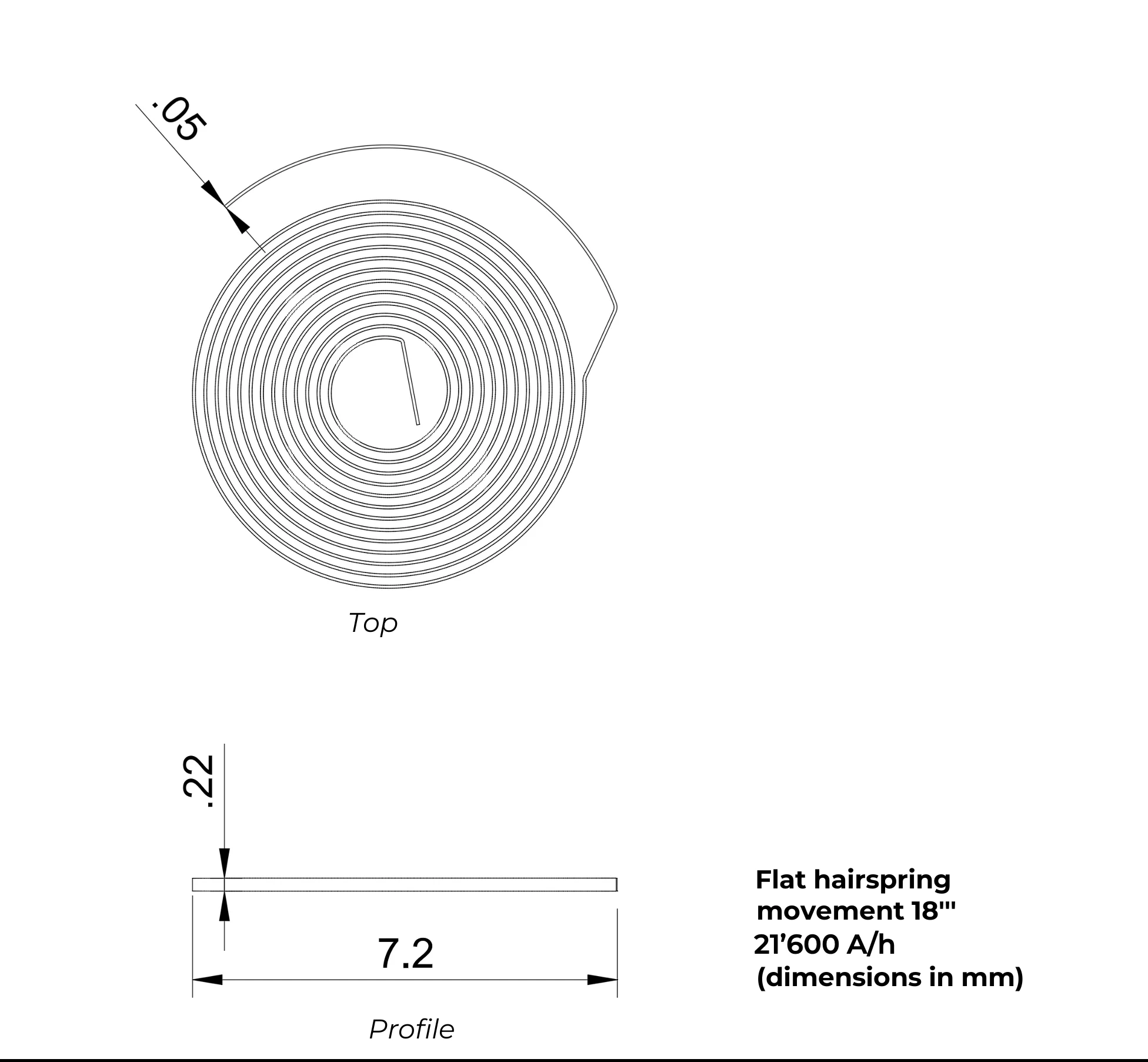
Figure 2
Diagram of a flat hairspring
Click on the thumbnail to enlarge it
1. General description
The hairspring is a metal, silicon, or even carbon nanotube blade with a rectangular cross-section. It is wound onto itself in a spiral shape and generally has between 12 and 15 turns (Figure 2). Combined with the balance, it forms the regulating organ of mechanical watches.
2. Role of the hairspring
The hairspring has the same function on the balance of a watch, as gravity does on the pendulum of a clock. Their role is to constantly bring the oscillator (balance or pendulum) back to the middle point of each of its vibrations: the dead point (so named because it is the position occupied by the oscillator when it no longer receives energy and stops). The central end of the hairspring is attached to the balance staff by means of a collet (moving part). The peripheral end of the hairspring is attached to the balance cock by means of a stud (hairspring stud) (fixed point).
When the pallets (lever) transmits its impulse to the balance, the latter begins its free vibration. The hairspring (balance spring) develops in contraction, slows the balance until it stops it and brings it back to the dead point. The balance then receives an impulse that launches an opposite vibration. The hairspring (balance spring) then develops in extension and also brings the balance back to the dead point.
It is the hairspring (balance spring) that bears the responsibility for precision. Whether the energy of the impulses transmitted to the balance is maximal or minimal and whatever the angle traveled by the balance (amplitude), each vibration must have exactly the same duration (period). This is isochronism. The active length of the hairspring (balance spring) determines the precision of the regulation/adjustment of the watch. If the hairspring (balance spring) is too short, the watch runs fast; if it is too long, the watch runs slow.
3. Constructions and materials
Watches being equipped with a regulator make it possible to modify the active length of the hairspring (balance spring), determined in this case by the position of the two regulator pins. Since the hairspring (balance spring) does not develop in a perfectly concentric manner around the balance staff, it creates, in vertical positions, detrimental balance defects. In light of this observation, some watchmakers came up with the idea of modifying the outer coil of the hairspring (balance spring). By raising it, bringing it back above the horizontal plane of the hairspring (balance spring). By attaching it in this position to the balance cock, the concentricity of the hairspring (balance spring) is considerably improved when it is working (Breguet terminal curve, Philips terminal curve). Cylindrical (helical) hairsprings, spherical with double terminal curve allow an almost concentric development of the hairspring (balance spring). Their complex manufacture and the space they require limit their applications in wristwatches to a few exceptional watches (Figure 3).
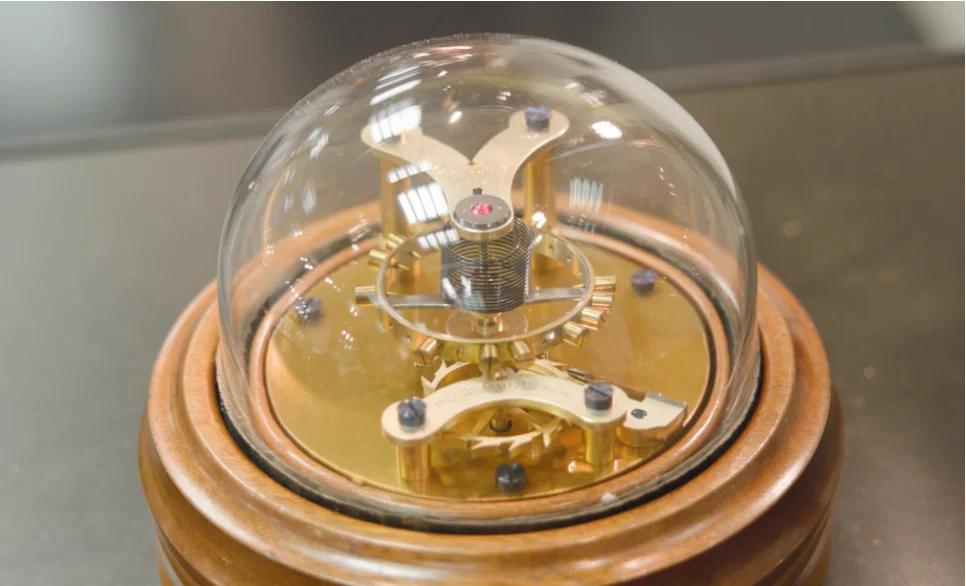
Figure 3
Model of detent escapement with cylindrical hairspring (balance spring)
Click on the thumbnail to enlarge it
Traditionally, hairsprings are made from an alloy called Elinvar. This alloy, invented in 1920 by Charles-Édouard Guillaume, has the advantage of an excellent modulus of elasticity, a low coefficient of thermal expansion and a relative resistance to the influence of magnetic fields (compared to conventional steels). The manufacture of Elinvar hairsprings requires great know-how and demands very high precision. Thus only about ten firms master its manufacture (see industrial method tab below).
Emerging in the early 2000s, silicon hairsprings offer the advantage of a better modulus of elasticity than steel and are completely non-magnetic. Their production cost is low and their manufacturing technology allows for unprecedented profiles. However, they are very brittle and any correction of their shape is impossible (see hi-tech method tab below). The use of silicon hairsprings tends to become widespread today.
4. Characteristics and calculations
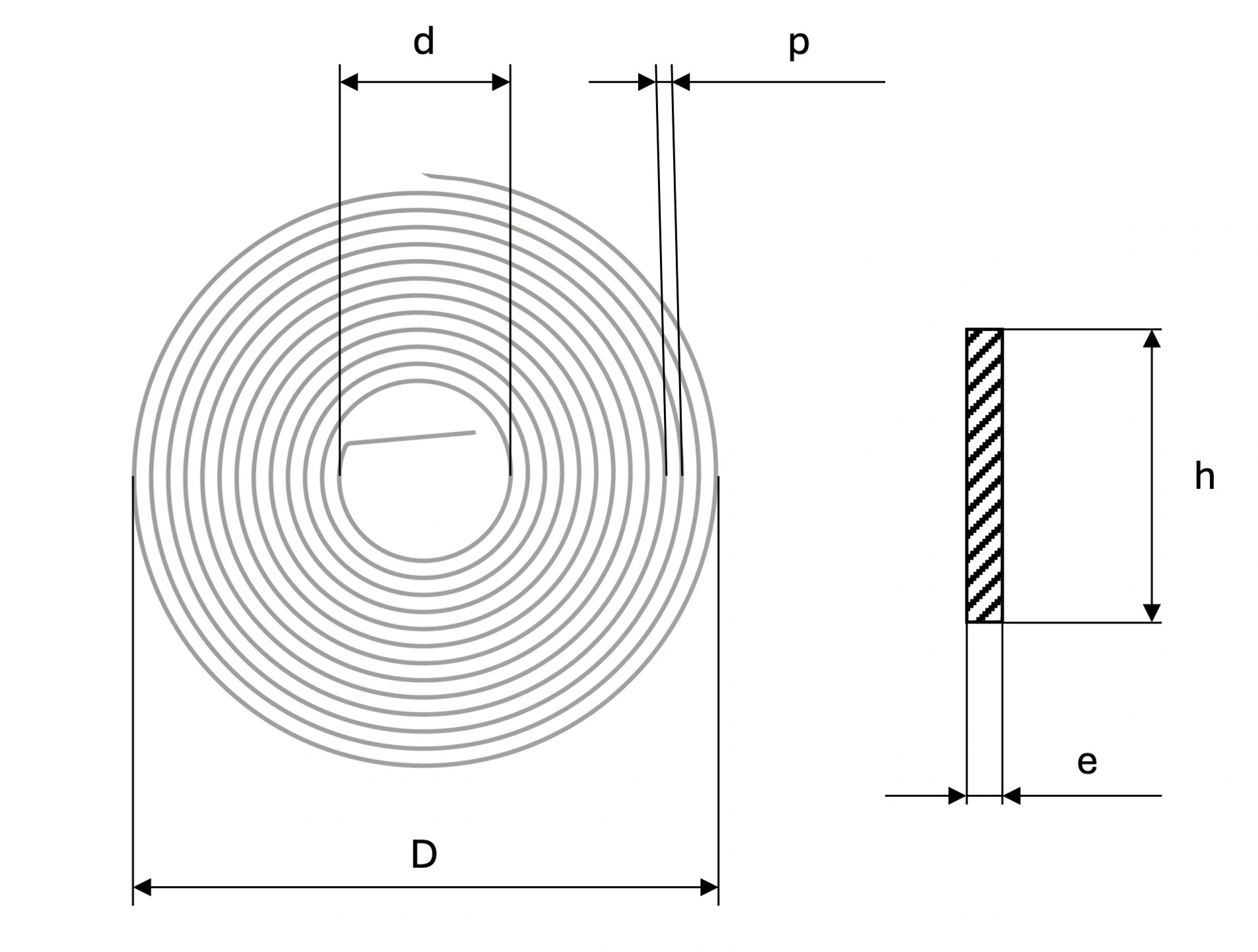
Figure 4
Click on the thumbnail to enlarge it
Stiffness (spring rate) of the hairspring
C= Elastic constant of the hairspring (N×mm/rad)
E= Modulus of elasticity of the blade (MPa)
h= Height of the hairspring (mm)
e= Thickness of the hairspring (mm)
L= Length of the hairspring (mm)
CGS number of the hairspring
the CGS number of a hairspring is a standardized reference that characterizes the mechanical properties of the hairspring, in order to allow its selection and replacement in a consistent manner.
K= Calculated CGS number (N×mm³/rad)
C= Elastic constant of the hairspring (N×mm/rad)
D= Outer diameter of the hairspring (balance spring) (mm)
d= Inner diameter of the hairspring (balance spring) (∅ of the collet) (mm)
p= Pitch (mm)


Proportionality factor
This is the ratio between the outer diameter of the hairspring (balance spring) and the diameter of the balance. It depends on the frequency of the regulating organ. When replacing a hairspring (balance spring), this factor allows the CGS number of the hairspring (balance spring) to be calculated from a test hairspring (balance spring).
 = Outer diameter of the hairspring (balance spring) (mm)
 = Diameter of the balance (mm)
 = Proportionality factor

Calculation of the CGS number from a test hairspring (balance spring)
The following formula allows determining an approximate value of the CGS number of an unknown hairspring (balance spring) from the known CGS number of a test hairspring (balance spring) and its outer diameter determined after counting (cf. regulation/adjustment). The diameter of the hairspring (balance spring) to be obtained depends on the diameter of the balance and the proportionality factor (cf. above).
K= CGS number of the unknown hairspring (balance spring) (N×mm³/rad)
K’= CGS number of the test hairspring (balance spring) (N×mm³/rad)
D= Outer diameter of the hairspring (balance spring) to be obtained (mm)
D’= Diameter of the test hairspring (balance spring) at the counting point (mm)

Variation of the hairspring (balance spring) length according to the daily rate
 = Variation of the hairspring (balance spring) length according to the daily rate (mm)
 = Length of the hairspring (balance spring) at the counting point (mm)
 = Daily rate (s/day)

5. History
In 1675, Christian Huygens, who had discovered the theory of the pendulum (isochronism) twenty years earlier, probably aided by the preliminary work of Abbé de Hautefeuille in France and Doctor Robert Hooke in England, had the first watch regulated by a balance-hairspring made. Portable clocks (travel clocks), navigation instruments (marine chronometers), and watches could henceforth exist and give mechanical horology the foundations of its technical principles. Principles that have continued to be improved since then through knowledge and technological developments, but which remain unchanged in their foundations to this day.
Watchmakers adopted Huygens’ principle and quickly became aware that the influence of thermal variations and balance (concentric development of the hairspring) is significant. In 1766, John Harrison devised a thermal compensation system. A bimetallic blade controls the movements of the regulator in order to correct the active length of the hairspring as it expands or contracts. Watchmakers as prestigious as Ferdinand Berthoud, Pierre Le Roy or A.-L. Breguet would refine Harrison’s work or devise their own thermal compensation solutions (bimetallic balance, etc.). In 1782, John Arnold filed a patent for a cylindrical hairspring. This one develops concentrically around the balance staff, unlike Huygens’ flat hairspring. This type of hairspring makes it possible to achieve exceptional chronometry, particularly when combined with a detent escapement. Chronometry, navigation and thus exploration will benefit from this true revolution. The cylindrical hairspring (balance spring) requires far more manufacturing steps and expertise than a flat hairspring (balance spring) and requires a volume that can significantly impair the thickness of a movement. This is why its use in wristwatches is limited to a few exceptional watches.
It was not until 1919 that Charles-Édouard Guillaume, who had invented Invar twenty-five years earlier, developed Elinvar (elastic and invariable). This alloy would revolutionize hairsprings (balance springs) through its low coefficient of thermal expansion, an ideal modulus of elasticity and low sensitivity to magnetic fields. Along with his work on Invar, it would earn Guillaume the Nobel Prize in Physics in 1920, and it remains the alloy used in the traditional manufacture of hairsprings (balance springs).
Since 2000, the application of production technology deep reactive ion etching (DRIE) of silicon has revolutionized the world of hairsprings. Their production method requires expensive advanced technologies, but its process is simple to master. It allows for qualitative production at large volumes. Finally, the material (silicon) offers excellent elasticity, is non-magnetic and shows remarkable resistance to wear and corrosion. This production method has been experiencing constant growth ever since.
6. Traditional production of a hairspring (steel)
This method uses, to this day, the alloy Elinvar invented by Ch.-E. Guillaume. This alloy, complex to produce, is used essentially by watchmaking and in negligible quantity. A handful of producers offer it at a substantial cost. Alloy producers (foundries) supply Elinvar in wire form of approximately 0.8-1 mm in diameter. The first manufacturing steps of a hairspring consist of wire-drawing this wire to reduce its diameter. The wire is drawn through successive dies, gradually smaller. The wire’s diameter decreases and its length increases. No material is therefore eliminated (machined) during these operations. Once the calculated wire diameter is reached, various rolling steps are carried out. The principle is the same as wire-drawing, but this time the wire is drawn between rollers until it is given the desired rectangular cross-section. Once the cross-section dimensions are reached, the blades can be cut to their almost final length. The spring’s shape is then given by winding several blades onto drums (coiling drums) which are subjected to various heat treatments extremely sensitive to achieve. The springs thus set into their final shape and acquire their elastic property. The length of the spring is then refined (inner and outer cutting), the outer curve is formed and its collet is fixed on the inside and its stud (hairspring stud) on the outside. Its elasticity module is then measured with a high-precision instrument, on which the inertia of the balances is also measured. This step allows an ideal balance-hairspring (balance spring) pairing for optimal chronometry. Finally, the hairspring (balance spring) can be pressed onto the balance staff of its balance, and the numerous manual steps of centering, flattening, poising and regulation/adjustment can be carried out. These steps can only be performed by hand and require exceptional dexterity.
Brands or subcontractors, only about a dozen houses master this production method. Many watchmakers and brands are therefore forced to source from them.
7. High-tech production of a hairspring (silicon)
Appearing in watchmaking as early as 2000, silicon has literally revolutionized the production of many components and the hairspring (balance spring) in particular. While the production technology (DRIE) is complex, production costs are low and allow for lasting repeatability and absolute precision. This method is the one used for manufacturing integrated circuits. The principle is to cut (etch) a silicon plate of a given thickness (generally that of the finished component) using a photo-lithographic process. This method allows the most complex profiles to be achieved with a precision reaching the micron. Depending on the size of the components to be produced, several hundred parts can be made simultaneously on the same disc (wafer). The most complex profiles can be obtained without the drawback of the radii of a milling tool or even the wire of an electrical discharge machining (EDM) machine. As this process does not exert any mechanical stress, it is possible to produce very thin components (springs, etc.) or to hollow them out to reduce their weight. Silicon is a material with a hardness greater than steel, excellent modulus of elasticity and is non-magnetic. The progress of this technology and its success make it increasingly attractive in terms of production costs and it tends to become widespread for the manufacture of numerous components (particularly for the escapement and the regulating organ).
This page was automatically translated from the French reference version using an artificial intelligence tool. Errors or inaccuracies may remain. If you notice any, especially if this is your native language, please feel free to report them to info@horopedia.org. Your contribution helps us improve the quality of the encyclopedia.
While awaiting their translation, images and videos remain temporarily displayed in French.
Thank you for your understanding.