
MENU
1. General description
The regulator assembly brings together all the components surrounding the regulating organ (balance-hairspring) that allow its regulation/adjustment to be corrected. Depending on the construction and the adjustment method chosen, the number of its components may vary. Thus, a regulator is generally not found on a movement with a terminal curve hairspring (Breguet or Philips).
Figure 1
Exploded view of a regulator assembly (with movable hairspring stud holder and swan’s neck)
Click on the animation to enlarge it
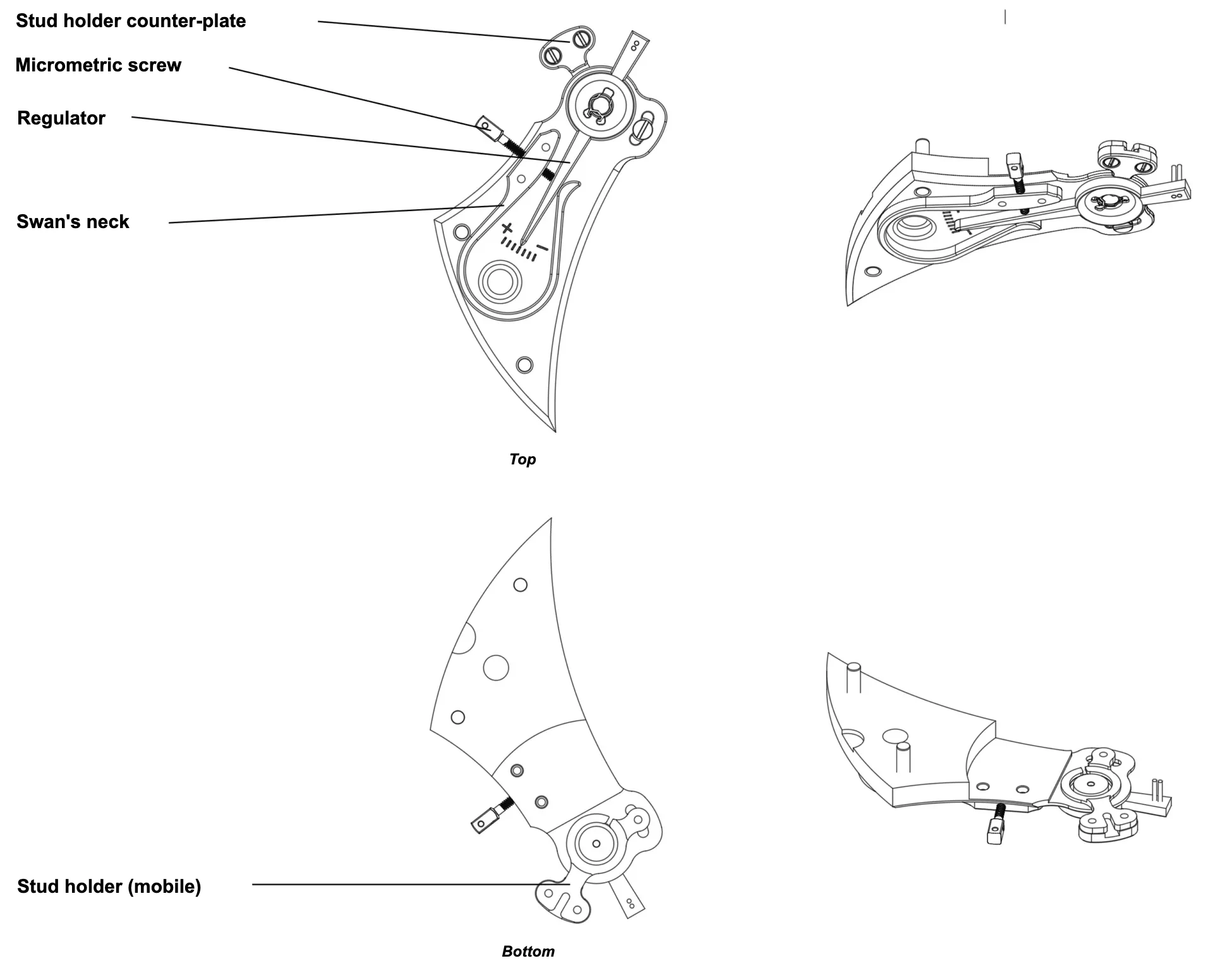
Figure 2
Diagram of an assembled regulator assembly (with movable hairspring stud holder and swan’s neck)
Click on the thumbnail to enlarge it
2. Components
Depending on its construction, the regulator assembly may include one or more of the following components:
3. History
The first components that can be linked to what we now call the “regulator assembly” logically appear with the invention of the balance hairspring (balance spring) as a regulator by Christian Huygens in 1675. However, the first watches thus regulated did not really include a regulator. It seems that the appearance of the first regulator is due to John Harrison on his famous chronometer H4 in 1759. The regulator devised by Harrison was not intended to allow an average correction of the regulation/adjustment by statically modifying the active length of the hairspring (balance spring), as is the case nowadays. Harrison, already aware of the influence of thermal variations, designed and placed the regulator of his H4 to thermally compensate for the expansion and contraction of the hairspring (balance spring). To achieve this, he built on his work on bimetallic constructions (which had already earned him the invention of the thermo-compensating bimetallic balance). The regulator pivots on a double blade made of two different metals. Through their combination, the regulator will tilt to the left when temperatures drop and to the right when they rise. Since the movements of the regulator are opposite to those of the hairspring (balance spring) (expansion-contraction), the regulator corrects the active length of the hairspring (balance spring) during temperature variations. Very complex to master, this system did not achieve great success and quickly lost its appeal as the mastery of materials and regulation/adjustment theories progressed. The regulator is nevertheless present in most watches from then until today, but in its role of statically adjusting the watch’s regulation/adjustment.
This page has been automatically translated from the French reference version using an artificial intelligence tool. Errors or inaccuracies may remain. If you notice any, especially if this is your native language, please feel free to report them to us at info@horopedia.org. Your contribution helps us improve the quality of the encyclopedia.
While awaiting their translation, images and videos remain temporarily displayed in French.
Thank you for your understanding.