
MENU
1. General description
The stud holder is an optional component regardless of the type of construction of the Movement and its regulation system. It allows the angular position of the rest point of the Balance. This position is called: the Guide mark. The stud carrier is a movable element whose axis of rotation is the center of the Balance axis. It is fixed to the Balance cock (Bridge (Balance), according to the same principle as the Regulator (loose fit via hub). The Stud (hairspring stud), itself fixed at the end of the Hairspring (balance spring), fits into and is rigidly fixed to the stud carrier. By rotating the stud carrier, the Balance is angularly displaced. The Guide mark will be reached when the watch is unwound (with no energy at all) and the Impulse pin (roller jewel) is on the line of centers of the escape wheel, the Pallets (lever), and the Balance. When the Movement does not include a stud carrier, the Stud (hairspring stud) is fixed directly to the Balance cock (Balance bridge), in a Groove milled into its plate.
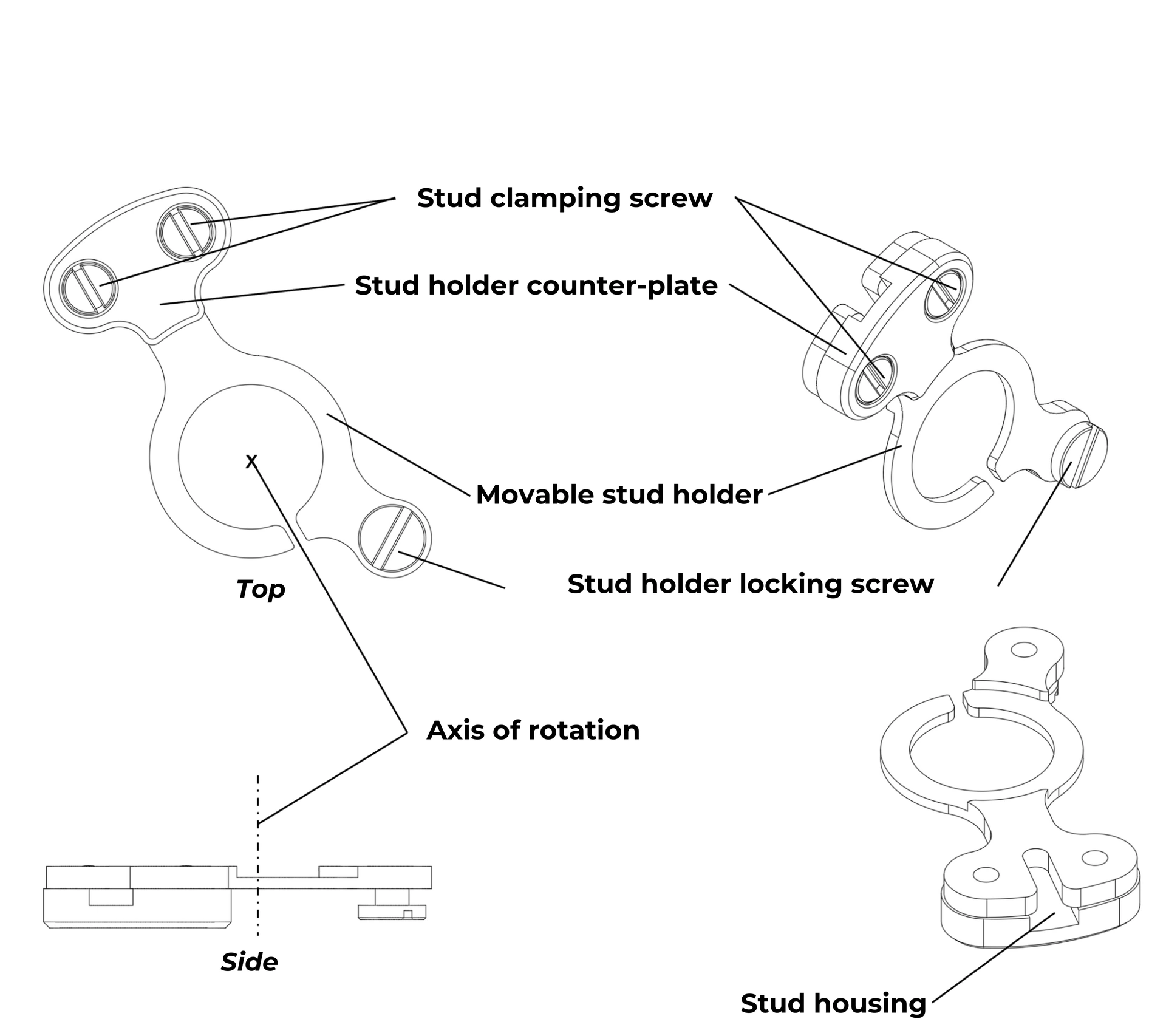
Figure 1
Diagram of a movable stud carrier
Click on the thumbnail to enlarge it
Figure 2
Correction of the guide mark by the movable stud
Click on the animation to enlarge it
2. History
The patent for the movable stud carrier, as we know it today, is the result of the work of Camille Calame in 1904. However, the earliest mention of a movable stud carrier dates back to 1889 and is the work of the German Horologist (watchmaker) Richard Lange.
3. Handcrafted manufacturing of a stud carrier
The Horologist (watchmaker) begins the handcrafted manufacturing of the stud carrier by marking and drilling the center of its rotation axis on the surface of a plate ofSteel of a thickness slightly greater than that of the finished component. He clears the heel of the stud holder using a lathe, centered on the pivot point of the stud holder. He then engraves the outline of the stud’s profile using a scriber, centering on its pivot point. Then he carefully cuts out the outline of the stud using a Piercing saw (jeweler’s saw). The sides of the piece are then filed to bring the stud to its final thickness, while strictly respecting its shape. The stud is then beveled and polished using the usual tools (files, cabrons, Polishing). According to the rules of the art, the craftsman then draws out the lines of the sides of the piece (Satin finish). It also adjusts the thickness of the Stud (hairspring stud) to regulate the friction between the Stud (hairspring stud) and its core. This friction must be light enough to allow precise adjustment of the position of the Stud (hairspring stud) and strong enough to prevent any unwanted misadjustment, particularly in the event of shocks.
4. Semi-industrial production of a Stud (hairspring stud) holder
To optimize the production costs of a single piece or a small series of components, Electrical discharge machining (EDM) proves particularly advantageous. Implementation costs and machine processing time remain relatively low and suited to small production volumes. A Milling operation for the Unlocking (drop angle) of the Balance cock (Bridge of the Balance) is then necessary. Compared to the artisanal method, cutting by Electrical discharge machining (EDM) offers a considerable time saving, with good repercussions on the Decoration. The end of the manufacturing and Decoration process depends on the craftsmanship method or the level of finishing required.
5. Industrial production of a Stud (hairspring stud) holder
Due to the relatively complex shape of the Stud (hairspring stud) holder, industrial-scale production favors manufacturing Stud (hairspring stud) holders by machining using an Automatic lathe capable of performing all machining operations in a single cycle. Finishing and Decoration will be carried out either by hand or industrially, depending on the quality sought. While this method offers the best cost/quality ratio, manufacturing Stud (hairspring stud) holders using machining centers or by Stamping is also possible.
This page has been automatically translated from the French reference version using an artificial intelligence tool. Errors or inaccuracies may remain. If you notice any, especially if this is your native language, please do not hesitate to report them to info@horopedia.org. Your contribution helps us improve the quality of the encyclopedia.
Pending their translation, images and videos remain temporarily displayed in French.
Thank you for your understanding.