
MENU
1. General information
The chronograph is a device designed to precisely measure the time elapsed between two events. Its history is marked by the influence of several visionary horologists who, through their inventions, laid the foundations of this complex mechanism that we know today.
2. Chronograph or chronometer?
There is often confusion between these two terms. The chronograph refers to a short time measurement mechanism functioning independently of the watch’s time display. The chronometer refers to a high-precision watch once certified by chronometric observatories and nowadays governed by the international ISO 3159 standard
3. History and etymology
3.1 Etymology of the word “chronograph”
The term “chronograph” comes from ancient Greek, “chronos” (χρόνος), meaning “time”, and “graphein” (γράφειν), meaning “to write”. Literally, a chronograph is an instrument intended to “write” time.
In its evolution, the ink chronograph, invented by Nicolas Rieussec in 1821, reinforced this meaning: the device marked the passage of time using an inking stylus, leaving a visible trace on a rotating disc. This innovative mechanism made Rieussec the pioneer of the chronograph as we know it.
As a result, it would be more accurate today to speak of a “chronoscope”.
3.2 History of the chronograph
Louis Moinet (1768-1853)
Louis Moinet, a brilliant French horologist, is recognized as one of the inventors of the chronograph, his tierces counter having been made a few years before that of Rieussec. In 1816, Moinet filed a patent for a chronograph capable of measuring durations with an unprecedented precision of 1/60 of a second. To achieve this, he created a regulating organ oscillating at 30 Hz (compared to 3-5 Hz for a conventional modern watch). While one can imagine the impact such a frequency would have on lubrication, power reserve and component wear, Moinet’s work laid the foundations for accurate timekeeping in practical applications.
Nicolas Rieussec (1781-1866)
One of the founding moments in the history of the chronograph dates back to 1821, when Nicolas Rieussec, a French horologist, invented the inking chronograph. Rieussec, keen to meet a specific need in horse racing, developed a mechanism in which an inking stylus left a visible mark on a rotating disc each time it was activated.
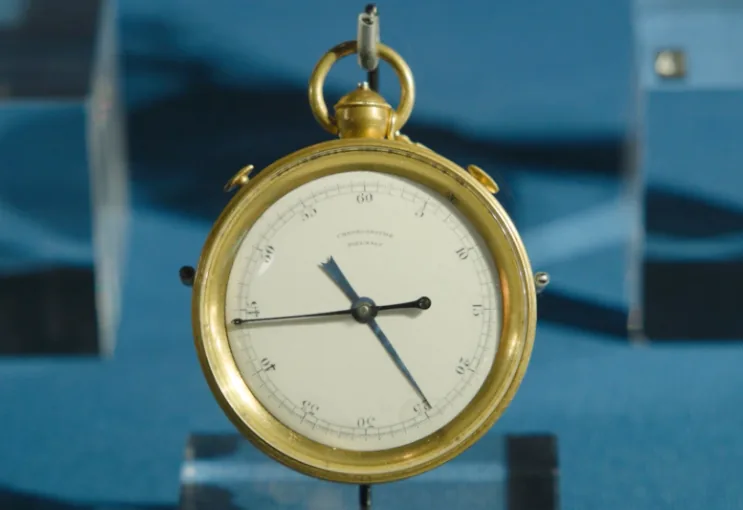
This innovative device allowed him to measure elapsed time precisely, which had until then been difficult with conventional clocks. Rieussec’s “inking chronograph” is therefore the origin of the function known today as the “chronograph”. At this stage in the history of the chronograph, the mechanism only had a start and stop control, with “reset” not yet existing and instead being carried out manually by swapping the graduated cardboard disc placed on the dial rotating part of the mechanism.
Frédérick-Louis Fatton (1812-1876)
He was a student of Abraham-Louis Breguet, who praised and encouraged his work, as he did that of Rieussec, for that matter. In 1822, only a few months after Rieussec, Fatton filed the patent for a chronograph (inking type) with a fixed dial. Here, it is the hand that is in motion and fed by an ink reservoir.
3.3 Attribution of the invention
It is difficult to attribute the invention of the chronograph to a single horologist, as so many contributed jointly to its invention and development.
An exhaustive list of the horologists who contributed to the development of the chronograph(s) is impossible, but we can mention names such as John Arnold, Abraham-Louis Breguet, Joseph-Thaddeus Winnerl, Abraham-Louis Perrelet, or Adolphe Nicole, who developed systems such as heart-piece zero-reset, the integration of an independent second into the movement of the watch, the monopusher chronograph, or the split-seconds chronograph, for example.
Starting from the ink used by Rieussec to mark time at Winnerl’s independent reset to zero, these inventors each played a major role in the evolution of horology and in the development of timing mechanisms that are both sophisticated and precise.
4. Integrated chronograph or additional module?
The chronograph is a short time measurement mechanism that is added to the traditional mechanism of the watch intended to display the time. There are two ways of designing the construction of a chronograph.
The first consists of integrating the chronograph mechanism into the movement base right from its design. This type of construction means that the movement will be used exclusively for watches equipped with a chronograph. It is generally accepted that an integrated construction is more authentic and of higher quality than an additional mechanism.
The second solution for producing a chronograph consists of using a traditional movement intended to display hours, minutes and seconds, and superimposing on it an additional mechanism (called a module) integrating all the components specific to the chronograph function. This solution minimizes development costs and offers great logistical flexibility, as a module can be assembled on different base movements and a base movement can receive modules of complications of different kinds.
6. Horizontal coupling or vertical coupling?
The chronograph draws its energy from the movement and is generally driven by the fourth wheel (seconds wheel) of the movement. The chronograph mechanism must therefore be engaged with the base movement when it is running and disengaged when it is stopped.
Two coupling methods exist:
6.1 Horizontal coupling
Horizontal coupling was the only method used until the appearance of vertical couplings at the end of the 20th century.
With this type of mechanism, the pivot of the fourth wheel (seconds wheel) extends above the surface of its bridge. A crown wheel is mounted on it, turning at the same speed as the fourth wheel (seconds wheel) (generally 1 rpm).
The coupling lever pivots around the axis of the fourth wheel (seconds wheel) and the crown wheel, and carries the coupling wheel (or intermediate chronograph wheel). The crown wheel and the coupling wheel are constantly driven by the fourth wheel (seconds wheel) regardless of the engaged function of the chronograph (start or stop). The coupling lever ends in a finger held in contact with the column wheel by the effect of the coupling lever spring.
When the “start” function is activated by the dedicated pusher, the column wheel advances by one step and the finger of the coupling lever falls into the space between two columns of the column wheel. The coupling lever thus pivots around its axis and carries the coupling wheel in a concentric movement with the crown wheel, with which it remains engaged. At the end of this movement, the coupling wheel comes into contact with the chronograph wheel and drives it.
At the same time, the brake is released and the chronograph starts. This construction is appreciated for its historical and authentic character. However, it has the drawback of a risk (contained) of imprecision when starting the measurement, due to the distance that the coupling wheel must travel. Furthermore, since the coupling wheel is constantly rotating, there may be a tiny offset between the position of the coupling wheel’s teeth and those of the chronograph wheel at the moment they begin to mesh. It is these two imperfections of the system that led to the development of vertical coupling chronographs.
6.2 Vertical coupling
There are different designs of vertical couplings. The general principle consists of superimposing the coupling wheel onto the chronograph’s intermediate wheel, or directly onto the chronograph wheel with which it moves concentrically.
When the chronograph start is activated, the coupling wheel rises to make contact with the chronograph intermediate wheel or the chronograph wheel, sliding on its axis, while remaining driven by the fourth wheel (seconds wheel). Between the two wheels are placed the coupling pad and the coupling spring, which guarantee perfect and instantaneous driving of the chronograph wheel.
7. Counters and scales
A chronograph displays, at minimum, the measurement of seconds. This is indicated by a hand, usually central, for a more precise and easier reading. The seconds scale is generally subdivided into several divisions. These correspond to the frequency of the regulating organ of the watch. Thus, for example, the frequency of a regulating organ oscillating at 18,000 vibrations/hour (i.e. 2.5 Hz) will have a chronograph hand that makes 5 jumps per second (1/5th of a second), whereas with a regulating organ oscillating at 5 Hz, the second will be divided into 10 jumps of the chronograph hand (accuracy to 1/10th of a second).
The second is frequently supplemented by a minute counter (totalizer). Although it can also be displayed in the center, the minute counter (Figure 1) generally appears on a dial set off-center (offset). With each minute, i.e. one revolution of the chronograph hand, the minute counter advances by one division. Minute counters are often graduated in increments of 30, 45, or 60 minutes.
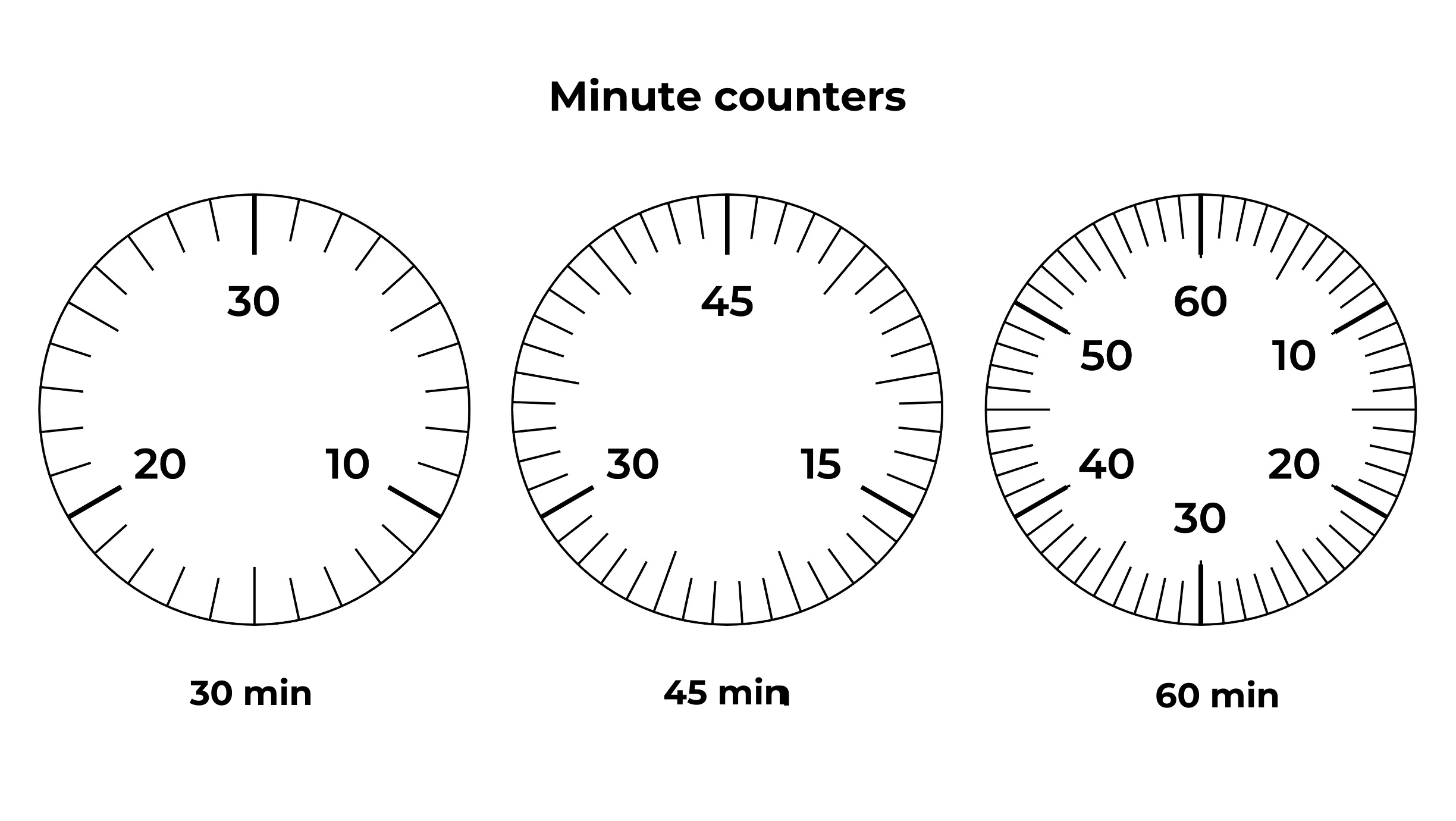
Figure 1
Minute Counters
Click on the thumbnail to enlarge it
This minute counter is often supplemented by an hour counter (Figure 2) generally featuring its own dedicated dial and displaying a 12- or 24-hour scale.
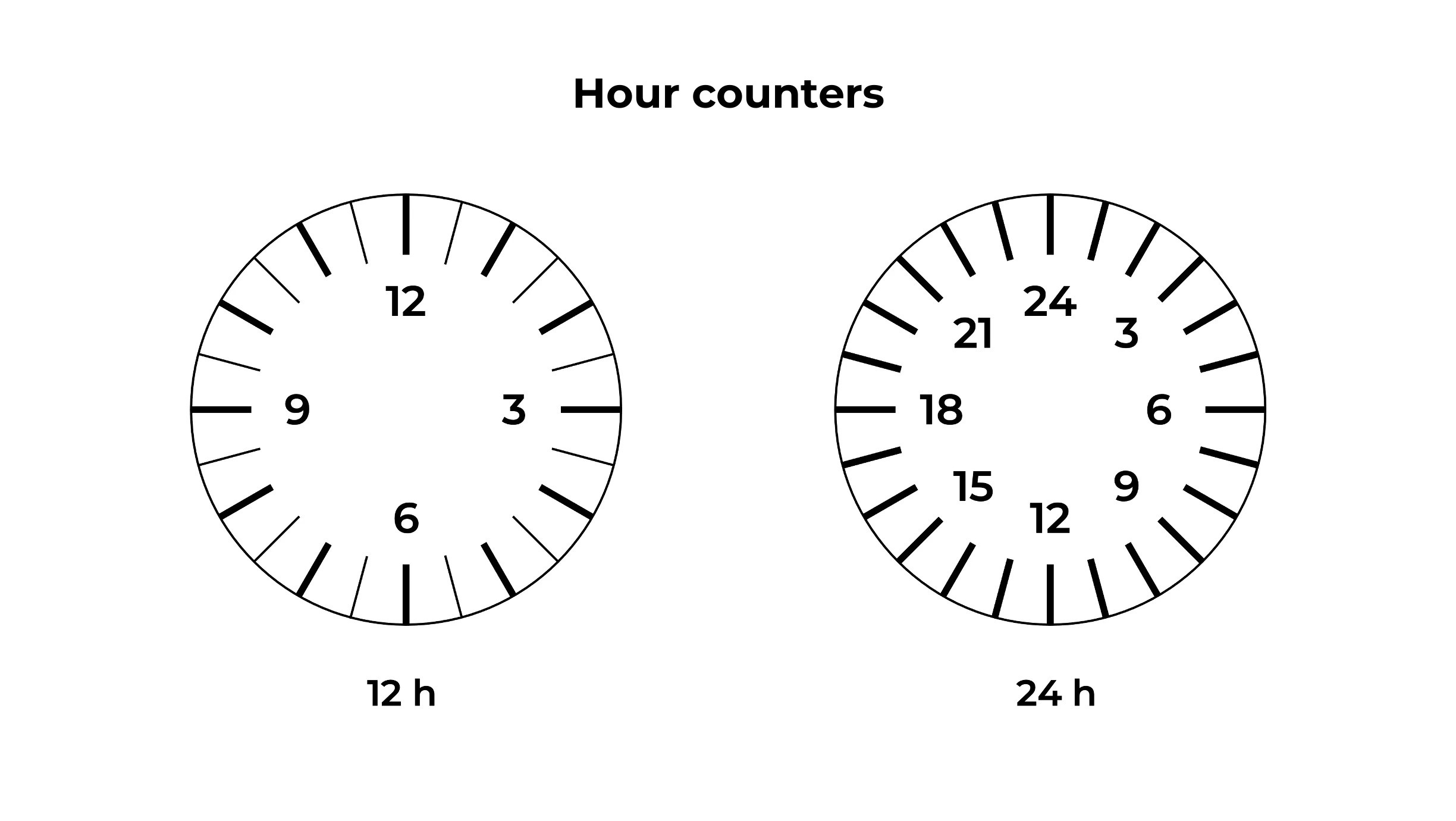
Figure 2
Hour Counters
Click on the thumbnail to enlarge it
The jump of the display of the minute and hour counters can be dragging, semi-instantaneous or instantaneous (Figure 3).
Figure 3
Different Counter jumps
Click on the animation to enlarge it
8. Telemeter, tachymeter, pulsometer (pulsation scale)?
Various conversion scales, or even calculation rules, can be displayed concentrically to the graduation of the seconds of the chronograph. These can be engraved or pad-printed on the dial, on a flange or on a bezel, fixed or rotating.
8.1 The telemeter
It is used to measure a distance based on the speed of sound. Its use is essentially military. For example, to find out the distance travelled by a shell that has just been fired. By starting the chronograph when the shell is seen to explode and stopping it when the sound of the explosion is heard. Thus, if there is a difference of 7.4 seconds, the shell will have exploded 2.5 km from its launch point. Because of the need to see the event (explosion) and hear its sound (even at a long distance), the telemeter has little other use, except to determine how far away lightning has struck (Figure 4).
Figure 4
Telemeter
Click on the animation to enlarge it
8.2 The tachymeter
This is a graduation that allows, in turn, the measurement of a speed or a rate. Here again, a reference will be needed. For example, to calculate the speed of a vehicle, a distance reference is required (for example, 1 km). Most highways have markers spaced exactly 1 km apart. By measuring the exact time it takes a car to travel 1 km (for example, 21.5 s), one can accurately determine its actual speed (167.4 km/h in our example).
One can also determine the hourly output of a machine by measuring the time it takes to manufacture a component. Thus, if the complete production cycle of a part takes 12 seconds, the machine will produce 300 parts per hour (Figure 5).
Figure 5
Tachymeter
Click on the animation to enlarge it
8.3 The pulsometer (pulsation scale)
Watches equipped with a pulsometer used to be familiarly called “doctor’s watches”. To calculate a patient’s heart rate per minute, it is enough to measure the duration of a limited number of pulsations.
For example, if the scale indicates a pulsometer for 30 pulsations, it is enough to measure the total duration of 30 pulsations to know the rate per minute. This scale thus allowed doctors to save time when taking this measurement. (e.g.: 30 pulsations in 22.5 s give a heart rate of 80 pulsations per minute) (Figure 6).
Figure 6
Pulsometer (pulsation scale)
Click on the animation to enlarge it
9. “TWO-PUSHER” CHRONOGRAPH
This is the most common construction. The three functions of the chronograph (start, stop, reset) are controlled by two pushers, generally arranged on either side of the crown. Various mechanisms will be described in this chapter.
10. FLYBACK CHRONOGRAPH
This mechanism was developed for use by aircraft pilots so that they would not waste time between two time measurements related to managing the approach of their aircraft. When the chronograph is engaged, a simple press on the pusher reset function makes it possible to simultaneously and instantly perform the stop, reset, and start functions, allowing the next measurement to be switched to with a single press.
11. SPLIT-SECONDS CHRONOGRAPH
This type of mechanism has two hands of concentric and superimposed seconds, as well as a third pusher. By pressing the split-seconds pusher, one of the seconds hands stops, allowing an intermediate or split time to be read, while the other seconds hand continues its course. By pressing the split-seconds pusher again, the stopped hand catches up with the other hand.
12. MONOPUSHER CHRONOGRAPH
As its name suggests, all the controls of this type of chronograph are operated by a single pusher. The three phases of the chronograph (start, stop and reset) follow one another in a loop each time the pusher is pressed.
This page has been automatically translated from the French reference version using an artificial intelligence tool. Errors or inaccuracies may remain. If you notice any, especially if this is your native language, please feel free to report them to info@horopedia.org. Your contribution helps us improve the quality of the encyclopedia.
While awaiting their translation, images and videos remain temporarily displayed in French.
Thank you for your understanding.