
LENGTHS AND ANGLES
1. Length
The metre is the official unit of length of the International System of Units (SI). It was initially defined as representing the 10,000,000th part of a half-meridian.
Definitions of the metre
From 1889, a standard metre (bar made of an Alloy of platinum-iridium with a low expansion coefficient) was used to define the metre internationally. Since 1983, the metre has been defined as the length travelled by Light in a vacuum in 1/299’792’458 s, or approximately 300,000 km/h. It is thus by a time measurement that length is defined.
Units in horology
The small dimensions of horological mechanisms and the extreme precision required for their manufacture have imposed the millimetre (mm) as the base unit of length throughout the horological world. Depending on the activity and the components concerned, the thousandth of a millimetre (micrometre or micron mm) is now commonly used, whether for dimensions or tolerances.
There is an old unit of measurement of length still used in the world of horology: the line (ln or ‘’’). This unit, dating back to the Middle Ages, is equivalent to one twelfth of an inch. Over time, it has undergone tiny variations in length. The one used in horology represents 2.255 mm. Nowadays, this unit is still used exclusively to designate the diameter of a movement, i.e. its “calibre”. Thus a calibre of 12 1/2’’’ has a diameter of 28.1875 mm.
Measuring instruments in horology
In horology, many instruments make it possible to measure a Length, the main ones being: Rule (ruler), Caliper (vernier caliper), Micrometre, Comparator, gauges or optical tools.
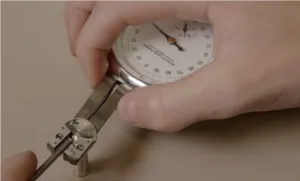
Micrometre
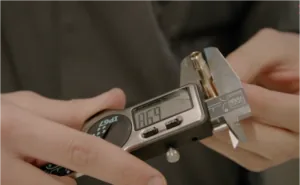
Caliper (vernier caliper)
2. Angles
It was the Babylonians and their sexagesimal calculation base that gave rise to the measurement of angles in degrees. Thus, a circle is divided into 360 sections of one degree each. The degree itself is divided into 60 minutes of arc, which are further divided into 60 seconds of arc. Nowadays, the decimal division of the degree is commonly used.
Thus:
36.7534° (decimal division) = 36°45’20’’24’’’ (sexagesimal division)
The unit of angle is the degree (°). Arc minutes are symbolized by (‘), arc seconds by (‘’), etc.
In watchmaking, angles can be measured using a protractor, a compass, gauges, or optical instruments. Of course, they can also be calculated by trigonometry.
This page was automatically translated from the French reference version using an artificial intelligence tool. Errors or inaccuracies may remain. If you notice any, especially if this is your native language, please feel free to report them to info@horopedia.org. Your contribution helps us improve the quality of the encyclopedia.
Pending their translation, images and videos remain temporarily displayed in French.
Thank you for your understanding.