
MENU
Figure 1
Exploded view of the regulating organ
Click on the animation to enlarge it
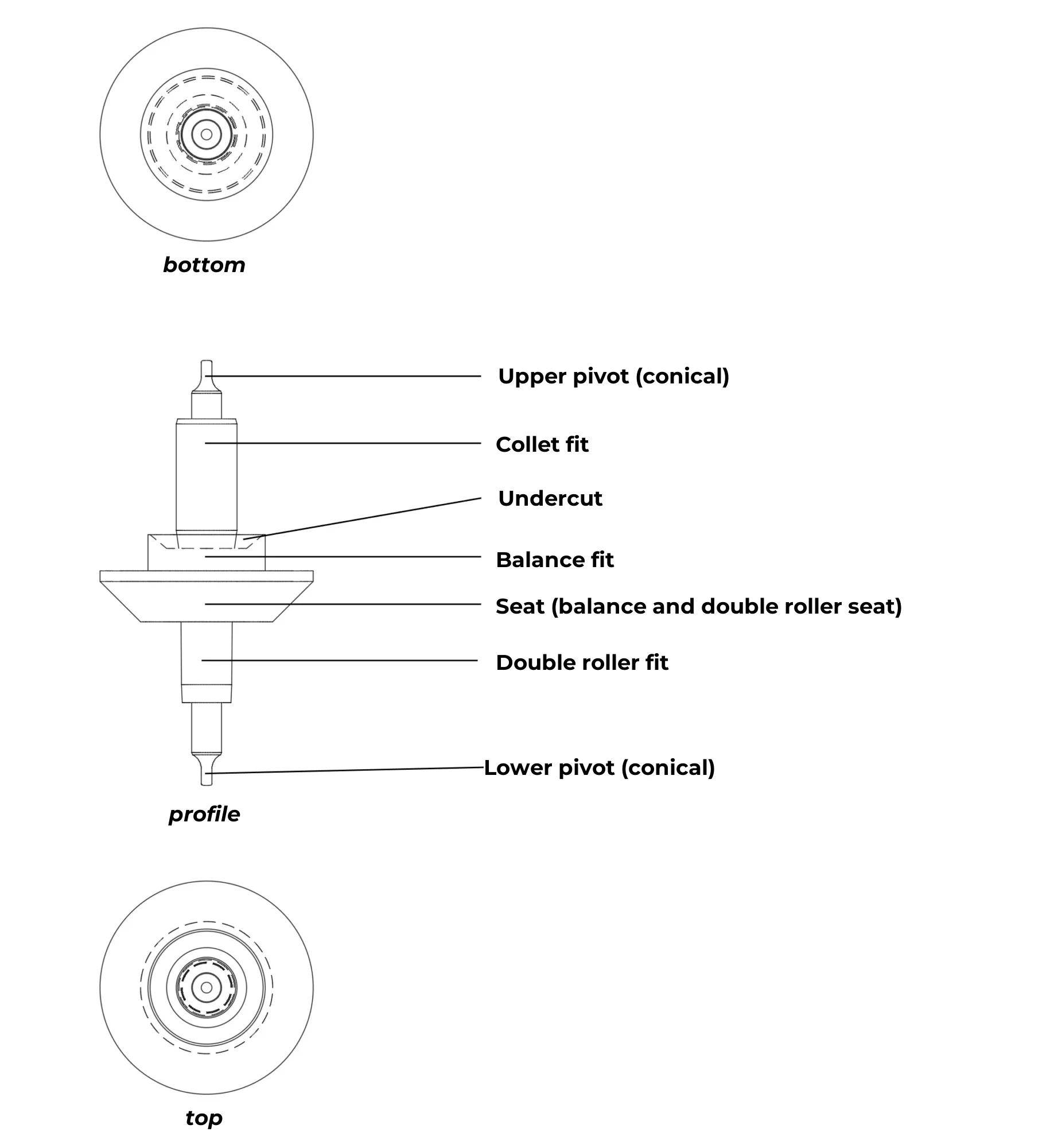
Figure 2
Diagram of a balance staff
Click on the thumbnail to enlarge it
1. General description
It is a pivoted axis made of steel which carries all the components of the regulating organ to which it belongs, as well as the last element of the distribution mechanism, namely the double roller. The balance is riveted onto its upper part. Above it, a cylindrical fit receives the collet which is pressed onto it and ensures the connection between the balance staff and the hairspring (balance spring). Finally, the double roller is pressed onto the lower part of the axis.
In order not to disturb the period of the oscillations of the balance and to minimize as much as possible the friction of its bearings, the pivots of the balance staff are conical and of a very small diameter (generally between 0.06 and 0.12 mm).
In the past, the breaking of a balance staff pivot was common during an impact. Their small diameter and the high inertia of the balance were the cause. Modern shock-absorber bearings have provided a reliable solution to this problem, making the breaking of a pivot anecdotal.
The harmful influence of magnetic fields on the regulating organ is well known. Many solutions have already helped minimize this problem. The technologies of electroforming (UV-LIGA) and deep reactive ion etching (DRIE) made it possible to manufacture components of the escapement and of the regulating organ from non-magnetic materials (nickel-phosphorus, Silicon, etc.). However, these technologies and materials do not allow the manufacture of a balance staff or the achievement of the properties necessary for its proper functioning (strength, hardness, coefficient of friction, etc.). A very recent technology now makes it possible to manufacture amagnetic balance staffs in ceramics and to machine them precisely and in series using femto-laser technology (pulsed laser).
2. Artisanal manufacture of a balance staff
Due to the very small dimensions of a balance staff, its artisanal manufacture requires great experience in turning and pivoting. On the other hand, it does not require much equipment. A bench lathe and a pivoting lathe are sufficient for its manufacture. After turning and burnishing (cold working) the various diameters of the axis, a fine notch is made using a graver above the fitting of the balance. This notch later allows the balance to be riveted onto the axis (see video on regulation/adjustment). Once the pivots have been turned, they are rolled on the pivoting lathe. Rolling is a form of cold working. It is then no longer a matter of machining the material, but of crushing, compressing its surface. This operation makes it possible to bring the pivot to its final dimension with precision, but also to increase its hardness in order to improve its strength and wear resistance, and finally, to reduce the roughness of the material and thus reduce its coefficient of friction.
3. Industrial production of a balance staff
On an industrial scale, balance staffs are produced by automatic lathe. The small dimensions of the balance staff require good machine adjustment, but the turning of a balance staff using this method is quick and does not pose any particular difficulties. The pivots can then be rolled using a machine dedicated to this task. Most rolling machines are not automated and require the intervention of a technician for each staff to be rolled. However, it saves a great deal of time compared to the artisanal method and is better suited to series production (repeatability, compliance with tolerances, etc.).
4. High-tech production of a balance staff
Introduced in 2025, this method makes it possible to produce non-magnetic balance staffs in ceramics. The patents protecting the manufacturing process unfortunately do not allow us to detail the steps at this time. The principle, however, is to form a ceramic blank by sintering and to machine it using a femtosecond laser (pulsed laser).
This page was automatically translated from the French reference version using an artificial intelligence tool. Errors or inaccuracies may remain. If you notice any, especially if this is your native language, please feel free to report them to us at info@horopedia.org. Your contribution helps us improve the quality of the encyclopedia.
While awaiting their translation, images and videos remain temporarily displayed in French.
Thank you for your understanding.