
GRAVERS
Used by many craftspeople in watchmaking (Engravers, horologists (watchmakers), micromechanics specialists, etc.), gravers are cutting tools. Their size, shape and Material vary depending on the specifics of each use. Similarly, gravers can be fitted with a handle and held directly in the craftsperson’s hand, or attached to a machine (Fixed graver, Lathe, Automatic lathe, machining center, etc.).
Hand gravers
In watchmaking, this type of graver mainly concerns engravers and horologists (watchmakers). The tool generally consists of a simple bar of metal (most commonly steel, whose tip is hardened). The tool’s profile varies according to use and the desired cutting groove profile (square, round, etc.). The faces of one end of this bar are ground at precise angles to ensure optimal cutting of the metal being machined or engraved, as well as effective chip evacuation. The handles of hand gravers used by horologists (watchmakers) are cylindrical and generally made of metal (Aluminium, Brass) or Wood. Those used by engravers are exclusively made of wood and shaped like a bulb to sit ergonomically between the craftsman’s fingers (tool guides) and the palm of the hand (to push the tool).
Regardless of their use, hand gravers are generally made of steel with a hardened tip. This allows the craftsman to shape and sharpen the graver according to their needs, and to modify or resharpen it throughout the tool’s life. Sharpening hand gravers is usually done using a grinder, and the finishing of the cutting surfaces is refined by hand using a softer stone. Sharpening a graver frequently requires rehardening the tool afterward.
The horologist (watchmaker) uses hand gravers exclusively for turning. Hand gravers can be used on small bench lathes driven by a bow or on manual electric lathes (type 70 and 102).
The engraver, for their part, uses their gravers to draw the outlines and lines of a subject created in copperplate engraving.
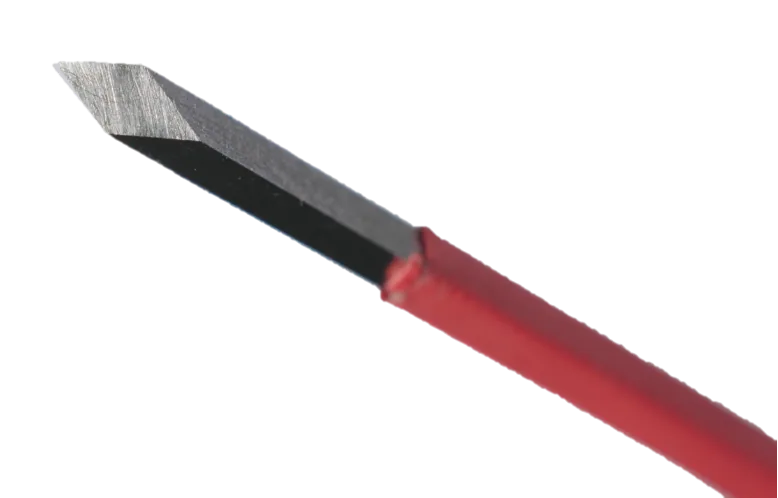
Hand graver with handle
Gravers for machines
Gravers for machines are exclusively intended for turning operations. They are attached and firmly fixed to the carriage of a lathe or to the tool holder of an automatic lathe or a machining center. Such gravers have been used on the fixed gravers (manually driven lathes) of horologists (watchmakers) since the 18th century, as well as on the carriages of manual lathes of type 70 and 102. Micromechanics, for its part, uses gravers on all turning machines (lathe, automatic lathe, machining center). Depending on the material of the components to be machined and their dimensions, gravers for machines can be made from various hard, heat-resistant metals, such as high-speed steels (mainly based on tungsten and vanadium carbides). In some cases and for economic reasons, only an insert screwed to the tip of the graver is made from the cutting material (high-speed steel, polycrystalline diamond).
This page was automatically translated from the French reference version using an artificial intelligence tool. Errors or inaccuracies may remain. If you notice any, especially if this is your native language, please feel free to report them to info@horopedia.org. Your contribution helps us improve the quality of the encyclopedia.
Pending their translation, images and videos remain temporarily displayed in French.
Thank you for your understanding.