
MENU
1. The Axis of a Milling machine or a machining center
2. History
The first machining centers appeared with the computerization of machines during the 1980s and are therefore numerically controlled machines (CNC = Computer Numeric Control). This is a vast family of machines whose specifics, capabilities, and role can vary significantly.
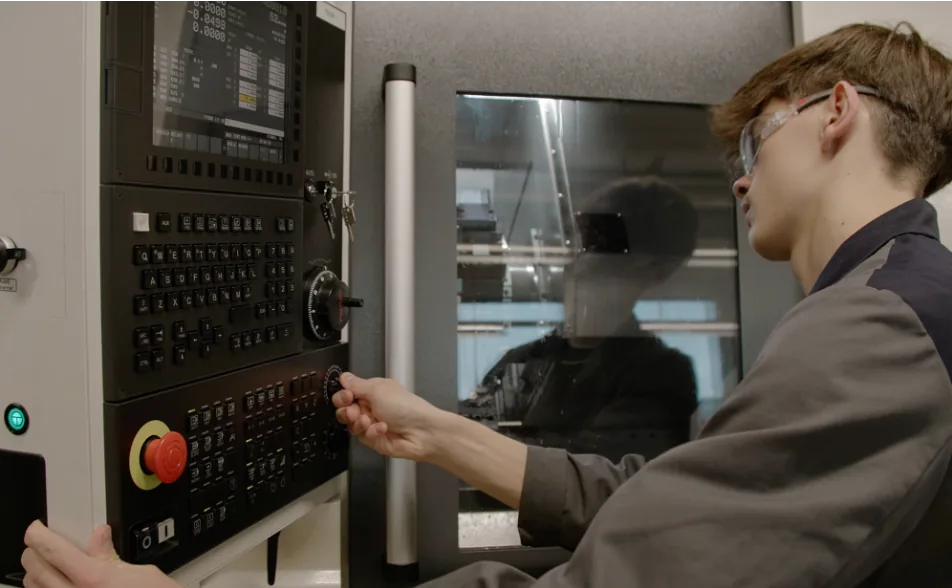
Control panel of a numerical machining center (CNC)
3. Operating Principles
In general, a machining center allows a defined sequence of machining operations to be carried out autonomously. Depending on the machining center, the raw material can be loaded into the machine in the form of a tray (rectangular blank) or a bar (in the manner of an Automatic lathe). The digitized drawing of the component to be manufactured and the list of necessary tools have been imported into the machine’s software. The ideal sequence of operations is suggested by the machine and can be modified by the operator. The various necessary tools (cutters, drills, grinding wheels, etc.) are placed in a magazine inside the machine, in the location corresponding to the dedicated sequence of operations defined by the machine’s program. Once the machine is programmed and the tools and material are loaded, it is ready to work and the operator only has to start the sequence. The machine then carries out the various machining operations according to the established sequence and automatically changes tools as often as necessary. Most machining centers mainly perform Milling operations. Machines loaded with bar material can generally add turning operations as well. Depending on the complexity of the machine, a machining center may have one or two spindles (rotating tool holders).
4. Axis
The spindles of a machining center are designed to move along different axes, the number of which can vary. This is why we speak of three-, five- or six-axis machines, etc. The first three axes of a machine are the linear axes (X, Y and Z or width, depth and height). So-called five-axis machines have the three linear axes (X, Y and Z) plus two rotation axes for the spindle (longitudinal axis and vertical axis). Six-axis machines add a third rotation axis, a lateral axis. Finally, the arm carrying the tool spindle can move along one or more axes. Depending on the case, we then speak of 7-, 9- or 12-axis machines. It should be noted that, in a great many cases, the machine’s various axes are distributed between the spindle and the table (the frame on which the tray is mounted). For example, the spindle will move on the rotation axes and the table on the linear axes.
5. “Reprise” machines
Some machining centers can work successively on both faces of the component to be manufactured. These are referred to as “pick-up” machines. For machines using material in the form of trays, the machining center will perform all operations on the first face, then turn the tray over to machine the second face. Machines using bar-shaped material perform operations on one side of the bar using a specific headstock and spindle. The bar is then gripped by a second spindle, carried by a headstock positioned 180° opposite the first. The bar is then cut off, released from the first spindle, and new operations can be carried out on the reverse side of the component. Pick-up machines are much more complex due to the need for perfect positioning and centering of the component on the machine after the pick-up operation.
6. Robotic loading
Most machining centers can be optionally equipped with loading robots (for bars or trays), thus offering the machine almost unlimited autonomy.
7. Eligible Materials
All machinable materials are eligible for machining centers (Metals, plastics, synthetic corundum, composites, etc.).
8. Advantages, disadvantages and fields of application
Machining centers are versatile, precise and autonomous. However, they require relatively long programming and setup times, which makes them a production method better suited to large series. In watchmaking, they can be used for the manufacture of nearly all components of the Movement, of the Case and the Bracelet / Strap, as well as for the manufacture of tooling.
This page has been automatically translated from the French reference version using an artificial intelligence tool. Errors or inaccuracies may remain. If you notice any, especially if this is your native language, please do not hesitate to report them to info@horopedia.org. Your contribution helps us improve the quality of the encyclopedia.
Pending their translation, images and videos remain temporarily displayed in French.
Thank you for your understanding.