
HOW A MECHANICAL WATCH WORKS AND ITS MAIN COMPONENTS
Based on the observation of celestial bodies, then on the projection of shadows (Gnomon, sundial) and the flow of fluids (Clepsydra, hourglass), Measuring instruments already became mechanical during the 13th century (Clocks). While the first pocket watches appeared in the 16th century, it was not until the 18th century that worn (pocket) watches became reliable and widespread. Most of the manufacturing methods and mechanical principles of that time remain the same today, although they have evolved along with knowledge and technology.
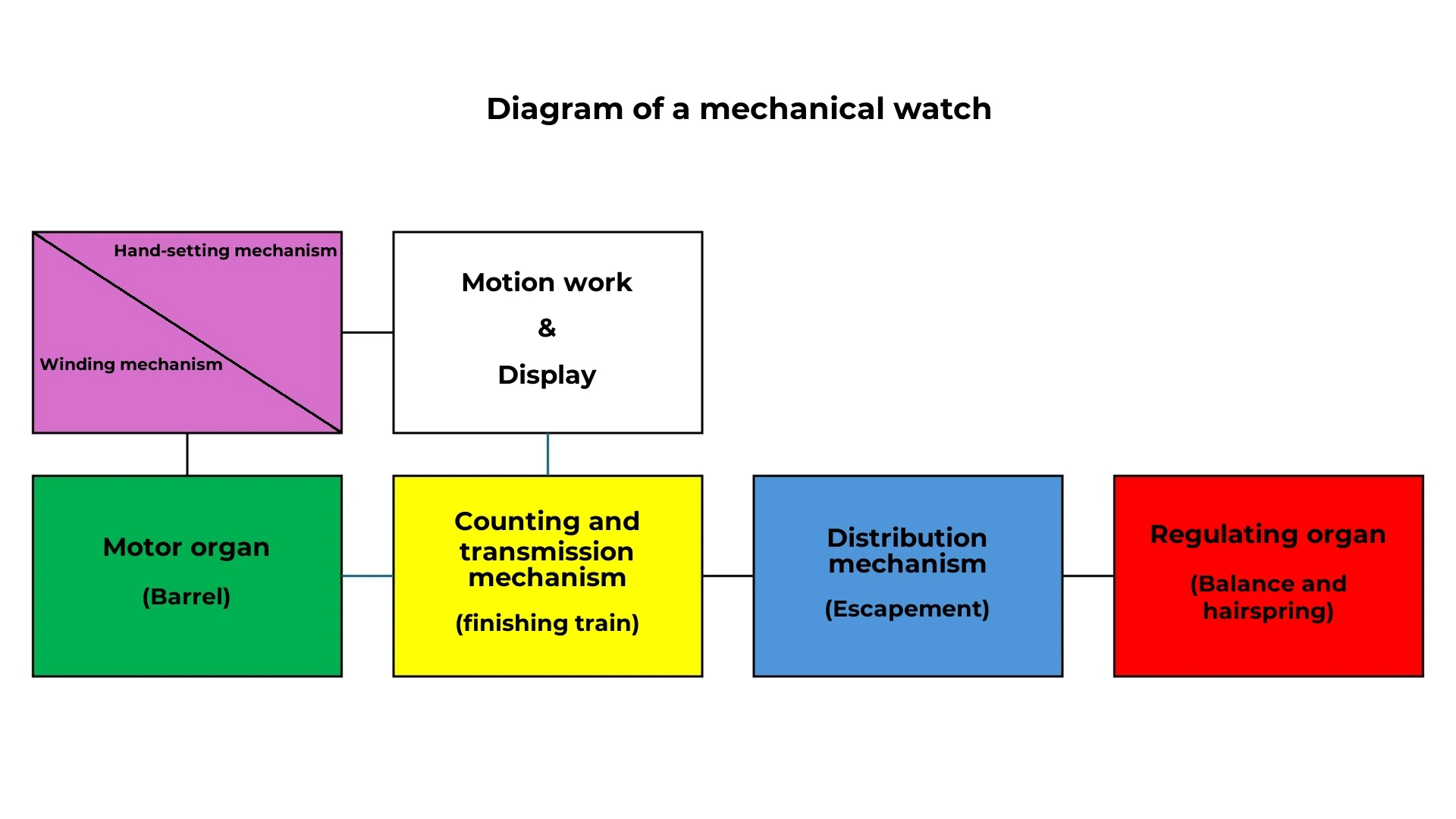
A basic mechanical movement (without complication) can be made up of more than two hundred components. To better understand how it works and the various interactions involved, it is customary to group these components into different mechanisms, each having a specific role. The different mechanisms of a mechanical movement are defined below, as well as in the explanatory video.
THE MOTOR ORGAN (barrel)
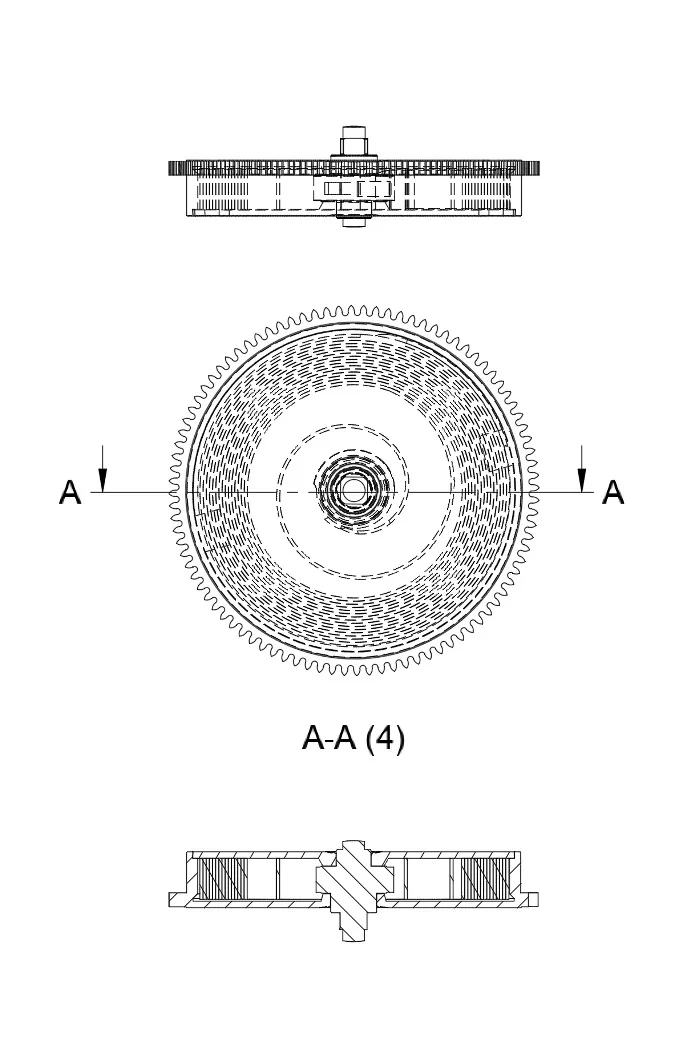
Role: Positioned at the beginning of the kinematic chain of the movement, the motor organ’s role is to store the energy necessary for its operation and to deliver it progressively.
Main components: the barrel (made up of a mainspring, a barrel drum, an arbor and a cover).
THE COUNTING AND TRANSMISSION MECHANISM (finishing train)
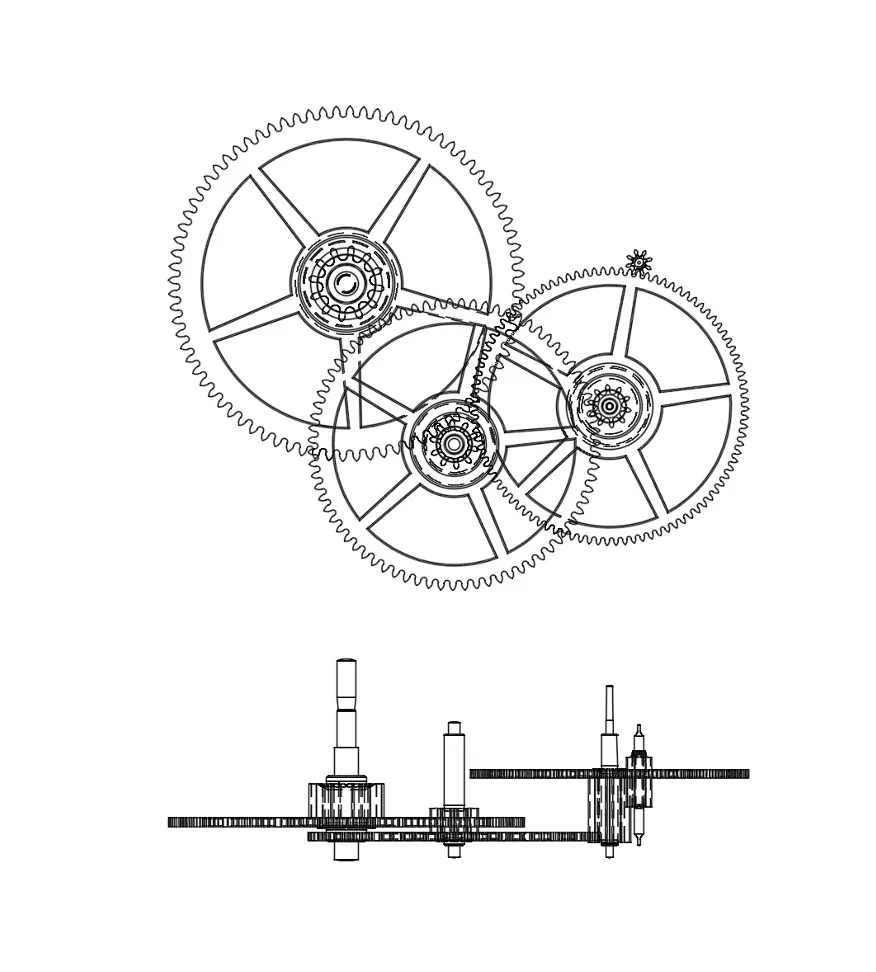
Role: The role of the counting and transmission mechanism is to convey the energy from the barrel (the motor organ (power source)) to the regulating organ via the escapement and to mechanically divide its frequency in order to distribute the various indications. Thus, the fourth wheel (seconds wheel) will make one revolution per minute, the center wheel (which carries the minute hand) will make one revolution per hour, etc.
Main components : The number of wheels in the Counting and transmission mechanism can vary. However, the following wheels are generally found: center wheel (or large third wheel), third wheel (or small third wheel), fourth wheel (seconds wheel), escape pinion.
THE DISTRIBUTION MECHANISM (escapement)
Role : The escapement performs two distinct functions. First, it blocks (stops) the finishing train (wheel train) when the balance is in its oscillation phase. Periodically (between 5 and 10 times per second), it releases the going train and transmits its energy to the balance through brief impulses aimed at sustaining the oscillations of the regulating organ (the balance-hairspring). The second function of the escapement is to transform the linear motion of the going train (continuous rotation) into an oscillatory motion (the oscillations of the regulating organ).
Main components : In a Swiss lever escapement, the components that make it up are: the escape wheel, the pallets (lever) and the double plate. Although the double plate is pressed together with the balance axis (the regulating organ), it constitutes the last component of the escapement’s kinematic chain and does indeed belong to this organ.
THE REGULATING ORGAN (balance-hairspring)
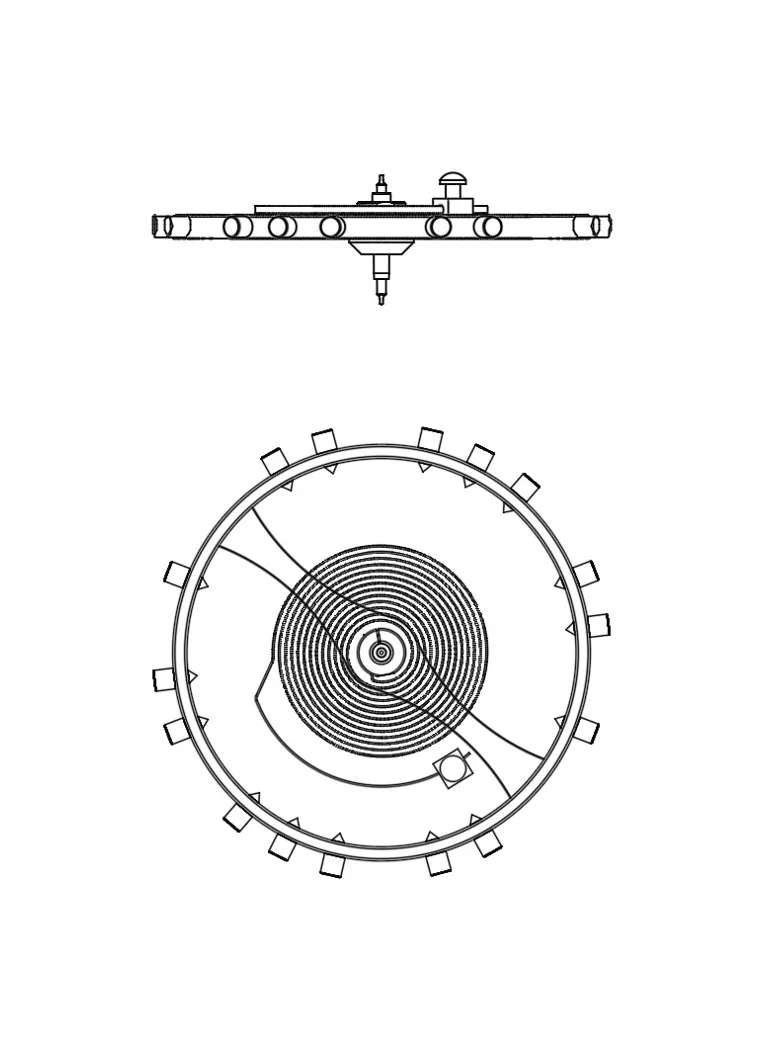
Role: It is responsible for ensuring the precision of a watch. Whatever the type of watch (or clock) and its construction, the regulating organ is always an oscillator. The higher the frequency of an oscillator, the more precise the watch will be. Although some attempts at very high frequencies have been made, the regulating organs of mechanical watches generally oscillate between 2.5 Hz and 5 Hz.
Main components: the balance and the hairspring (balance spring). This tandem, which constitutes the regulating organ, is often referred to as the balance-and-hairspring.
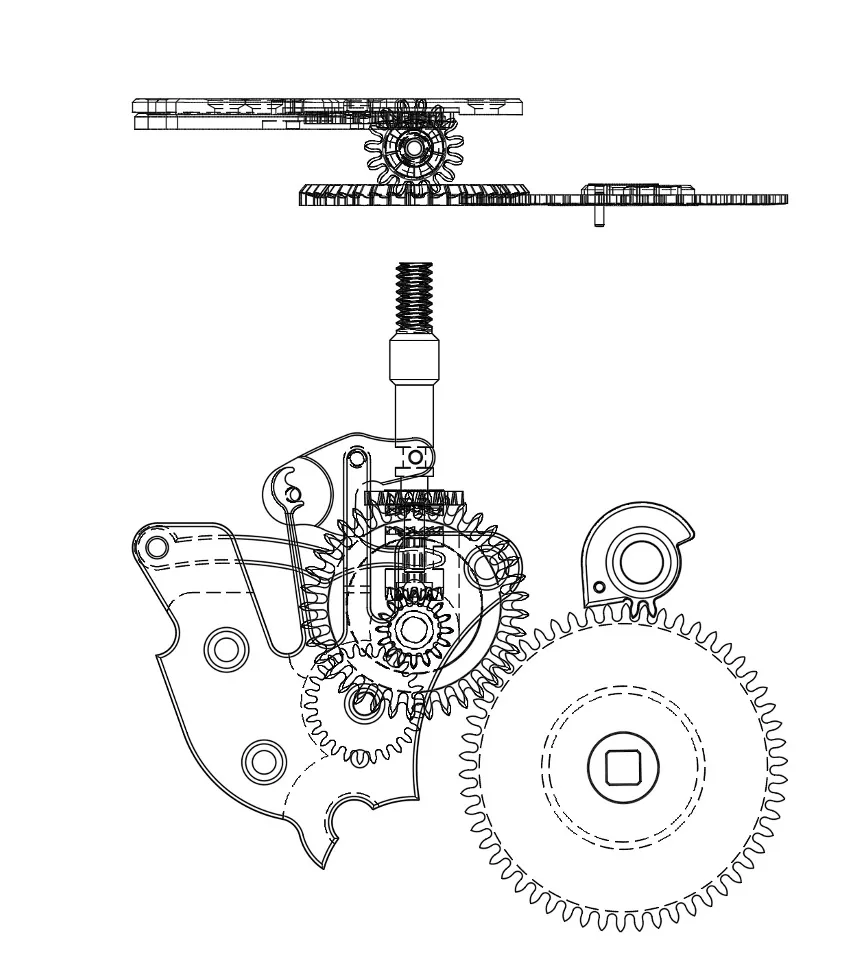
THE WINDING AND TIME-SETTING MECHANISM
It allows the user to power the motor organ (power source) and to set (at the very least) the time shown by the watch.
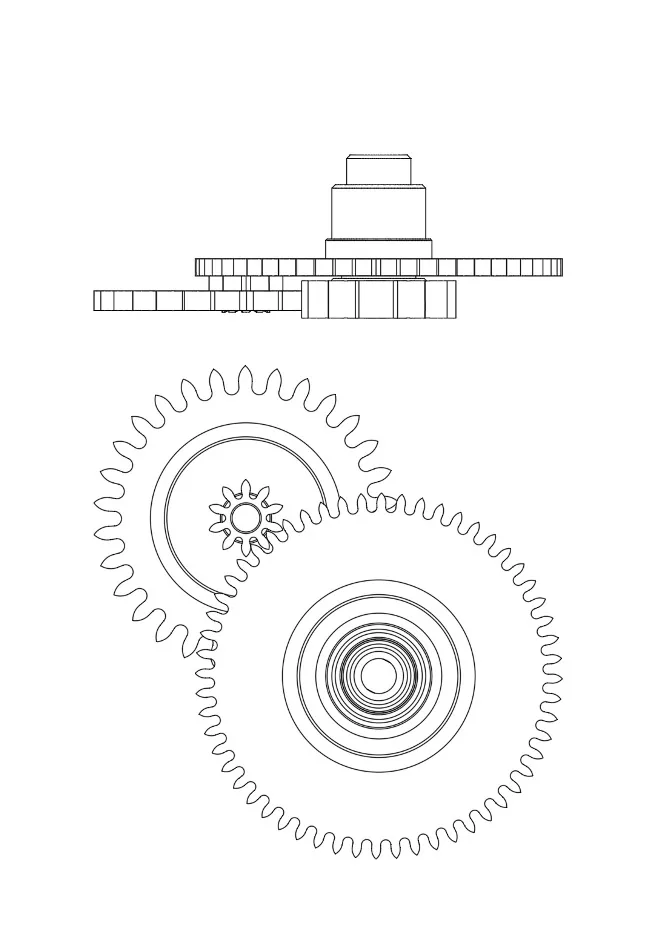
THE DISPLAY AND THE MOTION WORK
Distributes and displays the various information provided by the movement.
This page has been automatically translated from the French reference version using an artificial intelligence tool. Errors or inaccuracies may remain. If you notice any, especially if this is your native language, please feel free to report them to us at info@horopedia.org. Your contribution helps us improve the quality of the encyclopedia.
While awaiting their translation, images and videos remain temporarily displayed in French.
Thank you for your understanding.