
MENU
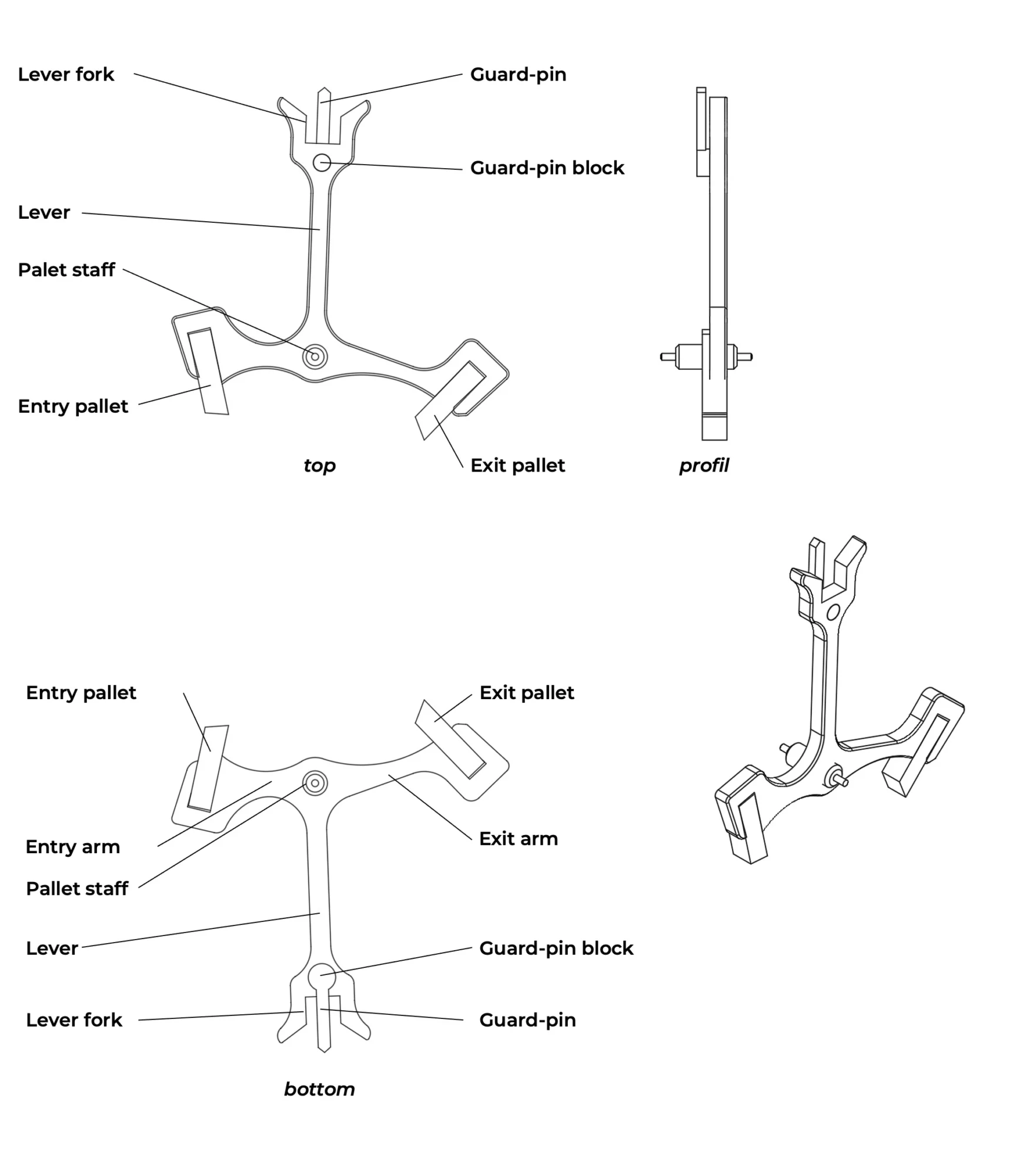
Figure 1
Diagram of pallets (lever) (steel and synthetic ruby/jewel)
Click on the thumbnail to enlarge it
1. General description
Together with the escape wheel and the double roller, the pallets (lever) is a component of the distribution mechanism (here, the Swiss lever escapement).
The shape of the pallets (lever) and its interaction with the escape wheel and the double roller (itself fixed to the balance axis) allow it to transform the rotary motion of the finishing train into an oscillatory motion. Moreover, when the balance freely performs its oscillation, the pallet stones of the pallets (lever) lock the escape wheel and thus the entire finishing train and the barrel.
The pallets (lever) owe their name to their shape and appear in different types of escapement. The pallets (lever) of the Swiss lever escapement include two ruby/jewel pallet stones that successively lock the teeth of the escape wheel. When the balance completes its free oscillation, the impulse pin (roller jewel) releases the pallets (lever), which pivot slightly. The tooth of the escape wheel, until then locked, transmits, in a brief rotational movement, its impulse to the pallets (lever) via the impulse plane of the pallets (lever), which, through a rocking motion, is transmitted directly to the balance by the fork of the pallets (lever) located opposite the pallet stones.
2. Components and materials
Depending on how it is made, the pallets (lever) consist of a variable number of components. In traditional manufacturing, the components are as follows:
The lever arbor (pallet-fork staff)
Made of steel, it is a pivoted axis onto which the pallet-fork bridge is driven in or screwed. Recent developments aim to produce a lever arbor (pallet-fork staff) in ceramics by femto-laser machining. Such a practice aims to eliminate the influence of magnetic fields in the escapement and the regulating organ but remains, to this day, anecdotal. It should be noted that to guarantee the perfect freedom of the pallets (lever), the pivots of the lever arbor (pallet-fork staff) must never be lubricated.
The pallet-fork body
This is the main component of the pallets (lever). Traditionally made of steel, it is driven in or screwed onto the lever arbor (pallet-fork staff). On either side of its pivot point extend the two arms that carry the pallet stones. The asymmetry of the two arms allows the resting planes of the pallet stones to be positioned equidistant from the pivot point of the pallets (lever). Opposite the two arms extends the rod (baguette shape), at the end of which the fork is cut, on the same plane. Finally, at the base of the fork, a hole allows the dart stud (guard-pin stud) to be received, driven in.
The pallet stones (or lifts)
These are traditionally made of synthetic rubies in order to minimize their wear as well as the friction in their interaction with the teeth of the escape wheel. Their geometry and their positioning in the arms of the pallet fork determine, in particular, the proper functioning of the escapement (see: the escapement-making (finishing) and the distribution mechanism).
The dart (safety pin)
It is traditionally made of brass, whose malleability makes it easy to file or forge in order to ensure the proper functioning of the escapement. It forms a single piece with the dart stud (guard-pin stud), which allows it to be driven into the pallet fork and positioned beneath it. The dart is a safety component that helps prevent overbanking (see: the distribution mechanism and the escapement-making (finishing)).
Important Notes
- In the case of pallets (lever) made of nickel-phosphorus (UV-LIGA), the dart (safety pin) and its stud are also made of nickel-phosphorus and form a single-piece element with the plate, which is non-magnetic.
- In the case of pallets (lever) made of silicon (DRIE (Deep Reactive Ion Etching) etching), the entire pallets (lever) assembly (including pallet stones) is made from a single non-magnetic block. Despite their many advantages, this technology and material do not allow any escapement-making (finishing) operation.
3. Profile and terminology of pallet stones (lifts)
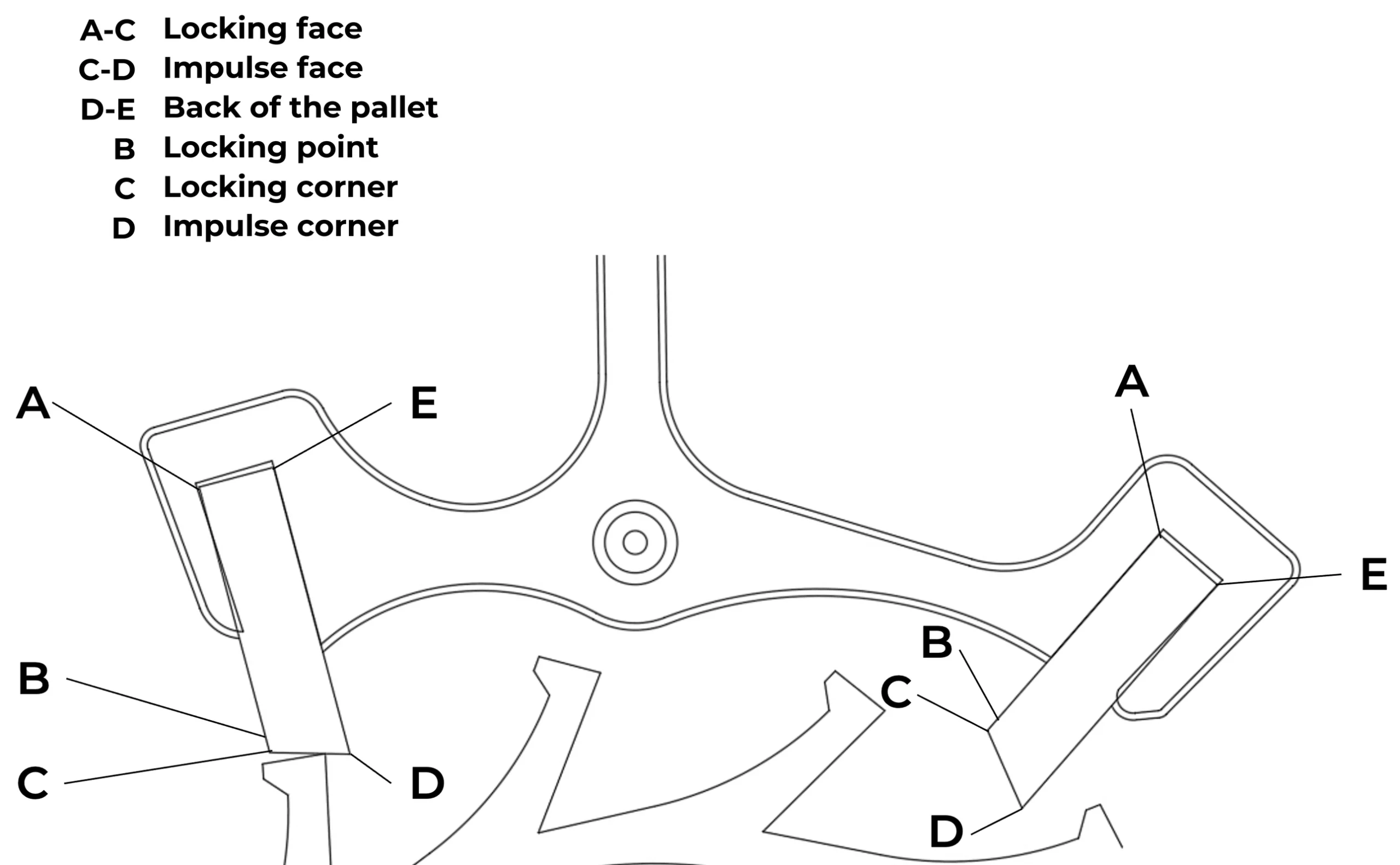
Figure 2
Profile of the lever’s pallet stones
Click on the thumbnail to enlarge it
4. History
The use of a lever in different types of escapements for clocks and then watches dates back to the beginning of the 18th century. And Thomas Mudge invented the Swiss lever escapement in 1754. This type of escapement has been by far the most widely used since the dawn of the 20th century. In itself, the lever has not undergone any major changes since its invention. Until the end of the 19th century, watchmakers frequently compensated for the balance defects of the pallets (lever) caused by its asymmetrical shape by attaching a counterweight to it. History would reveal that it is preferable to favor the lightness of the pallets (lever) over its balance, and counterweights were subsequently abandoned. The other historical milestones are related to the materials used. Thus, the pallet stones of the pallets (lever), once made of natural ruby/jewel, have since the mid-20th century been replaced by synthetic corundum pallet stones, just like all the jewels in a watch. Finally, the emergence of the UV LIGA manufacturing process (for nickel-phosphorus pallets (lever)) and DRIE (Deep Reactive Ion Etching) (for silicon pallets (lever)) at the beginning of the 21st century has made it possible to produce lighter, more robust, and non-magnetic pallets (lever).
5. Handcrafted manufacturing of pallets (lever)
The most traditional method of making pallets (lever) consists of tracing then cutting with a piercing saw (jeweler’s saw) the profile of the pallets (lever) in a steel plate. The final dimensions are achieved by filing and smoothing the surfaces. The stud that holds the dart (safety pin) is transferred and fixed to the pallets (lever) plate by two feet for precise and stable positioning. The cylindrical dart (safety pin) at the stud is flattened by filed forging to ensure its function. The lever arbor (pallet-fork staff) is turned then pivoted. Old, manual machines, or more recent motorized ones make it possible to grind the ruby/jewel pallet stones in order to give them their exact dimensions and to control the angle of the impulse planes. Once the components of the pallets (lever) have been manufactured and decorated, the craftsman proceeds to its assembly. The dart (safety pin) is thus driven into its stud, the plate is generally screwed onto the lever arbor (pallet-fork staff), and the pallet stones are held in their tweezers by shellac which, by heating it slightly, allows the exact position of each pallet stone to be adjusted and firmly secured once cooled.
6. Industrial production of pallets (lever)
On an industrial scale, the lever arbor (pallet-fork staff) is turned on an automatic lathe before its pivots are rolled. Stamping is particularly well suited to manufacturing the pallet fork body, although it can also be machined. The pallet stones are produced on automatic machines equipped with diamond grinding wheels. Depending on the level of finishing required, the pallet fork bodies are polished either by hand or in bulk in polishing drums. Finally, the use of adhesive to fix the pallet stones is now replacing shellac in industrial production.
7. High-tech methods for producing pallets (lever)
Microfabrication technologies have profoundly transformed the production of certain watchmaking components, in particular the components of the escapement. Among these processes, manufacturing by UV-LIGA and by silicon etching (DRIE) makes it possible to obtain pallets (lever) with extremely high geometric precision, difficult to achieve with traditional machining methods.
These processes are based on techniques derived from microelectronics and enable the production of parts with complex profiles, controlled surface finishes, and near-perfect industrial repeatability in materials known to be non-magnetic.
Unlike conventional methods (milling, stamping), UV-LIGA and Silicon processes:
- Remove mechanical stresses during manufacturing
- Involve non-magnetic materials
- Eliminate tool-related defects (milling cutter radius, burrs)
- Allow for superior precision and repeatability
They thus form part of an evolution toward high-precision watchmaking, combining traditional know-how with advanced technologies.
The manufacturing of pallets (lever) by UV-LIGA and in silicon by the DRIE (Deep Reactive Ion Etching) method illustrates the integration of microfabrication technologies into contemporary watchmaking. These processes make it possible to improve the precision, regularity, and performance of escapements, while opening the way to new architectures.
They now serve as a complement to traditional methods, particularly in the field of high-end technical watchmaking and the industrial production of high-value-added components.
This page has been automatically translated from the French reference version using an artificial intelligence tool. Errors or inaccuracies may remain. If you notice any, especially if this is your native language, please feel free to report them to us at info@horopedia.org. Your contribution helps us improve the quality of the encyclopedia.
While awaiting their translation, images and videos remain temporarily displayed in French.
Thank you for your understanding.