
THE BOW
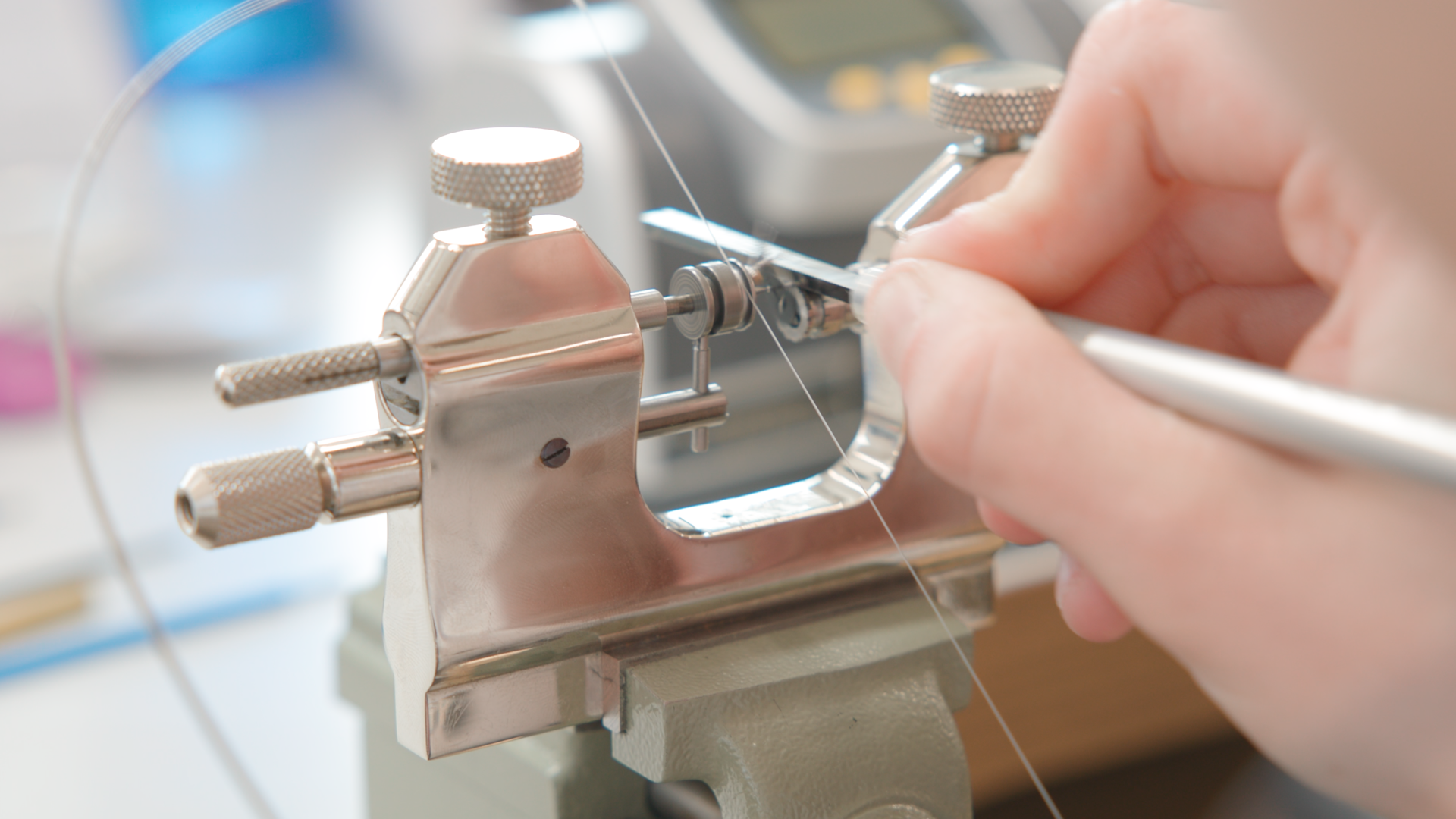
The Bow consists of a flexible rod, generally made of wood, formerly of whalebone, whose ends are connected by a thin cord (nowadays made of nylon). The cord wraps around a pulley that drives a workpiece, mainly for turning or drilling operations.
Function and advantages
The Bow thus plays the same role as the drive belt of a Lathe or any rotating machine (Drill, Milling machine, etc.). It allows the craftsman to control the rotation speed of the component or the tool with great precision. This device is the oldest to drive rotary movements. Depending on the operations to be carried out, the Bow drives a tool (straight awl, drill, Milling cutter); in other cases, it drives the component (turning of an Axis, a pivot, etc.).
Drawbacks
However, it has two major drawbacks: it occupies one of the craftsman’s hands for this role and systematically implies a Vibration in the direction of rotation of the tool or the component.
The principle of the Bow derives from the Neolithic fire bow, used to produce heat through friction long before being adapted to drive rotating parts. Introduced into horological workshops as early as the 17th-18th centuries, the Bow Lathe long served as the reference tool for turning small parts, before being gradually supplanted by the treadle Lathe and then by motorized machines in the 20th century. The Bow is nevertheless still used today in certain restoration workshops and in horological training, particularly for pivot Burnishing: the craftsman combines the Bow with a Burnisher to mechanically polish the surface of an Axis pivot, a gesture in which mastery of the direction and speed of rotation, made possible by manually pulling the string, remains irreplaceable.
This page has been automatically translated from the reference French version using an artificial intelligence tool. Errors or inaccuracies may remain. If you notice any, especially if this is your native language, please do not hesitate to report them to info@horopedia.org. Your contribution helps us improve the quality of the encyclopedia.
While awaiting their translation, images and videos remain temporarily displayed in French.
Thank you for your understanding.