
MENU
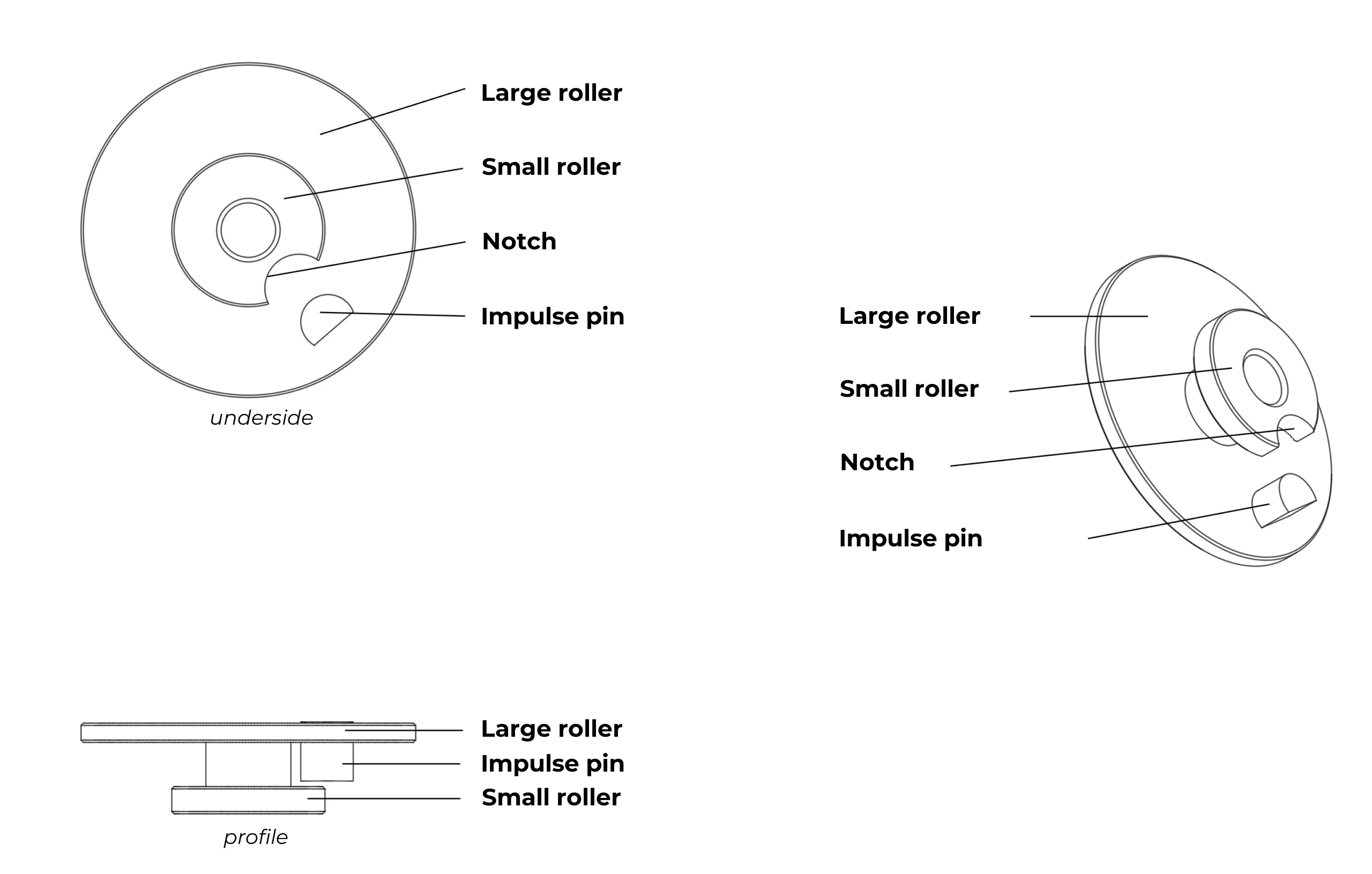
Figure 1
Diagram of a double roller
Click on the thumbnail to enlarge it
1. General description
Although it is fixed to the balance staff (the regulating organ) (cf. figure 2), the double roller belongs to the Swiss lever escapement (cf. figure 3), the distribution mechanism which regulates the transmission of energy from the counting and transmission mechanism (the finishing train) to the regulating organ (balance and hairspring).
Figure 2
Exploded view of the regulating organ (and double roller)
Click on the animation to enlarge it
Figure 3
Operation of the escapement
Click on the animation to enlarge it
2. Components
The double roller consists of three distinct elements (see Figure 1):
- The large roller which carries the impulse pin (roller jewel) (or ellipse).
- The impulse pin (roller jewel) which operates the unlocking (drop angle) phase and which receives the impulse from the pallets (lever) through interaction with the fork of the pallets (lever).
- The small roller is located beneath the large roller to which it is connected by a pipe. Its interaction with the dart (safety pin) of the pallets (lever) constitutes a safety mechanism preventing overbanking. An elliptical notch appears on its circumference, aligned with the impulse pin (roller jewel). This notch allows the dart (safety pin) to pass through during the unlocking (drop angle) and impulse phases, thus allowing the pallets (lever) to move freely from one banking pin to the other during these two phases only.
Although the large roller and the small roller are functionally distinguished, the two rollers and the pipe connecting them are generally machined as a single block.
3. Function in the Swiss lever escapement
In the operating cycle of the escapement, the double roller plays an essential role during the following operating phases:
- Unlocking (drop angle): At the end of the descending supplementary arc of the regulating organ, the impulse pin (roller jewel) strikes the fork of the pallets (lever) and drives it in a rotary motion.
- Impulse: When unlocking (drop angle) has taken place, the escape wheel transmits its impulse to the pallets (lever). The fork then catches up with the impulse pin (roller jewel) and transmits to it the impulse of the following vibration
- Operating safety: The circumference of the small roller provides a stop for the dart (safety pin) when the balance performs its ascending and descending supplementary arc, thus preventing the pallets (lever) from inadvertently jumping from one banking pin to another under the effect of a shock (overbanking).
(For more details, refer to the operation of the Swiss lever escapement)
4. Materials
Traditionally, the double roller is machined in hardened steel, in brass or in Glucydur. The impulse pin (roller jewel) is, for its part, made of synthetic ruby/jewel.
5. Adjustments and assembly
The double roller is driven onto the lower part of the balance staff, under the balance (see figure 2). This operation requires a staking tool and a stake of a perfectly suited diameter in order not to damage or deform the double roller. During this operation, care should be taken to align the position of the impulse pin (roller jewel) halfway between the two arms of the balance (or between two of its arms).
(for more details, refer to the chapter “Driving in the double roller” of the film dedicated to regulation/adjustment)
6. History
Thomas Mudge invented the Swiss lever escapement in 1754. This type of escapement has been by far the most widely used since the dawn of the 20th century. The double roller logically appeared with the invention of this type of escapement. Its construction and operation have not undergone any real evolution since then.
7. Industrial production of a double roller
The impulse pin (roller jewel) made of synthetic ruby/jewel cannot really be manufactured by hand (ruby production process, machining and polishing). Whatever its material, the double roller is generally produced by turning on an automatic lathe and its manufacture presents no particular difficulty. After being machined, the double roller is entirely polished (generally by a tribological process). Double rollers made of brass or Glucydur are then nickel-plated or rhodium-plated to protect them against oxidation. The impulse pin (roller jewel) is inserted into the milling of the large roller intended for this purpose before being fixed there with shellac or glue.
8. Important note
The double roller is an essential element for the operation of the Swiss lever escapement. The fact that it is driven onto the balance staff and therefore integral with the regulating organ leads to numerous confusions. It is therefore important to recall and emphasize that THE DOUBLE ROLLER IS A CONSTITUENT ELEMENT OF THE DISTRIBUTION MECHANISM and not of the regulating organ.
This page has been automatically translated from the reference French version using an artificial intelligence tool. Errors or inaccuracies may remain. If you notice any, especially if French is your native language, please feel free to report them to info@horopedia.org. Your contribution helps us improve the quality of the encyclopedia.
Until they are translated, images and videos remain temporarily displayed in French.
Thank you for your understanding.