
SPRING WINDER
WHAT IS A SPRING WINDER?
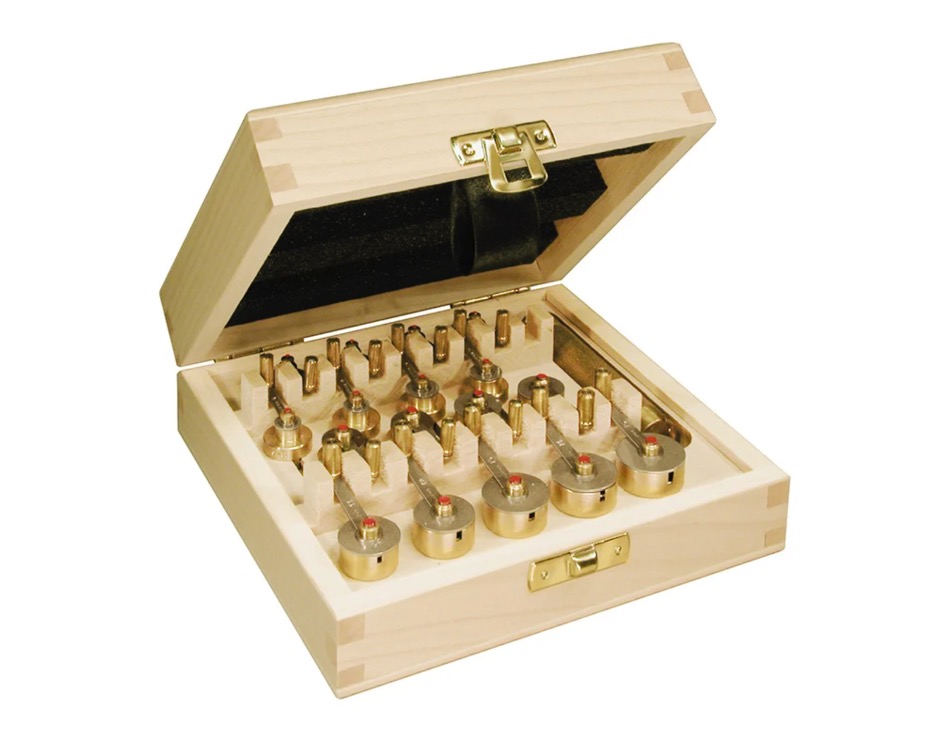
The spring winder (Fr. estrapade) is a hand tool designed for the controlled coiling of a long flat spring. Its most emblematic use in watchmaking concerns the spring, whose installation cannot be carried out without suitable tooling, owing both to the considerable length of the blade and to the energy it releases when allowed to uncoil suddenly.
In its most widespread design, the winder consists of a hollow cylindrical body — often in brass — fitted at its centre with a rotating arbor onto which the inner end of the spring is hooked. A crank, sometimes replaced by a removable key, drives the rotation of the arbor. A circular guide — or a set of interchangeable cylinders of differing diameters — compresses the coils as winding progresses, thereby calibrating the blade precisely once coiled.
The central use of the spring winder today belongs exclusively to the repair of antique pieces and to restoration work. It consists in introducing a relaxed spring into the barrel drum while respecting the direction of winding and avoiding any twisting of the blade. The spring, first coiled inside an intermediate cylinder of the winder whose diameter matches that of the drum, is transferred to the latter by a simple push, which receives the coils without deformation. Once the transfer is complete, the barrel arbor is fitted and the barrel cover closes the assembly.
Beyond this emblematic application, devices related to the spring winder are also used in the manufacture of hairsprings. Before the heat treatments that will permanently fix their geometry and elastic properties, the metal wire — previously drawn to the required dimensions — is coiled in a spiral around a mandrel to a precise pitch. This cold coiling, carried out with tooling based on the same principle as the spring winder, gives the future hairspring its primary form, which is then stabilised by annealing.
Useful links:
– Barrel
– Hairspring