
THE BALANCE POISING BENCH
What is a balance poising bench used for?
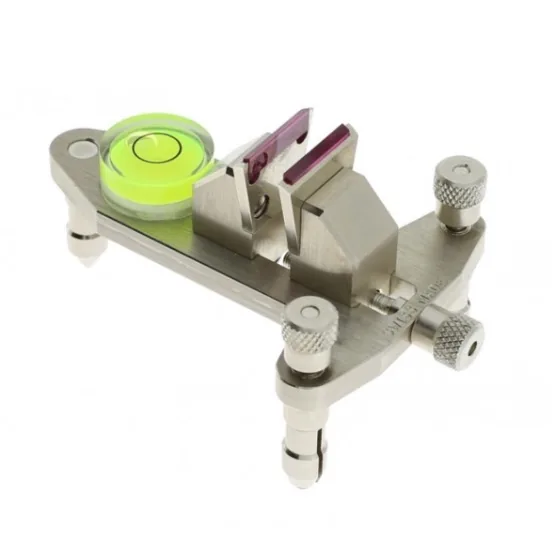
The balance poising bench is a precision instrument designed to test and correct the static poising of the Balance of a mechanical watch. It makes it possible to check that the Mass of the Balance is distributed evenly around its axis of rotation, an essential condition for the Regulating organ to maintain stable running in all positions of the watch.
In its classic configuration, the tool consists of a massive base — generally made of Smelting or Steel — on which two perfectly parallel knife-edges are set, most often made of Ruby / Jewel or polished hardened Steel. The knife-edges form two sharp edges on which the Balance pivots rest. A system of micrometric Screws, positioned under each of the bench’s three feet, allows the whole assembly to be perfectly leveled. Another micrometric Screw allows the spacing between the knife-edges to be adjusted to the Length of the Axis being examined.
To perform the Testing, the Horologist (watchmaker) places the Balance between the two knife-edges, then gives it a slight rotation. If the Balance is not balanced, it systematically comes to rest in the same position, its heaviest portion (commonly called the unbalance) settling directly below the axis of rotation. Correction is carried out by removing material at the identified point, generally by Milling the underside of the Felloe (rim base) using a dedicated Milling cutter. The operation is repeated until the Balance remains motionless at all successive stopping positions.
Poising takes place prior to the pairing with the Hairspring (balance spring) and of starting the Movement running. Carefully carried out, it determines the Isochronism and the final precision obtained during Regulation / Adjustment. While industrial workshops today use static poising machines capable of automatically detecting and correcting defects at high speed, the traditional balance poising bench remains a reference tool for artisanal high-end watchmaking and for restoration work.
This page has been automatically translated from the French reference version using an artificial intelligence tool. Errors or inaccuracies may remain. If you notice any, especially if this is your native language, please feel free to report them to info@horopedia.org. Your contribution helps us improve the quality of the encyclopedia.
While awaiting their translation, images and videos remain temporarily displayed in French.
Thank you for your understanding.