
MENU
1. General description
Depending on its shape, the required properties, the watch’s design and its intended use, the watch crystal (watch glass) can nowadays be produced in three categories of materials:
The plastic acrylics (Hesalite, etc.)
mineral glasses
The synthetic corundums (sapphire crystals)
Sapphire crystals (synthetic corundums) and mineral crystals
Their production method differs and their properties are specific to each. The widespread adoption of “sapphire” crystals, the decrease in their production cost, and their superior qualities have led them to completely and permanently replace mineral crystals, regardless of the watch’s selling price or range.
Acrylic plastic crystals
More flexible and less brittle than sapphire crystals, plastic crystals are sometimes favored for certain sports, technical, or military watches.
Due to the specificity of the materials and production means required, the manufacturing of watch crystals is systematically entrusted to specialized subcontractors.
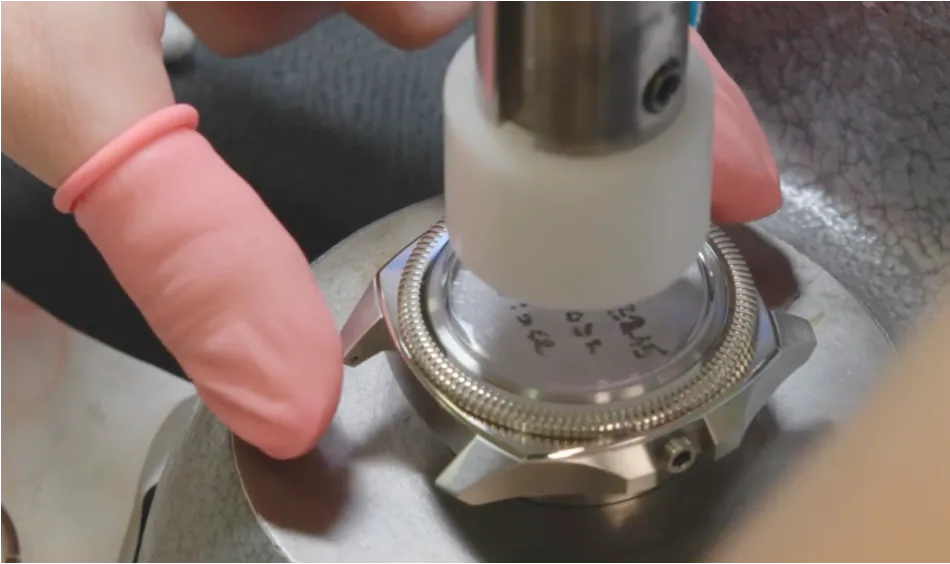
Figure 1
Fitting of a sapphire crystal
Click on the thumbnail to enlarge it
2. History
The earliest watches often had no crystal. An entirely metal case would then open directly onto the dial and the hand (or hands). From their very first appearance, watch crystals were made of mineral glass. Case back crystals, for their part, appeared between the late 18th and early 19th century, well before the invention of winding mechanisms and time-setting mechanisms. Just like clock dials, case back crystals then had to be pierced with two holes to allow the passage of the key used to wind (set up) and set the time of the watch. The evolution of tools and technologies has made it possible to constantly improve the quality of these crystals (beveling, quality of polishing).
It was not until the 20th century that plastic crystals (watch glasses) appeared, followed by sapphire crystals (watch glasses), along with the emergence of surface treatments (anti-reflective, water-repellent, etc.).
3. Production of plastic crystals (watch glasses)
The usual material used to produce plastic crystals (watch glasses) is polymethyl methacrylate (PMMA). This is an acrylic material (Plexiglas). It is valued for its strength, its excellent optical properties, and its resistance to UV rays.
Two production methods are used depending on the type of crystal (watch glass) to be manufactured.
To manufacture flat crystals (watch glasses), slices are cut from a cylinder of material. The discs thus obtained are then diamond-polished (polished) to reach the final thickness of the crystal (watch glass) and give it complete transparency.
To create curved (box) crystals (watch glasses), the method involves injecting the material. The cost of the mold does not favor small production runs, but this method has the advantage of being able to produce crystals (watch glasses) of complex shapes, limited only by their optical properties. Steps of polishing, more or less complex depending on the shape of the crystal, are carried out after injection. Numerous surface treatments have emerged and continue to develop. They help fight against reflections, scratches, UV, etc.
While plastic crystals are the most vulnerable to scratches, they have the advantage of being shock-resistant and easy to repolish.
4. Production of mineral glass crystals (watch glasses)
Glass (crystal) was the only material used for making watch crystals until the middle of the 20th century.
The rise of plastic (in the 60s and 70s), then of sapphire, saw the use of glass become anecdotal.
Glass (crystal) makes it possible to obtain flat, domed crystals of various shapes.
In all cases, the raw material will be machined before being polished and receiving any potential surface treatments (anti-reflective, anti-scratch, anti-UV, etc.). Like sapphire, the crystal (watch glass) can be metallized for decorative or indicative purposes.
5. Production of synthetic sapphire crystals (watch glasses)
The first manufacturing process for synthetic corundum dates back to the early 20th century (the Verneuil process) and is still used today. It involves obtaining cores (called boules) of corundum by melting particles of alumina (aluminium oxide). The monocrystal obtained has characteristics and properties identical to those of natural corundum (sapphire and ruby/jewel), without their “drawbacks”, such as inclusions.
It is through this invention that the natural ruby/jewel stones in watch movements were replaced, starting in the 1930s, by synthetic stones, which are easier to mass produce, more durable, and less costly.
The evolution and improved reliability of the Verneuil method quickly made it possible to manufacture watch crystals (watch glasses). Nevertheless, the boules of material obtained by the Verneuil method lose their homogeneity beyond a diameter of 40 mm, thus limiting to this size the largest components that can be produced by this process.
Another process, EFG (Edge-defined Film-fed Growth), has made it possible since the 1970s to obtain very large crystals and to generate a base material in the form of large plates or slabs. Sapphire crystals (watch glasses) are thus cut, then ground, and finally polished from the raw material. Sapphire (with a hardness of 9 on the Mohs scale) is the hardest material after diamond. Only diamond can therefore machine or polish sapphire.
This page has been automatically translated from the French reference version using an artificial intelligence tool. Errors or inaccuracies may remain. If you notice any, especially if this is your native language, please feel free to report them to info@horopedia.org. Your contribution helps us improve the quality of the encyclopedia.
While awaiting their translation, images and videos remain temporarily displayed in French.
Thank you for your understanding.