
MENU
1. Table of main properties of polymers
| Property | Typical value | Remarks |
|---|---|---|
| Density | ~0.9–1.5 g/cm³ | Very lightweight |
| Elasticity modulus (E) | ~1–5 GPa | Low |
| Tensile strength | ~30–150 MPa | Variable |
| Hardness (HV) | Low | |
| Thermal conductivity | ~0.1–0.5 W/m·K | Very low |
| Electrical conductivity | None | Insulator |
| Expansion coefficient | ~50–150 ×10⁻⁶ /K | High |
| Magnetism | No | Non-magnetic |
| Corrosion resistance | Excellent | |
| Machinability | Good | Depending on polymer |
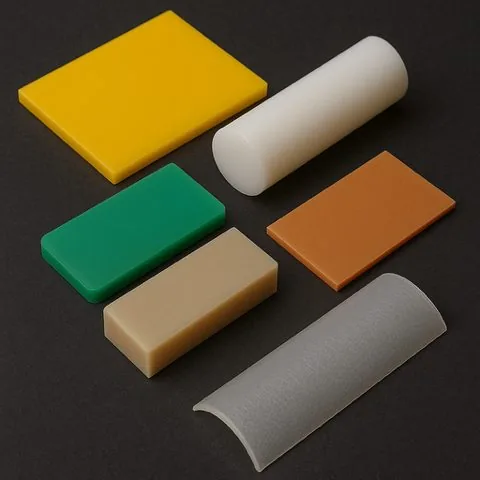
2. General description
Plastics and polymers form a vast family of organic materials composed of macromolecular chains. Gradually introduced into watchmaking in the 20th century, they now hold an important place, both in the external parts of watches and in certain quartz movements, or even mechanical ones, as well as in tooling. Their success is based on their low mass, their wide diversity of properties and their ease of shaping, which allows complex parts to be obtained at controlled cost. Depending on their nature (thermoplastics, thermosets or composites), they can meet varied requirements ranging from external parts to functional components of the movement.
3. Types of polymers used in watchmaking
Thermoplastics
Thermoplastics can be melted and reshaped.
Examples:
- ABS → cases, economical components
- PMMA (plexiglass) → watch crystals
- Polycarbonate (PC) → resistant transparent elements
- PEEK → technical applications
Thermosets
These polymers harden irreversibly after polymerization.
Examples:
- Epoxy resins (composite matrices)
- Phenolic resins
Used notably in composites (carbon, etc.).
High-performance technical polymers
Some polymers offer advanced properties:
- PEEK (polyetheretherketone)
- PTFE (Teflon)
- PA (technical polyamides)
Characteristics:
- Good mechanical resistance
- Low friction coefficient
- Improved thermal resistance
4. Manufacturing methods
Polymers are shaped using various industrial processes:
Plastic injection
- Melting of the polymer
- Injection into a mold
- Cooling and solidification
👉 Most common process in industrial watchmaking
Machining
- Cutting from solid stock
- Used for technical polymers
Compression / molding
- Used for resins and composites
- Allows complex shapes
Additive manufacturing (more marginal)
- 3D printing
- Prototyping or small series
6. Advantages and limitations
Advantages
- Very lightweight
- Low cost
- Great design freedom
- Corrosion resistance
- Non-magnetic
- Electrical insulation
- Possibility of self-lubrication
- Good impact resistance (certain polymers)
Limitations
- Low rigidity
- Sensitivity to temperature
- Aging (UV, oxidation)
- Limited mechanical resistance
- Less noble than traditional materials
- Sensitivity to scratches (depending on polymer)
This page was automatically translated from the reference French version using an artificial intelligence tool. Errors or inaccuracies may remain. If you notice any, especially if this is your native language, please feel free to report them to info@horopedia.org. Your contribution helps us improve the quality of the encyclopedia.
Pending their translation, images and videos remain temporarily displayed in French.
Thank you for your understanding.