
ASTRONOMICAL INDICATIONS
Astronomical complications include all functions or indications dependent on celestial bodies and their position. The information of a simple or complex calendar, the moon phases, or even a precise star chart are all considered astronomical complications.

THE DATE / CALENDAR
The Date / Calendar corresponds to the ordinal number of the day of the month, between 1 and 31. Watches generally display the Date / Calendar using a disc or a hand.

THE DAY OF THE WEEK
The display of the seven days of the week is one of the simplest complications to achieve. In most cases, the days of the week are indicated by a disc displaying the current day in an aperture / window or by a hand on a subsidiary dial. In this case, the day of the week indication can also be of the retrograde type.

THE MONTH
This involves displaying the current month of the year. This information is generally complementary, at the very least, to the Date / Calendar indication. It is generally found on simple calendars and on annual, perpetual and secular Date / Calendars.

THE MOON PHASE
The Moon phase display allows you to show the progress of the lunation (or the age of the moon). Astronomically, the duration of an average synodic period (lunation) is 29 days, 12 hours, 44 minutes and 2.8 seconds, i.e. 29.530589 days.

THE SIMPLE CALENDAR (TRIPLE CALENDAR)
This type of calendar displays the date, the day, the month and sometimes the moon phase. This mechanism does not take into account months of 28, 29 and 30 days and therefore requires the date to be manually corrected five times a year.
THE ANNUAL CALENDAR
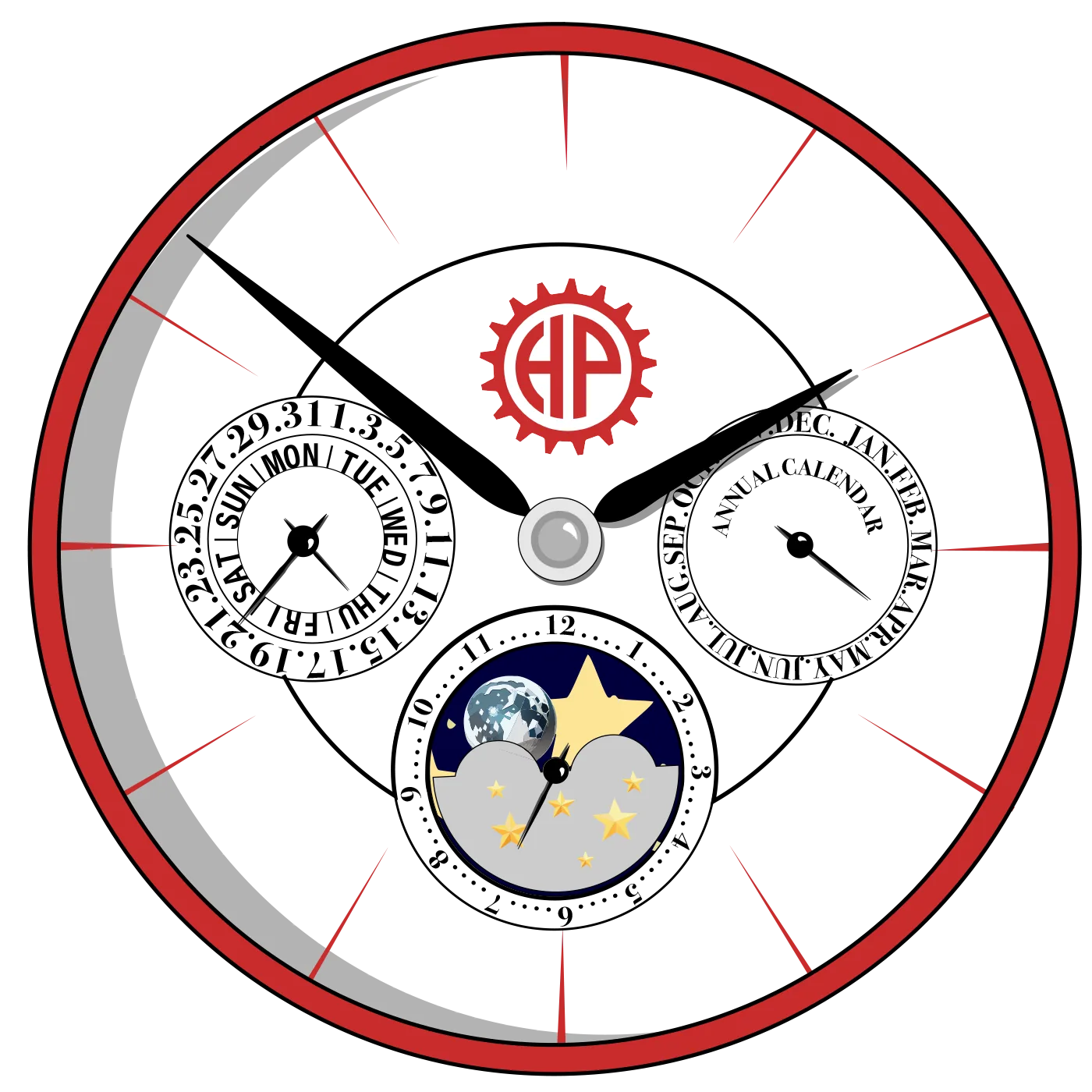
The annual calendar is a complication displaying the Date / Calendar at minimum. It takes into account the cycle of months of 30 and 31 days without accounting for months of 28 or 29 days. An annual correction is therefore necessary every March 1st.
THE PERPETUAL DATE / CALENDAR
The perpetual Date / Calendar is a complication displaying a calendar that takes into account months of 28, 29, 30 and 31 days. It requires a correction during centurial years not divisible by 400 (2100, 2200, 2300, 2500, etc.).
THE PERPETUAL SECULAR DATE / CALENDAR
Like the perpetual Date / Calendar, it takes into account months of 28, 29, 30 and 31 days within the 4-year leap cycle. But the secular Date / Calendar also takes into account the exceptions that are centurial years not divisible by 400, such as 2100, 2200, 2300 and 2500.
THE EQUATION OF TIME
The Equation of time indicates the difference, in minutes, between noon of the true solar day (the sun’s passage at the zenith of a given point) and noon of the mean solar day. The mean solar day is the one shown by our watches. Its constant 24 hours correspond to an annual average of all true solar days, whose astronomical duration varies according to the Earth’s position on its elliptical orbit around the Sun.
THE INDICATION OF SEASONS, EQUINOXES, SOLSTICES & ZODIAC SIGNS
Each of these events occurs annually, at regular intervals, following a cycle of one astronomical year. A hand making one revolution in a year can thus display all this information on a single dial.
This page has been automatically translated from the French reference version using an artificial intelligence tool. Errors or inaccuracies may remain. If you notice any, especially if this is your native language, please feel free to report them to us at info@horopedia.org. Your contribution helps us improve the quality of the encyclopedia.
While awaiting their translation, images and videos remain temporarily displayed in French.
Thank you for your understanding.