
MENU
1. Table of main CNT properties
| Property | Typical value | Notes |
|---|---|---|
| Mass density | ~1.3–1.4 g/cm³ | Very light |
| Elasticity modulus (E) | ~1000 GPa (1 TPa) | Extremely high |
| Tensile strength | ~10–50 GPa | Exceptional |
| Hardness | Very high | |
| Thermal conductivity | ~2000–3000 W/m·K | Very high |
| Electrical conductivity | Very high | Conductor |
| Expansion coefficient | Very low | Nearly zero |
| Magnetism | No | Non-magnetic |
| Corrosion resistance | Excellent | Very stable |
| Machinability | Not applicable | Nanomaterial |
2. General description
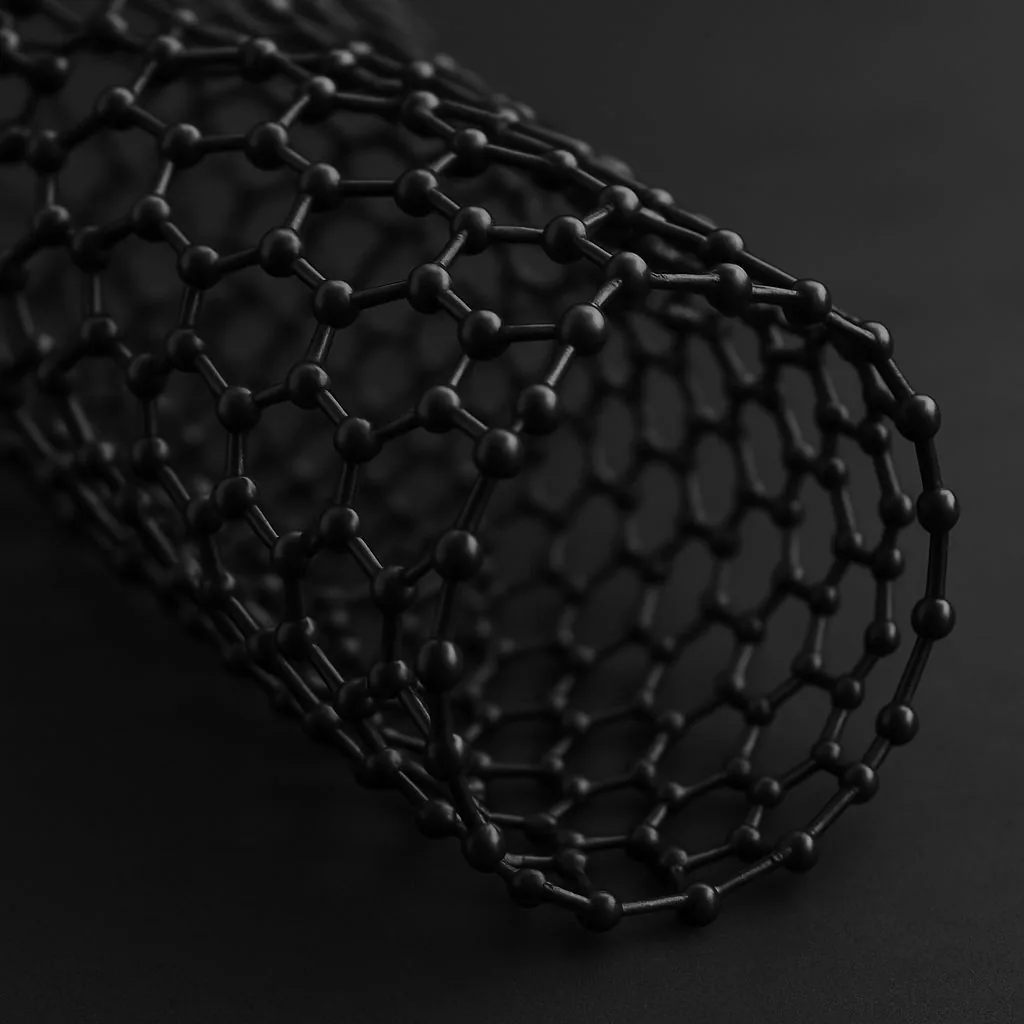
Carbon nanotubes (CNT) are cylindrical structures made up of graphene sheets rolled up at the nanometric scale. Derived from nanotechnology, they exhibit exceptional mechanical, thermal, and physical properties, far superior to those of traditional materials.
Presenting environmental hazards and health risks, carbon nanotubes have been subject to REACH regulation since 2020.
In watchmaking, their use remains very marginal and mainly experimental, particularly in the development of composite hairsprings aimed at improving the performance of the regulating organ.
3. Structure and behavior
Carbon nanotubes can be:
- Single-walled (SWCNT) → a single layer of graphene
- Multi-walled (MWCNT) → several concentric layers
They are generally used:
- in the form of networks
- integrated into a composite matrix
On a macroscopic scale, their properties depend heavily on:
- their orientation
- their dispersion
- their density
4. Watchmaking applications
In watchmaking, carbon nanotubes have been explored experimentally for:
- Composite hairsprings
Their main interest lies in their ability to:
- offer very stable elasticity
- reduce sensitivity to thermal variations
- eliminate the effects of magnetism
5. Advantages and limitations
Advantages
- Exceptional mechanical properties
- Very high lightness
- Remarkable thermal stability
- Non-magnetic
- High fatigue resistance
Limitations
- Complex implementation
- Difficulty in large-scale production
- Properties dependent on structuring
- Very high cost
- Still experimental use
- Difficulty of industrial reproducibility
- Subject to REACH regulation (health and environmental hazards)
This page has been automatically translated from the reference French version using an artificial intelligence tool. Errors or inaccuracies may remain. If you notice any, especially if this is your native language, please do not hesitate to report them to info@horopedia.org. Your contribution helps us improve the quality of the encyclopedia.
While awaiting their translation, images and videos remain temporarily displayed in French.
Thank you for your understanding.