
MENU
Figure 1: Exploded view of the regulating organ
Click on the animation to enlarge it
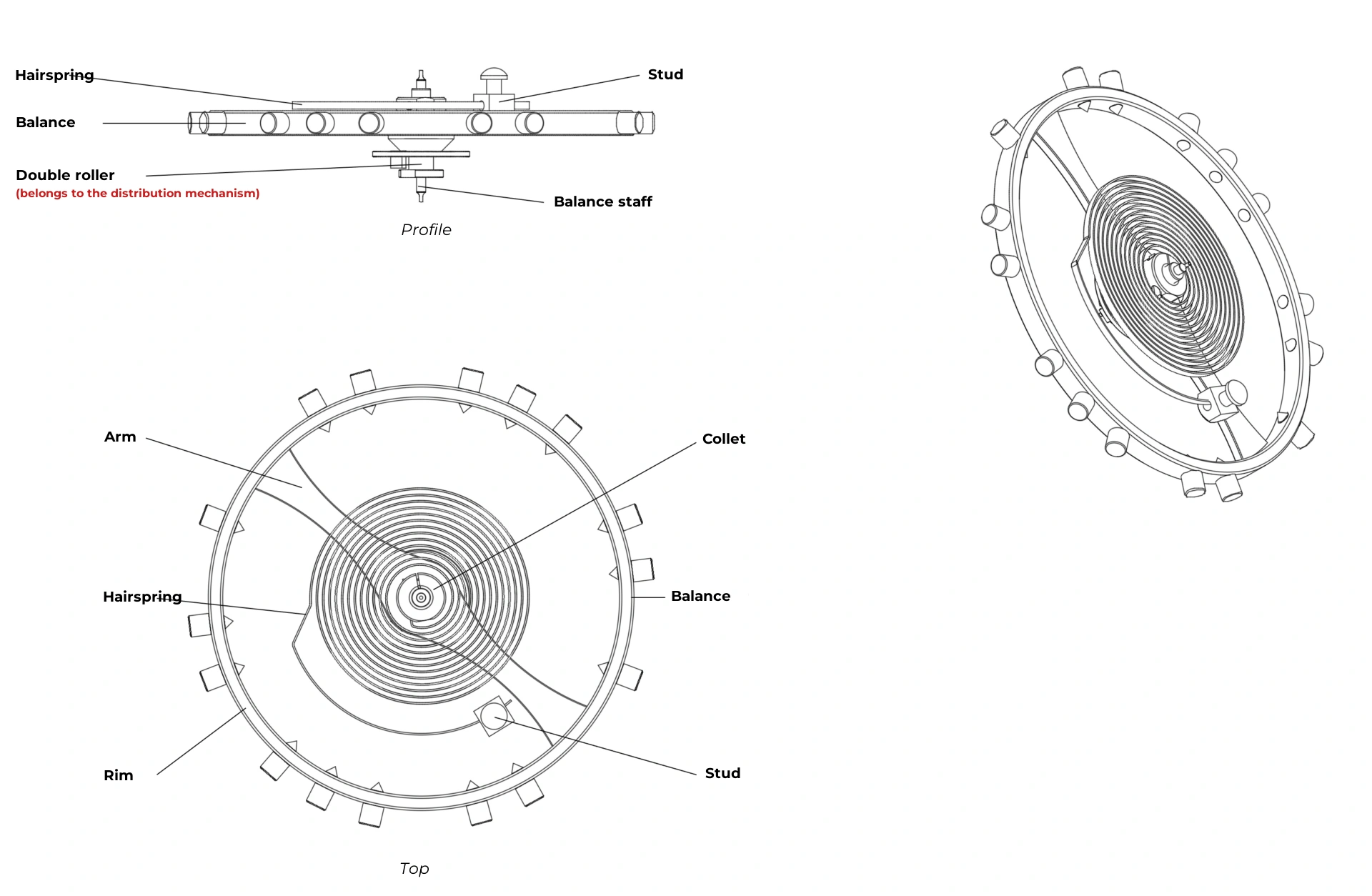
Figure 2: Diagram of the assembled regulating organ (screw balance, flat hairspring (balance spring))
Click on the thumbnail to enlarge it
1. Definition
The regulating organ is the oscillating device that sets the rate of a mechanical watch movement. The regulating organ of worn watches (pocket or wrist) is generally the tandem balance and hairspring (balance spring) which forms a harmonic oscillator whose regularity of the period determines the precision of the watch. It converts the energy stored in the mainspring into a succession of regular oscillations, which determines the regularity of the counting of time.
2. Different regulating organs
| Type of time measuring instrument | Type of regulating organ | Frequency | Precision |
| Clocks | Pendulum | 0.5-1 Hz | Variable |
| Mechanical watches/small clocks | Balance-hairspring | 2.5-5 Hz | approx. 5-10 s/day |
| Electronic watches | Tuning fork | 300-720 Hz | approx. 5-10 s/month |
| Electronic watches | Quartz | 32,768 Hz | approx. 1 s/month |
| Atomic clocks | Atoms (different types) | 429’228’004’229’873 Hz | approx. 1s/13 billion years |
The pendulum: This is the oldest of mechanical oscillators. It consists of a rod from which a mass is suspended, the height of which is generally adjustable. It is present in most clocks and pendulums. It was at the beginning of the 17th century that Galileo observed that the period of a pendulum is constant, regardless of its amplitude (theory of the isochronism). This theory would later be refined by Christiaan Huygens, who would go on to invent the balance-hairspring (balance spring). Pendulums allow for excellent chronometric results. Unfortunately, they cannot be moved while running and therefore do not apply to wearable horology. Pendulums generally oscillate at frequencies between 0.5 Hz and 1 Hz. Movements, shocks and temperature variations affect the precision of clocks regulated by a pendulum.
The balance-hairspring (balance spring) : It is the regulating organ of most worn mechanical watches. The balance-hairspring (balance spring) was invented in 1675 by Christiaan Huygens. This true revolution has, since its invention, made it possible to carry instruments for measuring time (marine chronometers, pocket watches, then wristwatches) while they are running. It consists of an inertia wheel (the balance) and a thin spring in spiral form (the hairspring (balance spring)). The frequency of the oscillations of a balance-hairspring is generally between 2.5 Hz and 5 Hz. This is the type of regulating organ that we will detail in this chapter.
The tuning fork is a regulating organ intended for electronic watches (powered by a battery). It consists of a steel blade cut in the shape of a tuning fork. An electromagnet sustains the oscillations of the tuning fork’s blades through the piezoelectric effect. Such an oscillator operates in the frequency range between 300 Hz and 720 Hz. The vibrations of the tuning fork are used to actuate pawls responsible for turning the seconds wheel. As a result, the seconds hand of a watch regulated by a tuning fork makes 300 to 720 jumps per second and appears to move forward continuously. This type of oscillator was briefly used in the early 1970s before being superseded by quartz technology. Thanks to their technology and the audible frequency range of the tuning fork, watches equipped with such a resonator emit a characteristic continuous high-pitched sound.
Quartz: The principle of quartz is the same as that of the tuning fork. A direct electric current causes a quartz crystal cut in the shape of a tuning fork to vibrate. Through the piezoelectric effect, the quartz begins to vibrate at a frequency of 32 kHz (32 kHz). The quartz converts the direct current it receives into an alternating current at this same frequency of 32 kHz. The electronic circuit of the movement has the role of reducing this frequency down to 1 Hz in order to regularly power the watch’s stepper motor.
Atoms of cesium, rubidium, strontium : The principle of such regulating organs consists in changing the energy state of cesium-133 or rubidium atoms. This change of state induces electromagnetic radiation emitted by the atom’s electrons, whose frequency is high and constant. Thus, the oscillation frequency of cesium-133 atoms is 9,192,631,770 Hz, and the latest optical frequency atomic clocks make it possible to excite strontium electrons at a frequency of 429,228,004,229,873.2 Hz. The precision drift for such clocks is 1 second over 13 billion years (i.e., the age of the universe). Besides time measurement, such clocks are used for astronomical observation, science, and physics (nuclear research, satellite guidance, navigation systems, etc.).
3. Description and components (balance-hairspring system):
The regulating organ of mechanical watches mainly consists of a flywheel called the balance and a spring shaped like an Archimedean spiral called the hairspring (balance spring). The balance is riveted onto its axis. On this same axis is fixed the inner end of the hairspring (balance spring) by means of the collet (Figure 2 & Figure 3).
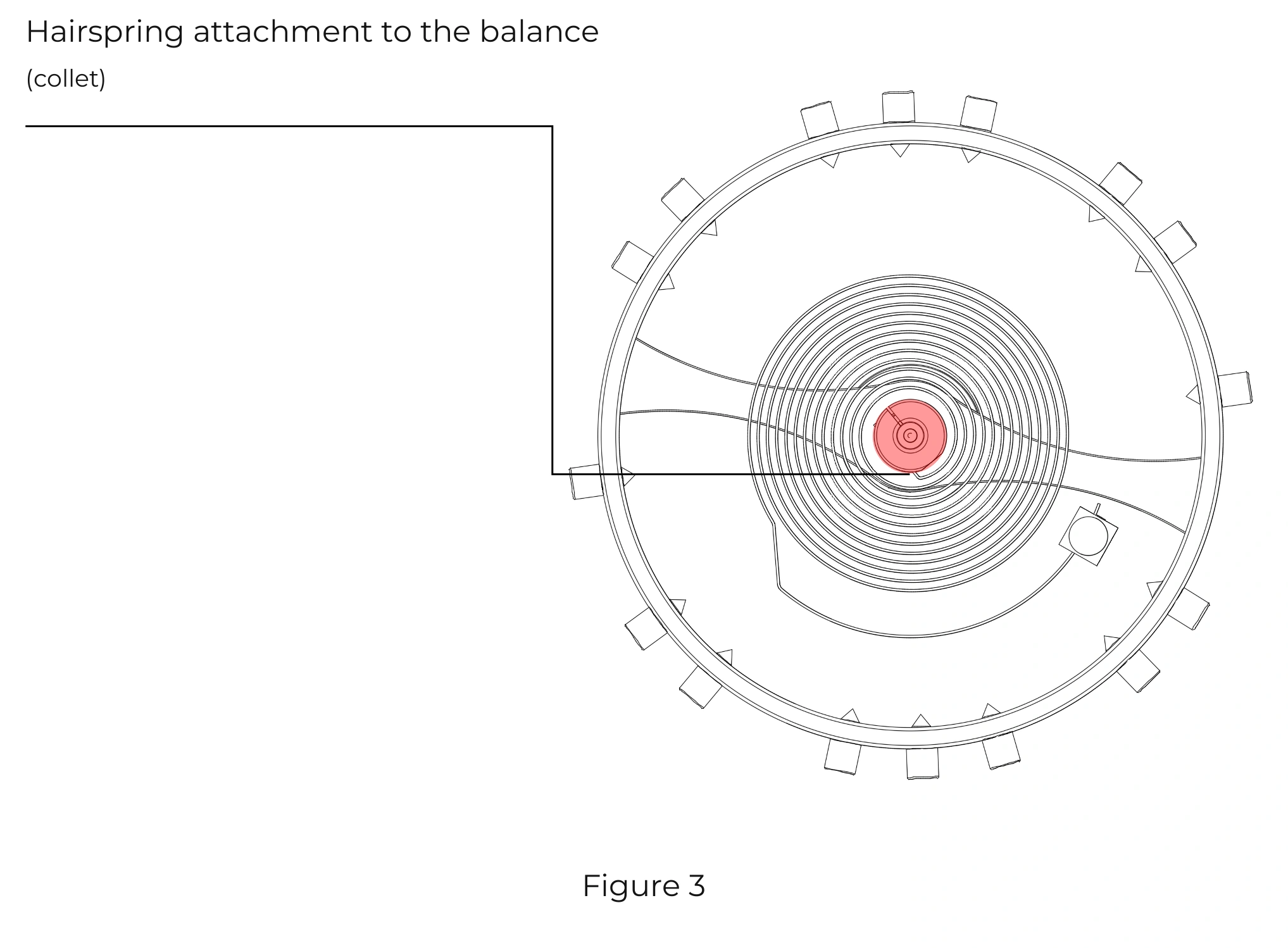
Click on the thumbnail to enlarge it
The outer end of the hairspring (balance spring) is, in turn, fixed to the balance cock by means of the stud (hairspring stud) (Figure 2 & Figure 4).
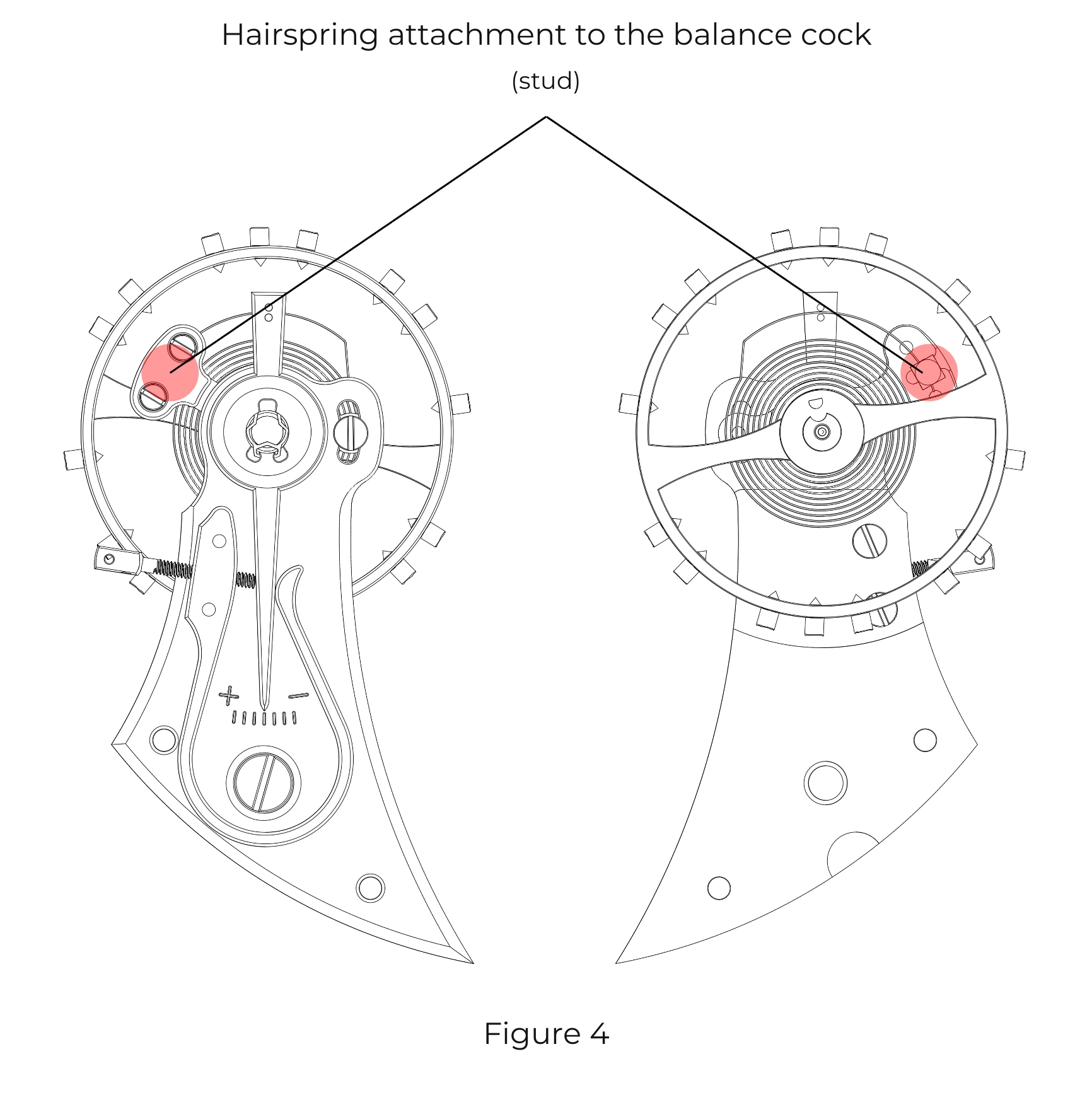
Click on the thumbnail to enlarge it
At an angle α generally between 60° and 70° relative to the stud (hairspring stud) (Figure 5, point 1), the terminal curve of the hairspring (balance spring) passes between the two pins of the regulator (Figure 5, point 2). The regulator pins are pressed onto the regulator (Figure 5, point 3) which pivots with a slight tightness, concentrically to the balance staff.
Important:
The presence or construction of the different components of the regulating organ may vary from one movement to another (e.g.: optional presence of the regulator or a mobile stud holder).
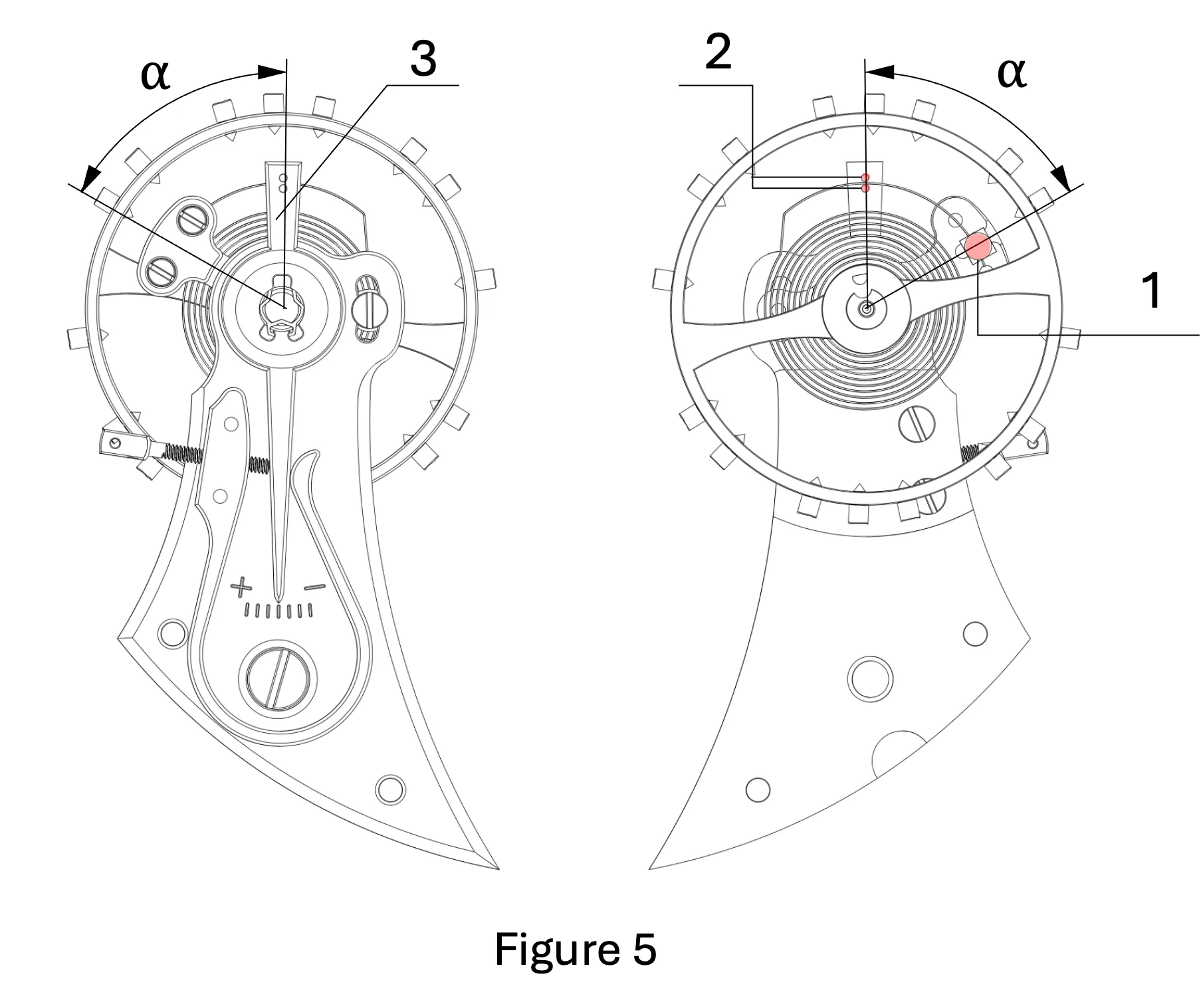
Click on the thumbnail to enlarge it
The regulating organ of a mechanical watch comprises the following components:
note: Most silicon hairsprings (balance springs) integrate the hairspring (balance spring), the collet, and often the stud (hairspring stud) into a single monobloc component.
4. Movements of the balance-hairspring (balance spring):
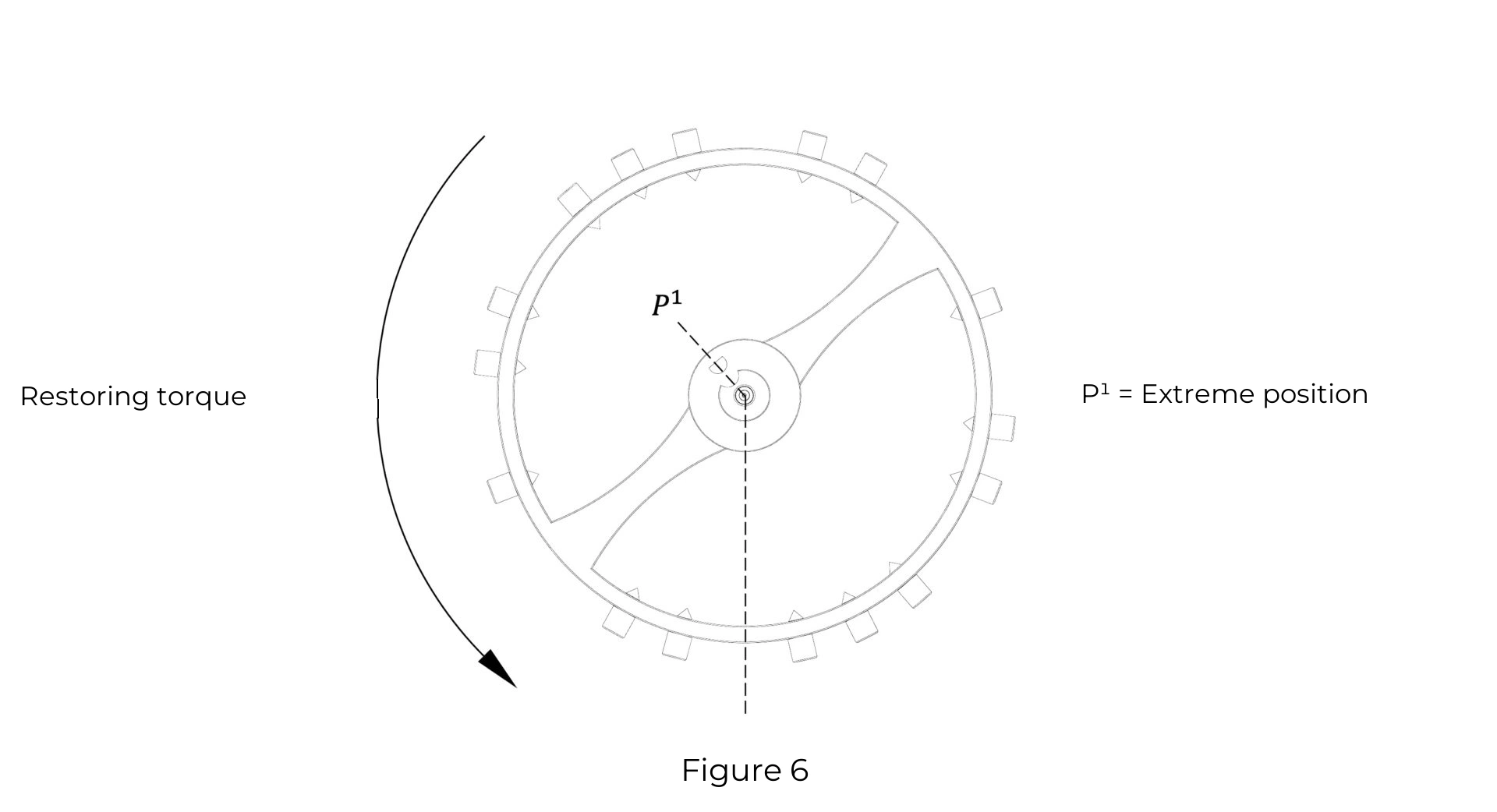
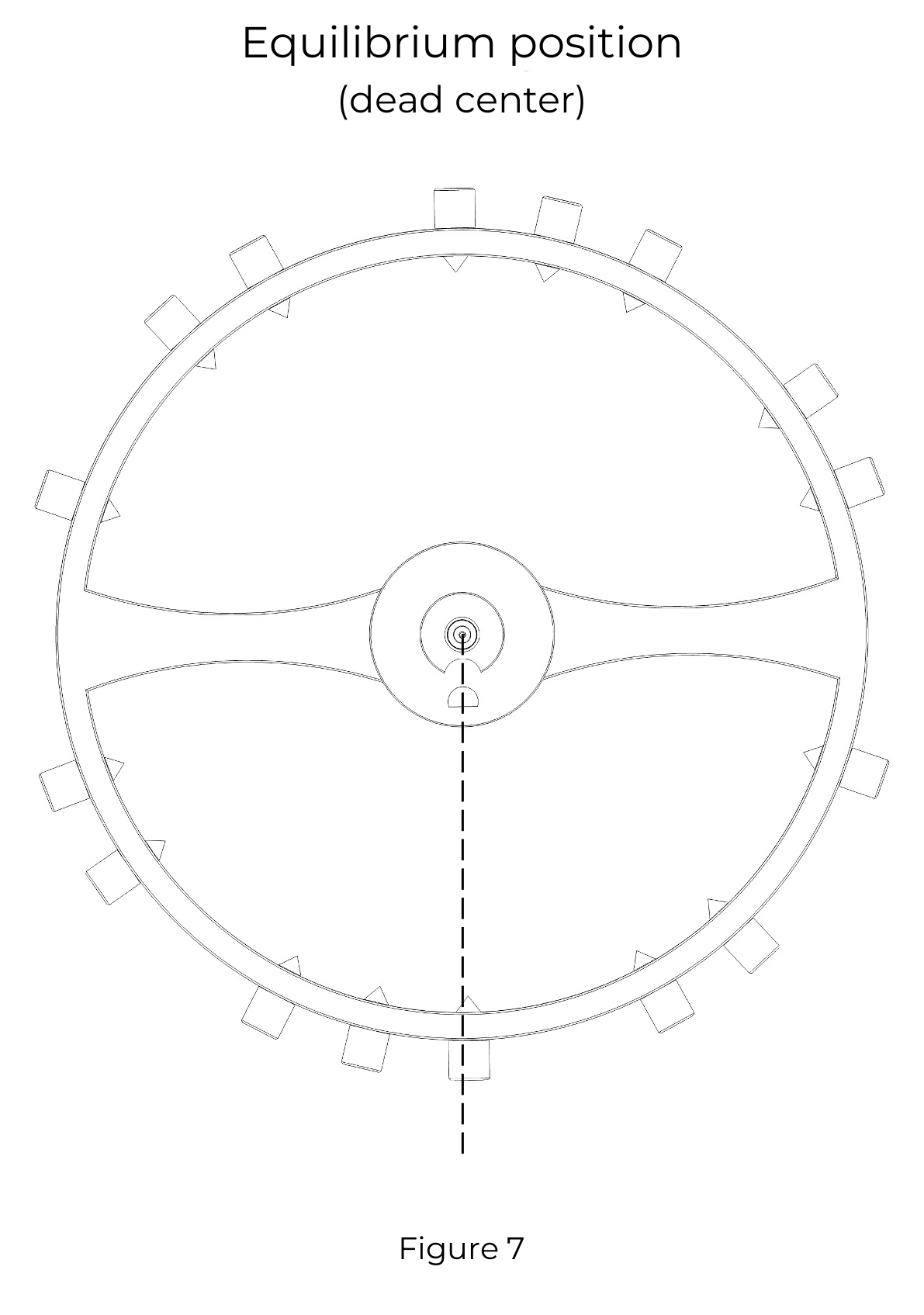
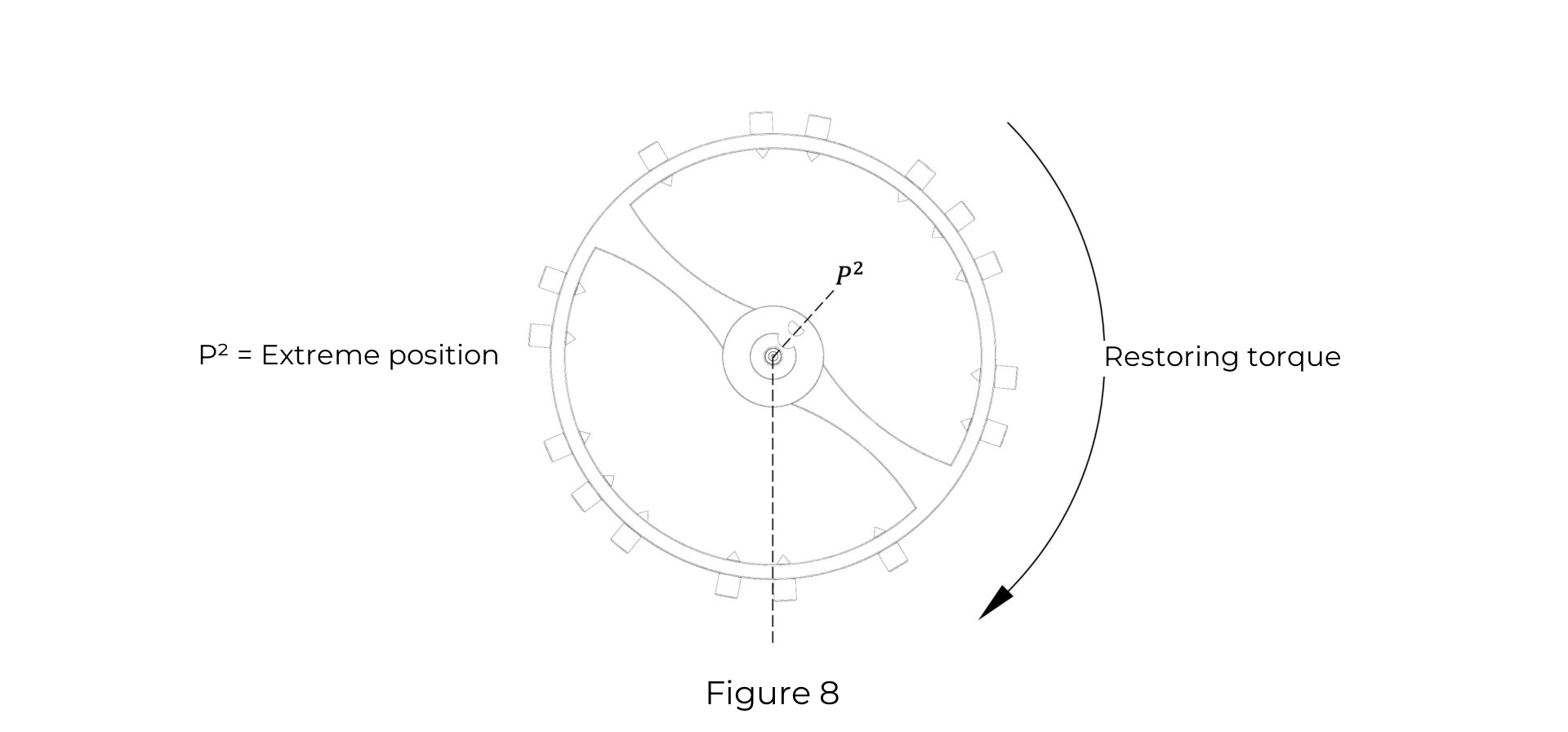
When the watch is running, the balance-hairspring oscillates concentrically around its axis, on either side of its equilibrium position, also called the “dead point” (Figure 7). When the balance is pushed beyond its equilibrium position (during an impulse; see the distribution mechanism), the hairspring (balance spring) is tensioned. When the impulse is given in one direction, the spring is tensioned in extension (Figure 6), and when the impulse is given in the other direction, the spring is tensioned in contraction (Figure 8). In both cases, a restoring torque is created (Elastic moment (torque)) which brings the balance back to its equilibrium position (dead point) (Figures 6 to 8).
Click on the thumbnails to enlarge them
5. Mathematical relation
The mathematical relation between the balance and the hairspring (balance spring) is as follows (see: pairing the balance and the hairspring (balance spring)):
T = Period (s)
l = Moment of inertia of the balance about its axis (kg×m²)
C= Elastic moment (torque) (Stiffness (spring rate)) of the hairspring (balance spring) (N×m/rad)

This page has been automatically translated from the reference French version using an artificial intelligence tool. Errors or inaccuracies may remain. If you notice any, especially if this is your native language, please do not hesitate to report them to us at info@horopedia.org. Your contribution helps us improve the quality of the encyclopedia.
Pending their translation, images and videos remain temporarily displayed in French.
Thank you for your understanding.