
MENU
1. General description
The winding pinion is made of Steel and has two perpendicularly cut sets of teeth. It belongs exclusively to the Winding mechanism. Its axis is pierced by a hole that allows it to freely adjust to the winding stem.
When the Crown (de facto the Winding stem) is pushed (against the Case), the Lever / Rocker presses the Sliding pinion against the Winding pinion. By turning the Winding stem, the Sliding pinion is driven by the square of the Winding stem. In its rotation, the Sliding pinion drives the Winding pinion through their common Breguet toothing (unidirectional disengaging). Because of this toothing, the driving of the Winding pinion only occurs in one direction of rotation of the Winding stem. In the other direction, it disengages, preventing the Train (wheel train) from turning backwards and from forcing on (breaking) the Click of the Winding.
Once driven by the Sliding pinion, the Winding pinion drives, through its second toothing, the Crown wheel positioned above or below the Bridge of Barrel on a perpendicular Axis.
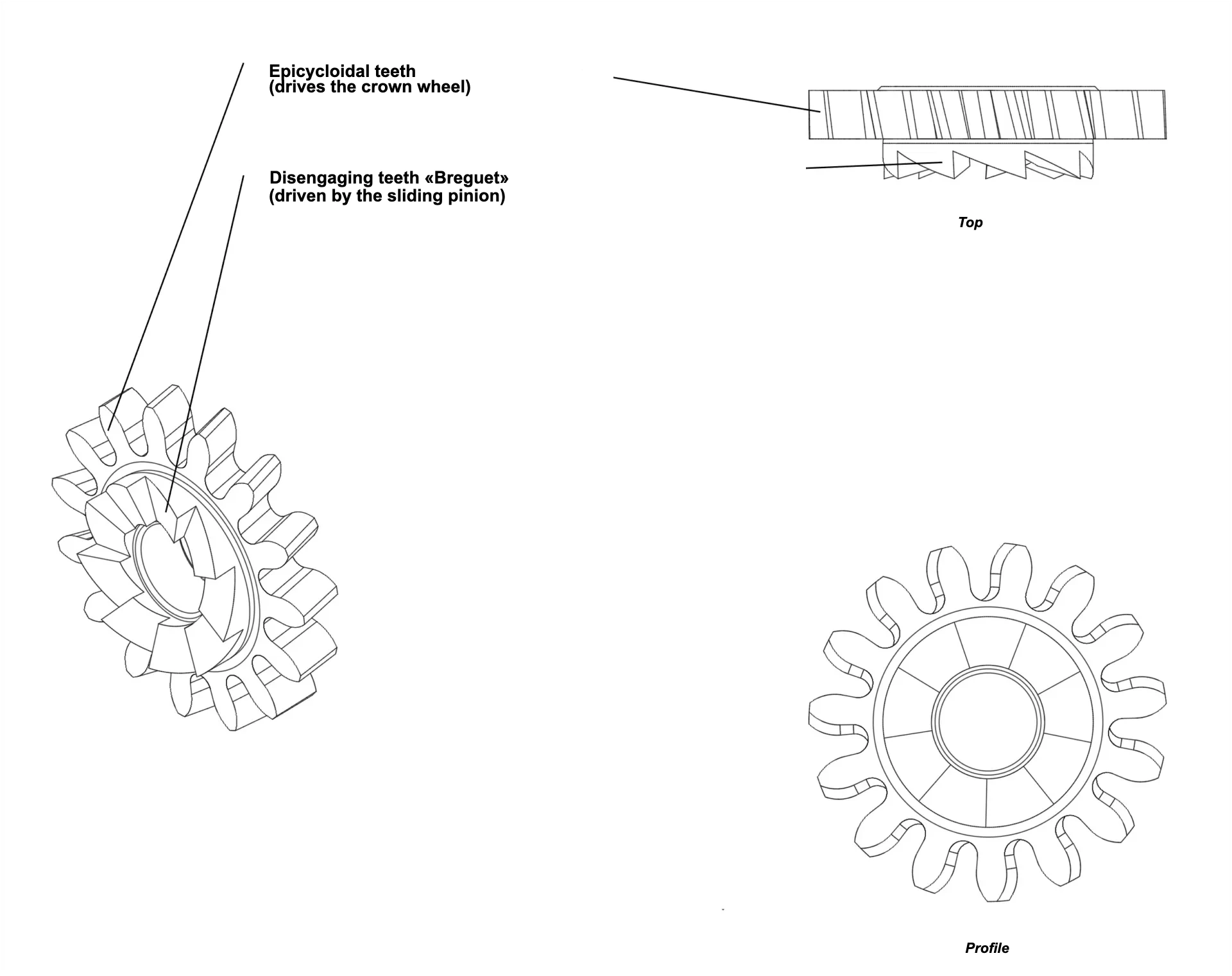
Figure 1
Diagram of a Winding pinion
Click on the thumbnail to enlarge it
Figure 2
Kinematics of the Winding mechanism
Click on the animation to enlarge it
2. History
The invention of the Winding pinion can be attributed to Adrien Philippe in 1842 when he filed the patent for the first pendant winder that did not require a Key. As the mechanism was not yet combined with the time-setting mechanism, the winding pinion was then directly driven by the winding stem and had a single toothing meshing with the crown wheel. It was in 1847, with Antoine Le Coultre’s invention of the lever winding (and setting) mechanism, that the winding pinion took on its current form and acquired its characteristic double toothing.
4. Industrial production of a winding pinion
As with most small-diameter circular components, the Automatic lathe is the ideal machine for producing winding pinions in any quantity. It is thus possible to carry out all the operations (turning, cutting) quickly and in a single cycle. Whatever quality is desired, machining a winding pinion using this method will only take a few minutes.
This page has been automatically translated from the French reference version using an artificial intelligence tool. Errors or inaccuracies may remain. If you notice any, especially if this is your native language, please feel free to report them to info@horopedia.org. Your contribution helps us improve the quality of the encyclopedia.
While awaiting their translation, images and videos remain temporarily displayed in French.
Thank you for your understanding.